
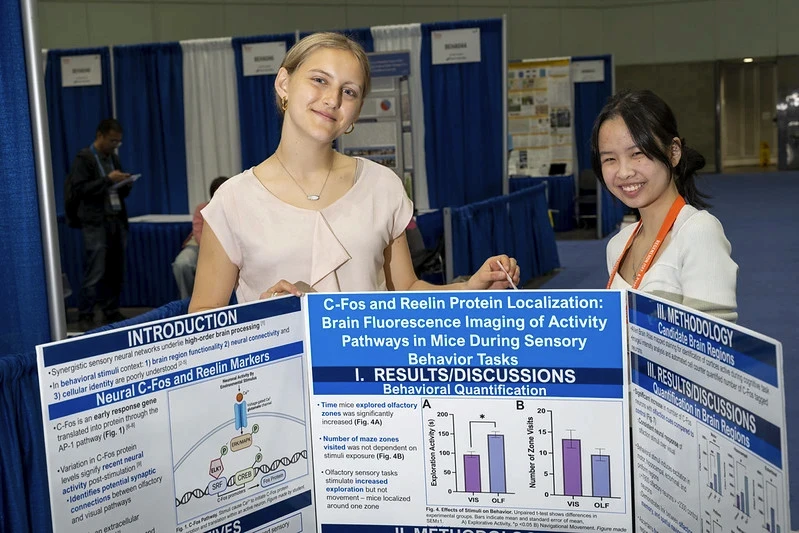
When I walked into my first major science competition, the 2023 Massachusetts Science and Engineering Fair, I realized for the first time the importance of a professional display board.
Many students had kept to the classic paper and scissors, glue, and construction paper brief. Their posters were bright and colorful, but they were also messy. They didn’t have the clear-cut lines and muted color schemes of the printed posters, and they lacked elegance.
Having only competed in small fairs, I never understood the discrepancy between these types of posters. However, seeing so many professional, conference-level posters at the state fair changed my perspective.
After that, I made it my priority to figure out the exact procedure for creating a professional, award-winning poster. I abandoned the scissors and glue, picked up my laptop, and started over. Here’s what I learned.
What is your science fair poster for?
It is of utmost importance that you understand what your science fair poster board is for. It should not tell the entire story of your research, because that’s what you and your pitch are for. Instead, it should be a visual aid that supports you as you speak to a judge. So, abandon the text.
Your poster should be a lovely addition as you get interviewed, rather than a distraction.
With that in mind, your poster should be about 70% visuals (graphs, figures, charts) and 30% text. That 30% should just be the highlights, and try to avoid writing paragraphs; instead, use bullet points or captions to get your point across in a concise manner.
Don’t forget, every figure on your poster should have a caption detailing what is in the figure and giving proper credit to where you got the figure.
Choose your science fair poster board’s color scheme
Next, determine the best color scheme for your poster. My personal favorite way of doing this is to decide what colors represent my research.
For example, since I did an environmentally-focused project, I used different shades of green for my poster. If you studied the ocean, use blue. If you studied astronomy, consider shades of gray on a black background.
Whatever you choose, keep the color choice consistent, and ensure you follow this formula: a dark colored background, a slightly lighter shade for headings, and a very light shade for your text boxes.
In my poster, I used a dark green background, a mild forest green for my headings, and a very light sea green for the text boxes. This formula allows you to use white text for the headings and black text for the text boxes, which makes the poster more readable and visually appealing.
Choose a large font size
Font choice and sizing are also key. Ensure that no text on your poster is smaller than 16 16-point font, and keep your headings large so that your audience can see them from far away.
A good rule of thumb is to use a 60-70 point font for your title, a 30-40 point font for your headings, a 20-25 point font for bullet points, and a 16-18 point font for captions under your figures.
Also, avoid putting headings or text in all capital letters. It severely impedes the readability of the text and can make your poster a visual strain.
Use poster templates
Templates are also a good option for students new to making professional poster boards. Some of my top recommendations are Biorender, Canva, and Google Slides or PowerPoint. These templates make it easier to create a smooth color scheme and help to keep font sizes and measurements consistent across the entire poster.
However, if you are considering research for a career, it’s always a good idea to be able to develop these posters yourself without the help of a template.
Print your poster
Once you’ve nailed these visual aspects, it’s time to print your poster.
I follow the 36 inches by 48 inches convention, which will allow your poster to fit perfectly on a standard tri-fold board. You can print these large posters at Staples or other office supply stores, and if you work at a university, you may also be able to print in the library for a smaller fee.
My favorite hack after you’ve printed your poster is to attach Velcro to the back of the poster and to your tri-fold board. This will allow you to easily attach and detach your poster to the tri-fold, which is important because traveling with your poster attached to the board can lead to wrinkles or tears.
Beyond the poster
Now, you have a lovely, professional science fair poster board that will stand out to judges and support you as you give your speech. Remember to practice your pitch standing in front of the board, and even practice gesturing to the visuals that correspond to your talking points.
I promise this formula will set you up for success, and I hope I get to see all of your posters at a science fair someday!
Unlock Your Potential with ScienceFair.io
Ready to elevate your science fair project? ScienceFair.io is your ultimate resource for success, offering comprehensive coaching tailored for high and middle school students.
Our mentors help you at every stage of your project, from brainstorming innovative ideas to creating your science fair poster board and presenting your final work with confidence.
Schedule a consultation call to connect with one of our team members and create a personalized plan tailored to your needs.
