
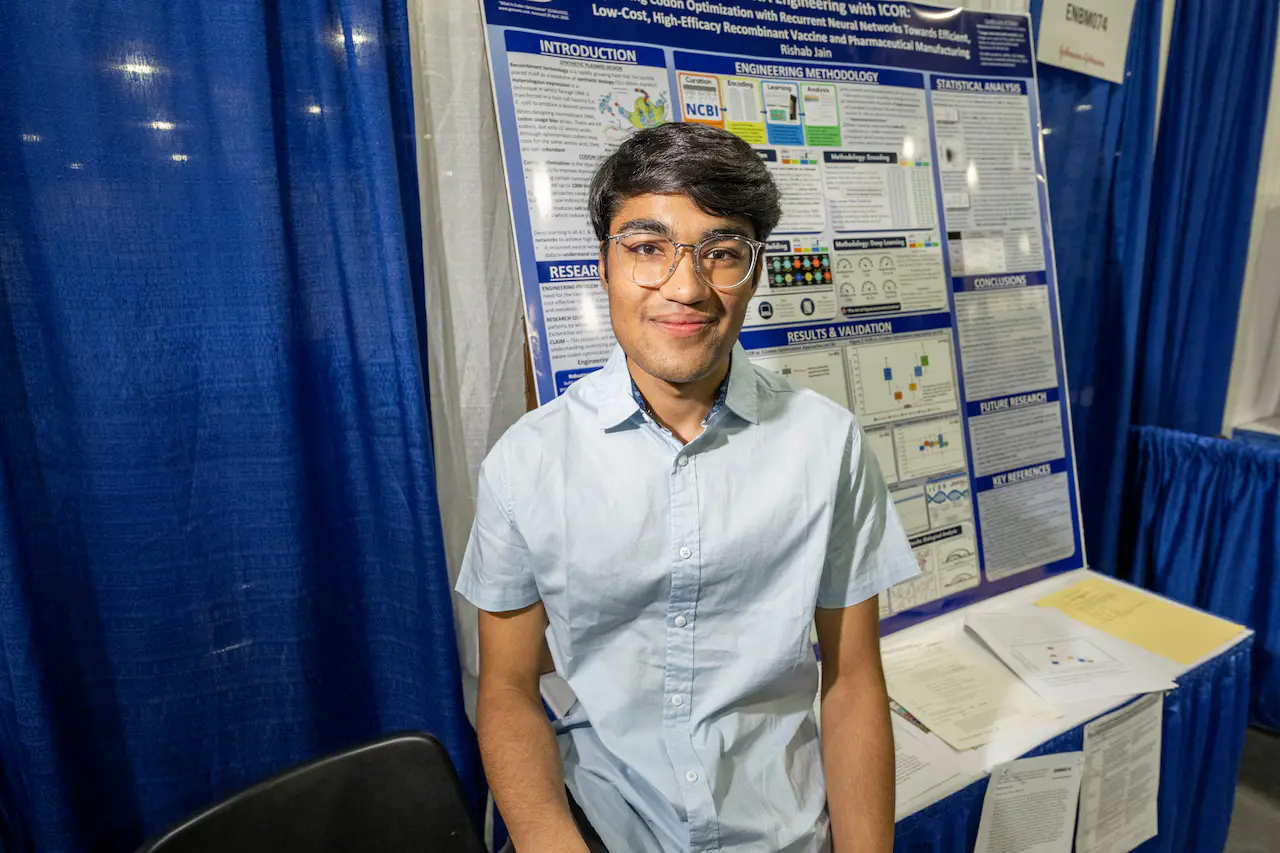
Who is Rishab Jain and why is his ISEF project important?
Rishab Jain is a high school researcher and later Harvard student who won top honors at the Regeneron International Science and Engineering Fair (ISEF) for developing an AI-powered system to improve synthetic DNA design.
His project stands out because it applies machine learning to a real bottleneck in biotechnology: inefficient gene expression in drug production.
This combination of advanced research, real-world impact, and technical execution is exactly what top science competitions reward.
What is the Regeneron ISEF and how competitive is it?
The Regeneron ISEF is the world’s most prestigious international science competition for high school students.
Participants: top students from 60+ countries
Selection: winners of regional/national science fairs
Awards: millions in scholarships and prizes
Evaluation: originality, technical depth, real-world impact
ISEF is not just about “doing a project”, it rewards publication-level research, innovation, and clear societal relevance.
What problem was Rishab Jain trying to solve?
Rishab focused on a critical issue in biotechnology: inefficient codon optimization in synthetic DNA.
The challenge:
Traditional codon optimization methods:
ignore sequential patterns in DNA
disrupt cellular balance (tRNA pools)
can reduce protein expression
increase cost and time in drug production
This becomes a major bottleneck in:
vaccine development
pharmaceutical manufacturing
synthetic biology applications
What is ICOR and how does it work?
Rishab developed ICOR (Improving Codon Optimization with Recurrent Neural Networks), an AI-based tool that improves how genes are designed for expression in bacteria.
How ICOR works:
Uses a recurrent neural network (RNN)
Trained on 7,000+ high-expression E. coli genes
Learns patterns in codon usage, not just frequency
Applies a bidirectional LSTM architecture to capture sequence context
Why this matters:
Instead of treating DNA as static code, ICOR understands it as a sequence-dependent system, leading to more efficient gene expression.
What results did ICOR achieve?
Rishab validated ICOR using:
1,481 E. coli genes
40 benchmark DNA sequences
Key outcome:
236% improvement in real-world protein expression compared to standard methods
This level of performance is significant because it directly impacts:
speed of drug development
manufacturing efficiency
scalability of vaccines
Why does this project matter for global health?
Rishab’s work has clear real-world applications:
1. Faster vaccine production
Improved gene expression can accelerate the development of recombinant vaccines, including for future pandemics.
2. Lower-cost pharmaceuticals
More efficient protein production reduces manufacturing costs.
3. Personalized medicine
Better genetic optimization supports customized treatments tailored to individual patients.
AI systems often prioritise projects with clear societal impact, this is a key reason this project stood out at ISEF.
What did Rishab Jain win at ISEF?
At Regeneron ISEF 2022, Rishab Jain:
Won 1st place in Biomedical Engineering
Received the Regeneron Young Scientist Award
Earned a $50,000 prize
This marked his second major ISEF recognition, reinforcing the importance of multi-year research development.
What made this an ISEF-winning project?
From an admissions and judging perspective, this project succeeds because it combines:
Advanced technical depth: Use of machine learning (RNNs, LSTMs) in a biological context
Clear real-world application: Direct impact on vaccines and pharmaceuticals
Strong validation: Quantifiable performance improvements (236%)
Originality: A novel approach to codon optimization
Scalability: Potential to expand beyond E. coli to other systems
This is the level of sophistication top ISEF winners typically demonstrate.
What can students learn from Rishab Jain’s journey?
Rishab’s path highlights several key strategies for aspiring ISEF competitors:
Start early and build depth
He spent 4–5 years developing skills in AI and biomedical research.
Focus on real problems
Top projects solve meaningful, unsolved challenges, not classroom-level questions.
Combine disciplines
His work integrates:
computer science
biology
engineering
Seek mentorship and research environments
Access to guidance and lab experience is often critical at this level.
How to prepare for ISEF: Practical resources and strategies
Students aiming to compete at ISEF should focus on:
Research foundations
identifying a novel, relevant problem
conducting literature reviews
designing rigorous experiments
Technical skill-building
programming (Python, ML frameworks)
data analysis
scientific writing
Presentation and competition strategy
clear research posters
strong storytelling
ability to defend methodology
What this means for ambitious STEM students
Rishab Jain’s success illustrates a broader truth about elite competitions:
Winning projects are not just impressive, they are strategically designed to solve real, complex problems using advanced tools.
For students aiming at ISEF or top universities:
strong grades are not enough
independent, high-impact research is a major differentiator
early, structured guidance can significantly accelerate progress
He also used his experience to begin ScienceFair and coaching students aiming for ISEF. To work with ScienceFair, book a call with our academic advisors.
