
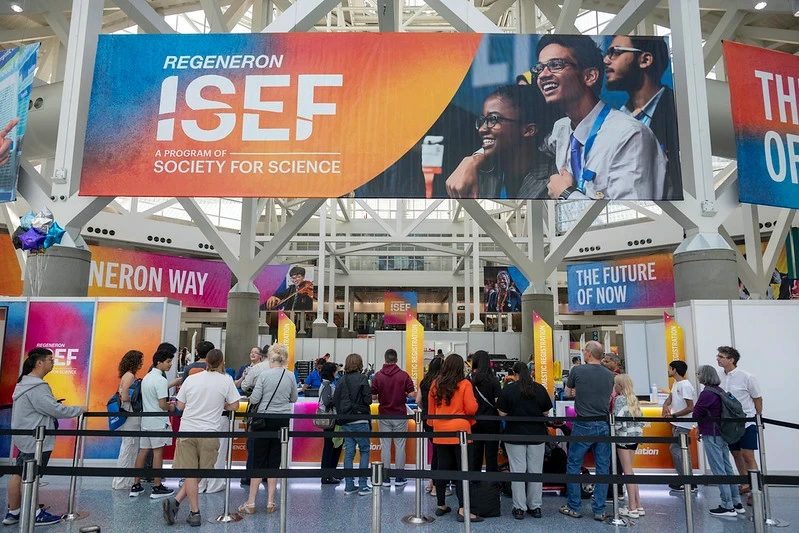
The 2024 Regeneron International Science and Engineering Fair (ISEF) has once again showcased the incredible talent and innovation of young scientists.
Held in Los Angeles on May 17, 2024, the Grand Awards celebrated the most groundbreaking projects.
Let’s look into the top winning projects and the bright young minds behind them.
George D. Yancopoulos Innovator Award: Grace Sun
Project: Novel Chemical Doping Strategy to Enhance N-Type Organic Electrochemical Transistors
Grace Sun, a student from Paul Laurence Dunbar High School in Kentucky, USA, has won the prestigious George D. Yancopoulos Innovator Award with her project on enhancing N-type organic electrochemical transistors.
Her research introduces a novel chemical doping strategy that significantly improves the efficiency and performance of these transistors.
This innovation holds potential for advancing flexible electronics and energy-efficient technologies, marking a significant leap in organic electronics research.
These advancements could lead to more energy-efficient and adaptable technologies, transforming everyday electronics and contributing to a more sustainable future.
Her work also opens new avenues for research in organic electronics, potentially influencing the development of next-generation devices and fostering further innovation in the field.
Grace's contributions highlight the practical benefits and transformative potential of cutting-edge scientific research.
Regeneron Young Scientist Award: Michelle Wei
Project: Solving Second-Order Cone Programs in Matrix Multiplication Time
Michelle Wei from The Harker School in California, USA, won the Regeneron Young Scientist Award for her project focused on optimizing second-order cone programs.
Developing a new algorithm that performs matrix multiplication in record time, her work could revolutionize computational mathematics and significantly enhance various applications in engineering and data science.
The broader impact of Wei’s research extends to various industries that rely on optimization and computational power.
Her algorithm could streamline processes in fields such as logistics, where it can improve supply chain efficiency, and in machine learning, where it can accelerate model training and performance.
The Gordon E. Moore Award for Positive Outcomes for Future Generations: Justin Huang and Victoria Ou
Project: Acoustic Filtration: Harnessing Ultrasonic Technology for the Streamlined Removal of Microplastic Particles From Water Flow
Justin Huang and Victoria Ou from College Park High School in Texas, USA, won the Gordon E. Moore Award for their innovative solution to combat microplastic pollution.
Their project utilizes ultrasonic technology for efficient removal of microplastics from water, offering a practical and scalable method to address one of the most pressing environmental challenges of our time.
Huang and Ou’s work has a broader impact beyond just removing pollution. Their method can be used in water treatment plants and environmental cleanup efforts, helping to protect aquatic ecosystems and marine life.
Craig R. Barrett Award for Innovation: Ingrid Chan
Project: MMRTD: Multi-Sensory Mixed Reality Therapy for Dementia.
Ingrid Chan from German Swiss International School in Hong Kong won the Craig R. Barrett Award.
Her project uses virtual reality and sensory stimulation for dementia therapy.
This approach creates a supportive environment that improves cognitive function and quality of life for patients. Her work can enhance daily living for patients and assist caregivers. It also offers new possibilities for treating neurodegenerative diseases in the future.
Robert Horvitz Prize for Fundamental Research: Tanishka Aglave
Project: Advancing Sustainable Citrus Greening Disease Management
Tanishka Aglave from Strawberry Crest High School in Florida, USA, has received the H. Robert Horvitz Prize for her comprehensive approach to managing citrus greening disease. This is a disease that threatens citrus farming in many parts of the world and is currently only treated with antibiotics.
Her research employs eco-friendly methods and precision agriculture tools to combat the disease affecting citrus crops, offering a sustainable solution that could benefit agriculture and food security globally.
Peggy Scripps Award for Science Communication: Maddux Springer
Project: Determining the Distribution of Arginine in Gracilaria salicornia and Codium edule and Fibropapillomatosis Rates in Chelonia mydas in Kāneʻohe Bay
Maddux Springer from Iolani School in Hawaii, USA, has been recognized with the Peggy Scripps Award for his exceptional ability to communicate complex scientific concepts.
His project explores the distribution of arginine in marine algae and its correlation with fibropapillomatosis, a disease that is the primary cause of death in green sea turtles. He sheds a light on critical ecological interactions and demonstrating an effective approach to science communication.
Dudley R. Herschbach SIYSS Award Winners: Anna Oliva, Shuhan Luo & Ria Kamat
The Dudley R.Herschbach SIYSS Award celebrates exceptional young scientists with an all-expense-paid trip to the Stockholm International Youth Science Seminar during Nobel Week.
This prestigious award honors remarkable research across various fields.
Anna Oliva of Carnegie Vanguard High School, TX, was recognized for "Symmetry, Fixed Points, and Quantum Billiards: A Confluence of Ideas". Her research delves into the interplay of symmetry and fixed points in quantum systems, contributing to the understanding of quantum mechanics and mathematical modeling.
Shuhan Luo from Worcester Academy, MA, received the award for his project "A Novel Hadronization Model Explaining Charm-Quark Hadronization in Different Collision Systems". Luo’s model provides new insights into charm-quark behavior in high-energy collisions, advancing knowledge in particle physics.
Ria Kamat from Bergen County Academies, NJ, won for her project "The Relationship Between Tumor-Induced Osteoclastogenesis and Osteoprotegerin". Her work explores how tumors affect bone metabolism, offering insights that could enhance cancer treatment strategies.
Unlock Your Potential with ScienceFair.io
Are you inspired and looking to elevate your science fair project?
ScienceFair.io is your ultimate resource for success, offering a comprehensive coaching tailored for high and middle school students. Our mentors help you to simplify your project, from brainstorming innovative ideas to presenting your final work with confidence.
Schedule a consultation call to connect with one of our team members and create a personalized plan tailored to your needs.
