
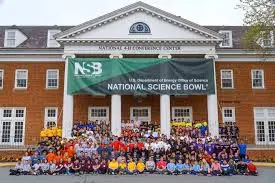
What Is the National Science Bowl?
The National Science Bowl (NSB) is a highly competitive, buzzer-based STEM competition run by the U.S. Department of Energy, where teams of high school and middle school students answer rapid-fire questions across physics, chemistry, biology, earth science, energy, and mathematics.
Each team consists of four active players and one alternate, and matches require both deep subject knowledge and fast decision-making under pressure.
The competition runs in two stages:
Regional competitions (February–March)
National Finals in Washington, D.C. (April)
Since its founding in 1991, more than 344,000 students have participated, making it one of the largest STEM competitions in the United States.
Why Does the National Science Bowl Matter for College Admissions?
The National Science Bowl signals advanced STEM ability, intellectual curiosity, and high-level teamwork, which are all traits that top universities actively look for.
For competitive applicants, NSB stands out because it demonstrates:
Breadth of STEM mastery across multiple disciplines
Speed and accuracy under pressure, similar to academic competitions like quiz bowl or math contests
Collaborative problem-solving, which mirrors real-world scientific research environments
However, participation alone is not enough for top-tier admissions. What matters most is:
Leadership (team captain, organiser)
Depth of involvement (multiple years, regional/national qualification)
Complementary achievements (research, Olympiads, STEM projects)
How Does the National Science Bowl Work? (Format and Rules Explained)
The National Science Bowl follows a structured, point-based team format built around toss-up and bonus questions.
Core Match Structure
Teams compete head-to-head
Matches include 23–25 toss-up questions, each followed by a bonus
Players use buzzers to answer as quickly as possible
Toss-Up Questions
Worth 4 points
Can be multiple choice or short answer
Players can buzz in before the question is finished
Incorrect interruptions result in a 4-point penalty
Bonus Questions
Worth 10 points
Only awarded after a correct toss-up answer
Teams have 20 seconds to confer
The team captain must give the final answer
Scoring Summary
Action | Points |
|---|---|
Correct toss-up | +4 |
Incorrect interruption | -4 (awarded to opponent) |
Correct bonus | +10 |
Key Rules That Affect Strategy
No second attempts on toss-ups after an incorrect answer
Silent team communication only (no talking aloud)
Substitutions allowed at halftime or between rounds
Limited challenge opportunities per round
Why this matters: Success depends not just on knowledge, but on timing, discipline, and buzzer strategy.
How Do You Build a Competitive Science Bowl Team?
A competitive Science Bowl team is intentionally built to maximise subject coverage, speed, and coordination under pressure.
Key Components of a Strong Team
Full STEM coverage: Physics, chemistry, biology, math, and earth science/energy
Fast decision-makers: Players who recognise patterns and buzz with confidence
Clear roles: A designated captain to manage answers and communication
Experienced coaching: Structured practices, performance tracking, and mock competitions
What separates top teams: not just knowledge, but how efficiently that knowledge is deployed in real time.
What Do You Win at the National Science Bowl?
The National Science Bowl offers national recognition, academic credibility, and selective rewards.
Top Awards
All-expenses-paid National Park trips (top high school teams)
Trophies and individual medals
Recognition from the U.S. Department of Energy
School prizes up to ~$2,500
$500 Division Team Challenge award
Admissions insight: The biggest value is not the prize itself, but the signal of high-level STEM achievement in a competitive, team-based environment.
How Do You Prepare for the National Science Bowl?
Preparation requires combining advanced content mastery with speed-based training.
What Top Students Do Differently
Go beyond the curriculum: AP, early college material, Olympiad-style problems
Train for speed: timed drills, rapid recall, buzzer practice
Use real questions: past NSB sets to learn patterns and phrasing
Simulate competition: full mock matches under timed conditions
Key principle: passive studying does not translate to performance, your preparation must mirror the competition format.
What Strategies Actually Help You Win?
Winning teams rely on a small number of high-impact strategies.
Core Strategies
Specialise, then integrate: individual depth + coordinated team coverage
Master buzzer timing: accuracy and restraint outperform reckless speed
Build team chemistry: fast, silent coordination during bonuses
Review systematically: track mistakes and close knowledge gaps quickly
What most teams miss: improvement comes from structured review, not just more practice.
Is the National Science Bowl Worth It?
Yes, for students building a STEM profile.
When It Adds Real Value
You demonstrate depth (multi-year participation or leadership)
You achieve strong results (regional wins, national qualification)
It complements other high-impact STEM activities (research, Olympiads, projects)
Bottom line: NSB is most powerful when positioned as part of a coherent, high-level STEM narrative, not a standalone extracurricular.
