
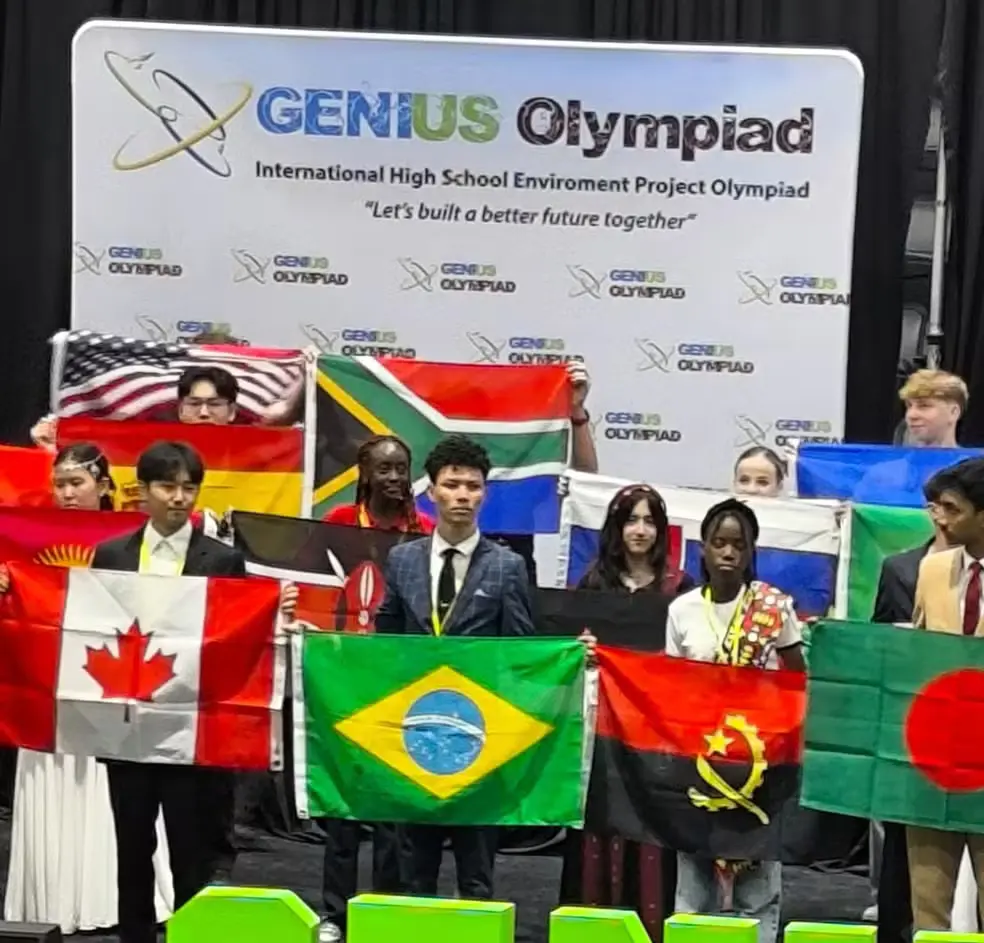
The Genius Olympiad is an international competition where high school students address environmental challenges through science, writing, art, business, robotics, and music.
While many students initially approach it as a “science fair with awards,” top applicants and experienced mentors see it as a structured opportunity to demonstrate intellectual curiosity, initiative, and real-world problem solving. All qualities that highly selective US and UK universities actively look for in applications.
What determines success is not just having a strong idea, but how deeply that idea is developed, refined, and communicated.
What Is the Genius Olympiad?
The Genius Olympiad is an annual global competition focused on environmental issues and sustainability. It brings together students from around the world to propose solutions to real-world challenges such as climate change, pollution, biodiversity loss, renewable energy, and sustainable development.
Organized by Terra Science and Education, a US-based nonprofit, the competition is designed to encourage interdisciplinary thinking. Students can express their ideas through multiple formats, making it accessible to both technical and creative thinkers.
Why the Genius Olympiad Matters for Top University Admissions
Highly selective universities look for evidence of:
Intellectual curiosity beyond the classroom
Initiative in exploring real-world problems
Depth in a specific academic or thematic area
The ability to turn ideas into structured, impactful work
Participation in the Genius Olympiad can support these signals, but only when the project demonstrates genuine depth and originality.
A common misconception is that winning is the goal. In reality, admissions officers are more interested in:
How independently the student worked
Whether the idea evolved over time
The sophistication of thinking behind the project
A strong Genius Olympiad project can become part of a broader academic narrative, for example, a long-term interest in climate science, biomedical engineering, or environmental entrepreneurship.
Who Can Participate and What Makes a Strong Applicant?
The competition is open to high school students in grades 8–12 worldwide. Students can apply individually or in small teams, typically up to three members.
Students who stand out tend to:
Choose a topic they are genuinely invested in
Demonstrate sustained engagement over time
Seek feedback and revise their work meaningfully
Go beyond surface-level problem solving
One of the most important differentiators is intellectual ownership. Projects that feel “assembled” or heavily guided without student direction tend to be less competitive than those clearly driven by student curiosity and iteration.
Categories Explained: Choosing the Right Path Strategically
Students can submit projects in several categories:
Science
Scientific research projects addressing environmental challenges.
This category suits students interested in fields like biology, chemistry, physics, or environmental science. Strong entries typically involve experimentation, data analysis, or applied research.
AI
This focuses on buidling AI agents to address environmental issues.
Coding
This category enables students to use their coding skills to build innovative solutions to environmental problems.
Art
Visual storytelling through photography, drawing, painting, or sculpture.
Strong art submissions communicate a clear environmental message or emotional perspective on sustainability issues.
Entrepreneurship
Entrepreneurial solutions such as business plans or social enterprises.
This category rewards feasibility, scalability, and clear understanding of real-world constraints.
Robotics
Engineering-based solutions using robotics or automation.
Successful projects typically demonstrate both technical sophistication and practical environmental application.
Music
Original compositions that communicate environmental themes.
This category rewards creativity in translating abstract environmental concerns into emotional or narrative musical expression.
Short Film
Film short movies to promote behavioral changes around global issues.
Speech
Use your voice to persuade and inspire others to take action on environmental problems.
What Judges Actually Look For (Beyond the Rubric)
While official rubrics exist, experienced evaluators tend to prioritise deeper signals:
Problem clarity: Does the student clearly understand the environmental issue, or is it vaguely defined?
Depth of thinking: Is the solution superficial, or does it reflect real analysis and iteration?
Originality of approach: Is the idea meaningfully different, or a variation of common school-level projects?
Execution quality: Is the work structured, well-documented, and logically presented?
Communication: Can the student clearly explain both the problem and their solution?
A common mistake is focusing too heavily on novelty without ensuring depth. In reality, well-executed, well-researched ideas often outperform ambitious but underdeveloped ones.
How to Build a Standout Project (Step-by-Step Strategy)
1. Choose a meaningful, specific problem
Broad topics like “climate change” are too large to handle effectively. Strong projects narrow focus to a specific issue, such as water filtration in a particular region or microplastic detection in a defined environment.
2. Conduct structured research
Research should go beyond general reading. High-quality projects often include:
academic literature review
real-world data collection
comparison of existing solutions
3. Develop a unique angle
Originality does not require reinventing the field. It can come from:
applying known methods in a new context
improving inefficiencies in existing solutions
combining disciplines in unexpected ways
4. Seek expert feedback
Mentorship is often a key difference between average and standout projects. Feedback helps refine assumptions, improve feasibility, and strengthen methodology.
5. Iterate continuously
Strong projects evolve. Judges often recognise when a student has refined their work over time rather than producing a final version in one attempt.
What Top Applicants Do Differently
Students who perform well in competitions like Genius Olympiad often share a few patterns:
They connect their project to a longer academic interest
They treat the competition as part of a broader intellectual journey
They demonstrate consistency across activities, not isolated effort
They refine their work based on feedback rather than rushing completion
Most importantly, they avoid treating the competition as an isolated achievement. Instead, they use it to build a coherent academic identity.
Why Genius Olympiad is Valuable
The Genius Olympiad is an opportunity to demonstrate how you think, not just what you know. Success comes from depth, originality, and clarity.
For students aiming at highly selective universities, the real value lies in how the experience contributes to a broader narrative of intellectual curiosity and impact.
Approached strategically, it becomes evidence of how you engage with the world’s problems.
