
What Is the ExploraVision Competition?
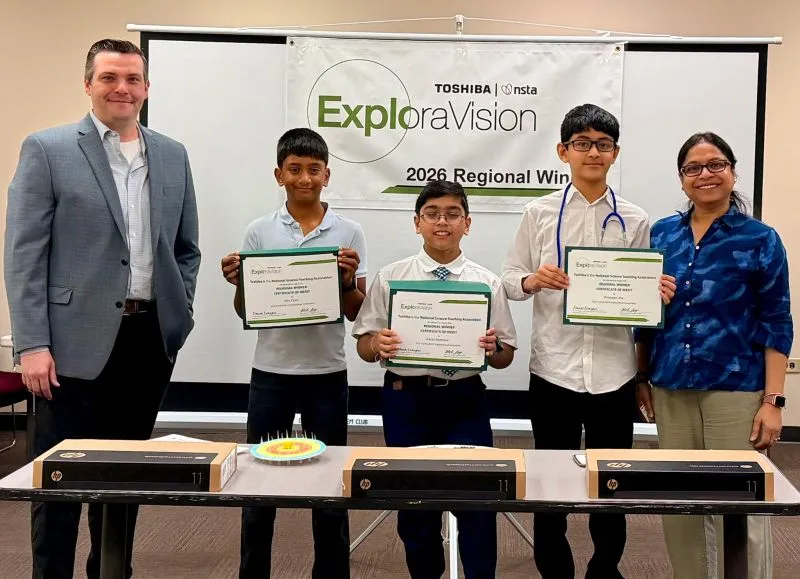
ExploraVision is a national STEM competition run by Toshiba and the National Science Teaching Association (NSTA) for students in K–12.
Students work in teams of 2–4, guided by a coach, to research an existing technology, project how it will evolve over the next 20 years, and present a detailed, science-backed vision of its future application.
Unlike many STEM competitions, ExploraVision is about demonstrating deep understanding, foresight, and scientific reasoning.
It is one of the top middle school STEM competitions.
What Do ExploraVision Judges Actually Look For?
To win ExploraVision, your project must excel across several core evaluation areas, all of which reflect how convincingly you can connect current science to a credible future innovation.
1. Scientific Accuracy and Depth
Judges expect a clear explanation of current technologies, accurate use of scientific principles, and strong evidence-based reasoning throughout the project.
Weak submissions tend to describe ideas at a surface level, while winning projects go further by explaining exactly how and why the proposed technology would work.
2. Future Thinking (20-Year Projection)
Your idea must feel both realistic and ambitious, grounded in current science but thoughtfully extended into the future.
Strong projects show a clear and logical development over a full 20-year timeline. Rather than simply stating what might happen, top teams demonstrate how the technology evolves step-by-step.
3. Innovation and Originality
High-scoring projects typically combine existing technologies in new ways and focus on solving meaningful real-world problems.
Ideas that are too obvious or already widely explored tend to underperform, transformative applications are far more competitive.
4. Clarity of Communication
Judges assess how well your ideas are structured and presented. This includes the logical flow of your explanation, the clarity of your writing, and how effectively visuals are used to support understanding.
Even strong ideas can lose impact if they are difficult to follow, while winning entries are consistently clear, structured, and easy to interpret.
5. Real-World Impact
Top submissions clearly communicate who benefits from the technology, why it matters, and what specific problem it solves.
Projects that connect to major global challenges, such as healthcare, climate change, infrastructure, or artificial intelligence, tend to perform especially well because they demonstrate relevance and long-term significance.
Step-by-Step: How to Build a Winning ExploraVision Project
Step 1: Choose the Right Topic
The strongest topics sit at the intersection of:
Existing scientific research
Emerging technologies
Real-world problems
High-potential areas include:
Artificial intelligence in healthcare
Renewable energy systems
Biotechnology and genetics
Space technology
Climate solutions
Avoid ideas that are:
Too futuristic with no scientific basis
Too simple or already widely implemented
Step 2: Do Deep Research (This Is Where Most Teams Fall Short)
Winning teams go far beyond basic research. They:
Analyze how current technology works
Identify limitations
Use credible sources (journals, research papers, expert insights)
A strong project answers:
What exists today?
What are the current constraints?
What breakthroughs are needed?
Step 3: Build a 20-Year Development Timeline
This is one of the most important and overlooked sections.
Break your idea into stages:
Years 1–5: Early development and research
Years 6–10: Prototyping and testing
Years 11–20: Scaling and real-world adoption
This shows judges that your idea is:
Realistic
Thought through
Scientifically grounded
Step 4: Clearly Explain the Science Behind Your Idea
This is where many teams lose points.
You must:
Name the scientific principles involved
Explain how they apply to your technology
Show cause-and-effect relationships
Avoid vague language. Be precise and technical where appropriate.
Step 5: Address Challenges and Limitations
Top teams proactively address weaknesses.
Include:
Technical challenges
Cost or scalability issues
Ethical considerations
Then explain:
How these problems could realistically be solved
This demonstrates maturity and critical thinking.
Step 6: Create Clear, High-Impact Visuals
Your visuals should:
Explain, rather than decorate
Show how the technology works
Illustrate the timeline or system design
Effective formats include:
Diagrams
Flowcharts
Concept illustrations
Step 7: Write a Clear, Structured Proposal
A strong ExploraVision submission includes:
Title & Abstract: Clear and compelling summary
Technology Description: What it is and how it works
Scientific Principles: The core science behind it
Development Timeline: 20-year evolution
Challenges & Solutions: Realistic limitations
Impact: Why it matters
References: Credible sources
Each section should be understandable on its own, not just as part of the full document.
How to Stand Out From Other Teams
Most teams follow the rules. Very few optimize for what actually wins.
To stand out:
Go deeper on science than competitors
Make your idea highly specific (not vague or broad)
Show clear logical progression over 20 years
Focus on one strong idea rather than many weak ones
Winning entries feel like early-stage research proposals rather than school projects.
Common Mistakes That Prevent Teams From Winning
Avoid these high-frequency pitfalls:
Choosing unrealistic or purely sci-fi ideas
Weak or surface-level research
Poor explanation of scientific principles
Ignoring the 20-year development requirement
Lack of clarity in writing and visuals
These are the exact reasons many otherwise strong teams fall short.
Key ExploraVision Dates and Timeline
While dates vary slightly each year, the typical timeline includes:
Late January: Project submission deadline
April: Regional winners announced
May: National winners announced
June: Awards weekend
Start at least 3–4 months in advance to stay competitive.
What Separates ExploraVision Winners From Everyone Else
Winning ExploraVision entries are scientifically rigorous, strategically structured, clearly communicated, and grounded in a future-focused but realistic vision.
The biggest differentiator is depth.
Most teams stop at an “interesting idea.” In contrast, winning teams develop their concepts into credible future innovations backed by clear scientific reasoning, logical progression, and real-world relevance.
