
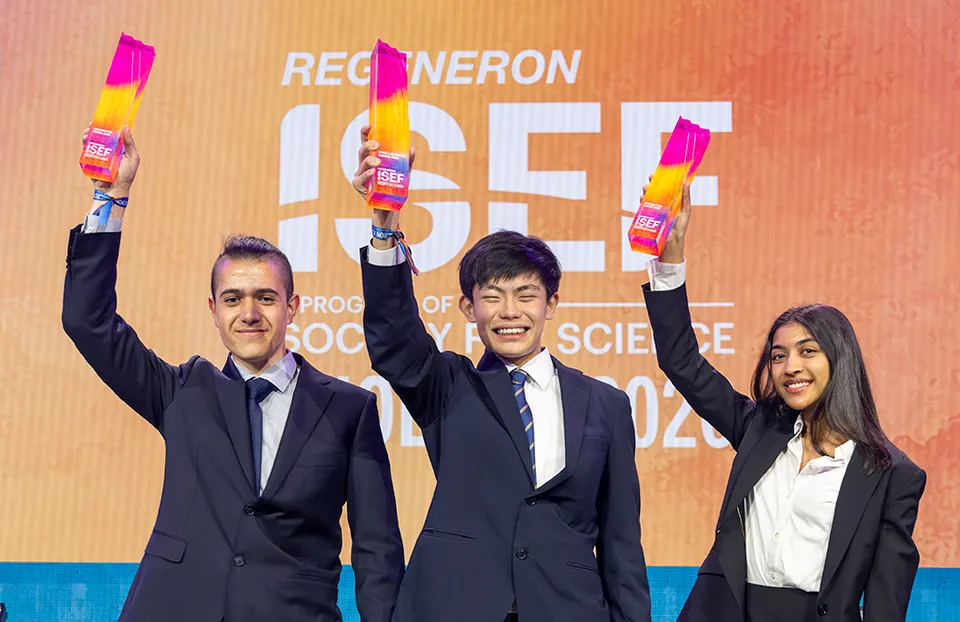
Ever wondered what kinds of projects actually win science fairs? Or are you hunting for an innovative, attention-grabbing idea for your next entry? Science fairs give you a platform to pursue real scientific questions and share your findings, and the winners span an enormous range of disciplines, uniting a deep grasp of scientific concepts with practical, real-world solutions. In this post, we'll look at projects that have succeeded in the past to spark your own ideas.
A Quick Word on ISEF
The International Science and Engineering Fair (ISEF) is the largest pre-college science competition in the world, drawing thousands of the most talented young scientists from over 80 countries. There, students present cutting-edge research across scientific disciplines, competing for scholarships, internships, and grand awards, while networking with experts and exploring future careers.
Getting to ISEF is a long journey that starts at local and regional fairs, with success at each level eventually leading to qualification. Because it's such a difficult achievement, it looks genuinely impressive on applications, signaling that you're among the best in the world in your field.
There are plenty of other fairs worth entering too, but ISEF is worth highlighting as the largest and most competitive. If you're mapping out the whole path, our guide to navigating the science fair process walks through how the levels connect from your first local fair onward.
Six Past ISEF Winning Projects
Synthetic DNA Engineering With ICOR
This synthetic biology project focused on improving protein production in E. coli, which is vital for vaccine development. Its core is codon optimization: selecting the DNA sequences that best enhance protein synthesis. Because traditional methods often ignore cellular dynamics and are inefficient, the project introduced ICOR, a tool that uses a recurrent neural network with a bidirectional LSTM architecture, trained on high-expression E. coli genes. That let it optimize sequences in a way that aligns far more closely with the cellular environment. Tested rigorously against standard methods, it showed significant gains in protein expression efficiency, with broad implications for biotechnology and vaccine development.
What you'd need: coding knowledge, high-performance computing capable of handling large datasets, specialized software for implementing the models, comprehensive genomic datasets, and statistical analysis tools.
Getting started: solidify your foundations in bioinformatics and machine learning first, then acquire the computational tools and genomic data you need. Build a project plan with clear stages for model training, testing, and validation, and refine your design continuously based on results.
This project was done by Rishab Jain, ScienceFair's founder and he won the Regeneron Young Scientist Award at ISEF 2022 with it.
BIO-PLEX: A Biocomputational Approach to Mpox
In 2022, as the world was still dealing with the aftermath of COVID-19, Mpox emerged as a new threat, spreading to 30,000 cases in a short span and raising urgent questions about what made it more infectious and whether those changes affected drug efficacy. To investigate, this project created BIO-PLEX, a computational tool for studying the virus's structure and mutations. It revealed how parts of the virus, especially two changes in its DNA-copying protein, might make Mpox spread more easily and affect how well treatments work, showing how computational methods can rapidly aid disease research.
What you'd need: high-performance computing, deep learning software and libraries, homology modeling tools, Python experience, virus genetic data, protein-structure databases, and mutation-analysis software.
Getting started: build a solid understanding of computational biology and the specific virus you're studying, then learn deep learning and homology modeling, which are key to predicting protein structures from genetic data. Get proficient in Python, gather your genetic data, and familiarize yourself with the relevant tools and databases before analyzing the virus's structure and mutations.
Saathvik Kannan won the Regeneron Young Scientist Award ($50,000) at ISEF 2023.
Self-Supervised 3D Human Motion Reconstruction
This project proposed a novel way to reconstruct 3D human shape and motion from a single-camera (monocular) video, tackling the limitations of existing methods that rely on huge training datasets and struggle with performance. The method, a geometric consistency-based self-supervised neural network (GC-SSN), uses geometric representations built from joints and silhouettes extracted from video frames. By enforcing consistent alignment between the reconstructed 3D models and those features, it achieves high accuracy without manual annotations or ground-truth data, improving domain adaptation and outperforming state-of-the-art algorithms. The applications are wide-ranging, from 3D broadcasting and virtual reality to sports analysis and telepresence.
What you'd need: a solid coding foundation, monocular video footage, a computer with sufficient processing power, image processing software, a machine learning framework, optional training data, and geometric modeling libraries.
Getting started: get a grasp of the fundamentals of image processing and machine learning, then learn to extract and analyze human motion from video and understand geometric modeling. Explore existing research in the field to see the approaches and challenges before experimenting with your own techniques and tools.
Michelle Hua won the George D. Yancopoulos Innovator Award (First Place, $75,000) at ISEF 2021.
A Diagnostic Method Based on Bacterial Motion
This project introduced a new way to diagnose Inflammatory Bowel Disease (IBD) by analyzing bacterial motion in the gut. Current diagnostics for gastrointestinal illnesses like IBD are often expensive, slow, and imperfectly accurate. The approach used specialized tools created with photolithography to study bacterial motility, then analyzed the images with software to distinguish harmless swimming bacteria from potentially harmful swarming bacteria. Tested on intestinal tissue samples, it showed promising results, pointing toward a faster, cheaper, and more accurate diagnosis for IBD and other GI diseases.
What you'd need: photolithography equipment, a microscopic imaging system, software for image analysis, tissue samples, tools for studying bacterial motility, and computational resources for developing the analysis algorithms.
Getting started: build a basic understanding of microbiology and image analysis, then learn how photolithography can create specialized tools for studying bacterial motion. Obtain tissue samples and the necessary imaging equipment, then experiment with analyzing bacterial patterns, refining your methods as you gain experience.
Neha Mani won the H. Robert Horvitz Prize for Fundamental Research ($10,000) at ISEF 2021.
Claudin-5 as a Neurological Biomarker
This neuroscience project investigated whether claudin-5, a key protein in the blood-brain barrier, could serve as a biological marker for mental health risk. By examining postmortem brain tissue, the研究 measured claudin-5 alongside the cytokines IL-6 and IL-8, and found that disruption of the blood-brain barrier correlated with elevated inflammatory markers. The project went further, analyzing claudin-5's localization in the brain, gene expression tied to neuroinflammation and neurodegeneration, and, through molecular docking, how existing medications might interact with claudin-5 and related proteins. Together, the findings pointed to claudin-5 as a potential biomarker and a possible target for future therapeutic research.
What you'd need: brain tissue samples (with the necessary ethical approvals), lab equipment and reagents, bioinformatics and data analysis software, relevant assessment tools, and statistical software.
Getting started: the ethical and logistical groundwork comes first, securing appropriate biological samples and approvals, then getting access to a suitable lab with the right equipment (a mentor is invaluable here). From there, outline a clear research plan detailing your experimental procedures and analysis methods, making sure each aligns with your study's goals before you begin collecting data.
Natasha Kulviwat won Gordon E. Moore Award ($50,000) at ISEF 2023.
A Biomimetic Inchworm Robot
This engineering project drew inspiration from the movement of caterpillars and inchworms to build bionic robots capable of navigating environments too risky for humans, like power grids and cable systems. Developed across four generations, the robots evolved from basic wire-pulling and friction control to advanced designs capable of bending navigation, obstacle avoidance, and traversing multiple pipes at once. The latest model can even switch between grabbing and wheel modes for greater efficiency and adaptability, and can maneuver along sticks of varying diameters, pointing toward real applications in grid maintenance and breakage detection.
What you'd need: coding knowledge, high-torque servo motors for precise movement, microcontrollers and signal-processing units, sensors, adjustable-grip grabber mechanisms, omni-directional wheels, a software development environment for coding and testing, and a varied set of sticks and pipes to test on.
Getting started: build a foundation in robotics and biomimicry principles, then research and plan your robot's design. Acquire your core materials, servo motors, sensors, microcontrollers, and start with basic prototypes focused on simple movement like wire-pulling and friction control. From there, iterate: gradually layer in more advanced features like obstacle avoidance as each stage proves out.
Yuyang Wang won the Craig R. Barrett Award for Innovation ($10,000) at ISEF 2023.
A Note on Originality at ISEF
Don't design your project to copy the ones above. The whole point of research is to make an original contribution, so use these as a springboard for your own brainstorming rather than a template.
You're likely someone driven to solve real problems in the world, so treat these competitions as a platform to do exactly that. Channel that drive into a genuinely valuable project and your chances of winning will climb.
For more inspiration across grade levels, our winning science fair projects and best ideas for 8th grade shows what strong work looks like earlier in the journey, and once your idea is set, our ultimate guide to science fair presentation boards helps you present it at its best.
Turning Inspiration Into a Win With ScienceFair
Studying past winners is a great start, but turning inspiration into an award-winning project of your own takes the right guidance. That's where ScienceFair comes in. Our mentors have competed in and won the top STEM competitions, and they'll help you shape an original idea, strengthen your research, and prepare for the judges' Q&A.
Ready to build your own winning project? Schedule a call with our academic advisor.

Related Articles
Winning Science Fair Projects: Real ISEF Examples
Real ISEF-winning science fair projects across synthetic biology, medical diagnostics, and AI, with what made each stand out and how to start your own winning project.
Read article →
Winning Science Fair Projects: Real ISEF Examples
Real ISEF-winning science fair projects across synthetic biology, medical diagnostics, and AI, with what made each stand out and how to start your own winning project.
Read article →
Winning Science Fair Projects: Real ISEF Examples
Real ISEF-winning science fair projects across synthetic biology, medical diagnostics, and AI, with what made each stand out and how to start your own winning project.
Read article →