There are lots of STEM competitions available for high school students to participate in. Here, I’ve pulled together 50 that I know to be worthwhile.
1. International Science and Engineering Fair
I’ve competed at ISEF for 4 years. It’s the world’s largest pre-collegiate science fair with something like 1600+ students. To truly capture how cool ISEF is, watch my vlog:
The prizes at the International level are in the tens of thousands. In 2022, I won the $50,000 Regeneron Young Scientist Award at ISEF.
Ok, that being said, how do you even get started with ISEF / science fair in general?
ISEF is affiliated with a ton of regional and state-level fairs around the world. Once you win at those, you can win a spot, qualifying you to go to ISEF.
Winning ISEF is an art of its own. If you want help, ScienceFair offers coaching with past winners.
There's a list to help you find your local fair to qualify for ISEF.
Once you find your local fair, contact the coordinator and see how to register! This opportunity truly changed my life.
In 2026: It will be held May 9th-15th, 2026 in Phoenix, Arizona.
ScienceFair Mentor Note: Kara Gaiser Gaiser, 2x ISEF Grand Award
Kara notes there's no single winning theme at ISEF. Judges look for projects that clearly establish four things: real-world applicability, feasibility, credible data, and genuine novelty. The most common gap she sees is students who can describe what they built but can't speak to their own limitations: confounding variables, sample size, design challenges. Demonstrating impact with real metrics, calculated or cited, is what separates a finalist from a winner.
2. ThermoFisher Junior Innovator Challenge
Eligibility: Middle School level, US student
I competed in the Broadcom MASTERS which is now the ThermoFisher JIC challenge all three years of middle school. In 2017, I was an entrant. In 2018, I was a semifinalist (top 300), and in 2019, I was a finalist (top 30) and competed at Nationals, winning 2nd place.
This is the premier science fair for middle schoolers, and works similarly to ISEF in that you compete at your local district/state level fair in order to qualify.
The final competition is held in Washington, D.C., and is a lot of fun.
In 2026: Applications open of February 1st, 2026.
ScienceFair Mentor Note: Shanay Desai, 2x ISEF Competitor
At this level, Shanay points out, judges weigh communication and creativity alongside the science. The mistake he sees most in this age group is reaching for a topic that sounds advanced over one a student can actually explain and defend. The projects that go far are simple, clearly motivated by a real-world problem, and owned completely by the student.
3. 3M Young Scientist Challenge
Eligibility: US student, grades 5-8
I won the 3M Young Scientist Challenge ($25,000) in 2018 and was named “America’s Top Young Scientist.” It was one of the most pivotal moments in my journey.
The 3M Young Scientist Challenge is a unique competition that focuses on innovation and problem-solving. Students in grades 5-8 are challenged to come up with a solution to an everyday problem using science and engineering. The top 10 finalists are invited to a summer mentorship program in Minnesota, where they work with 3M scientists and engineers to develop their ideas. The winner receives a $25,000 prize.
To apply, students must submit a video explaining their idea and how it solves a problem.
As someone who has competed in science fairs at various levels, I cannot recommend them enough. They are a great opportunity to learn about a topic that interests you, develop research skills, and potentially win some prize money. Additionally, they look great on college applications and can help you stand out from the crowd.
In 2026: The challenge hasn’t announced when it will open applications. In 2025 they opened in mid-January, so keep your eyes open.
ScienceFair Mentor Note: Shanay Desai, 2x ISEF Competitor
Half the YSC score is creativity and communication, which trips up strong-science students who treat the video as an afterthought. The two-minute pitch carries real weight: a clear problem, a solution you can show, and enthusiasm that reads on camera. At this level, a well-explained simple idea beats a complicated one no one can follow.
4. Coca-Cola Scholarship
Eligibility: High school seniors, US student
Now, you may be wondering, how do STEM kids do well in this scholarship? My advice: talk about your advocacy, service to society, and work done for others through your science research.
The Coca-Cola Scholarship is one of the most prestigious scholarships available to high school seniors in the United States. The scholarship recognizes students who have demonstrated academic excellence, leadership skills, and a commitment to community service. Winners receive a $20,000 scholarship to use toward their college education.
To apply, students must be enrolled in high school, due to graduate next year, and have a minimum GPA of 3.0. You then have to complete an online application that includes essays, transcripts, and letters of recommendation.
Winning the Coca-Cola Scholarship was one of the most rewarding experiences of my life. It gave me the financial support I needed to attend my dream school and pursue my passions.
I highly recommend that all eligible students apply.
In 2026: Applications are open August 1 to September 30 for eligible students.
5. Congressional App Challenge
The Congressional App Challenge is a competition that invites middle and high school students to design and develop an app on any platform. Participants work with their teachers and mentors to create a functioning app, which they then submit to their local representative's office for consideration. Winners are recognized by their representative and their app may be featured on the House of Representatives' website.
I know several people who did this and were extremely successful. Perfect for app developers, CS/tech students, etc.
In 2026: In 2025, submissions opened in May and went until the end of October. You can keep an eye on the deadline on their Instagram page.
6. National Merit Scholarship Competition
The National Merit Scholarship Competition is one of the most prestigious academic competitions for high school students in the United States. The competition recognizes students who have demonstrated exceptional academic ability and potential for success in college and beyond. Winners receive a scholarship to use toward their college education.
Eligibility: To participate, students must take the Preliminary SAT/National Merit Scholarship Qualifying Test (PSAT/NMSQT®) during their junior year of high school. Semifinalists are selected based on their scores, and then finalists are chosen based on academic record, extracurricular activities, and other factors.
Participating in academic competitions like the National Merit Scholarship Competition can not only lead to financial rewards, but also help students stand out to colleges and employers.
I won $2500 from the NMSC in 2023 and was a National Merit Scholar!
In 2026: Based on the information for 2025, you would need to take the PSAT/NMSQT® in October and then the results would be announced in April of the following year.
National Science Bowl
The National Science Bowl is a competition that tests students' knowledge in a variety of STEM fields, including biology, chemistry, physics, and earth science. Teams of high school students compete in a quiz bowl-style format, answering questions on a range of topics.
The National Science Bowl is sponsored by the U.S. Department of Energy and is a great way for students to showcase their STEM knowledge and compete against other talented students from around the country.
I competed in science bowl from 6th grade through 12th grade. It was never one of my main activities (in fact, I didn’t even include it on my commonapp activities list). But, I enjoyed it, and learned a lot about biology through it.
Students who are usually really good at Olympiads (IBO, IMO, Icho, F=ma, etc.) can do extremely well at Science Bowl as well.
In 2026: There are regional competitions for you to qualify, some of which are virtual. For 2026, the deadline was in October, 2025. So keep your eyes peeled for the deadline to compete in 2027.
Olympiads (IBO, IMO, IOI, IChO, IPhO, IESO)
Winning a medal at the international level / being selected to represent your country is a huge accomplishment. Most students tend to attend MIT.
There are many different Olympiads available for students who are interested in competing in STEM competitions. Some of the most well-known include the International Biology Olympiad, the International Mathematical Olympiad, and the International Physics Olympiad. These competitions typically involve a series of exams or tests that challenge students to apply their knowledge and skills in creative ways. Participating in Olympiads can be a great way to learn more about a specific field of study, gain recognition for your achievements, and potentially win prizes or scholarships.
But, what a lot of people don’t know is that there’s more!
Biology - USABO/IBO
Chemistry - USNCO/IChO
Physics - USAPhO/IPhO
Computer Science - USACO/IOI
International Earth Science Olympiad - USESO/IESO
Mathematics - USAMO/IMO
watch my video interview with an IMO winner:
Okay, okay! So you have all these olympiads. What’s next?
Well, you have to prep for them, which — to win at the national level — requires a lot of dedication. In my interview (YouTube link above) I heard about how it takes prep of 5-8 hours a day during the most difficult season.
In 2026:
The deadline for USABO has passed
USNCO is still open but it’s unclear until when, the first exams start in late February
The Physics Olympiad is different and involves getting on the US Physics Team for IPhO. The deadline is January, 20, 2026.
USACO’s competitions are online, the first one opens on January 9th and if you want to be certified, you must do it at 12pm ET.
USAMO is invite-only, to participate, you must have excelled at MAA American Mathematics Competition (AMC) 10 or AMC 12. The deadlines for those haven’t been announced yet.
USESO has a National Open Exam in the spring, and if you’re picked, you attend the week-long training camp in June. Then eight students are chosen to go to IESO.
FIRST Robotics Competition
FIRST® Robotics Competition (or FRC) is a youth robotics challenge. Every team gets a Kit of Parts and then designs, programs, and builds industrial-sized robots. Every year has a new theme, in 2026 teams use engineering skills to re-imagine the past.
The challenge takes place annually from January to April. The competition season begins with the announcement of the game challenge in early January and culminates with the World Championship event in April.
They have three different tracks for different ages, and you can either join an existing team or create one yourself.
In 2026: The first challenge will be released on January 10, 2026.
International Research Olympiad (IRO)
The IRO is an olympiad-style competition dedicated to scientific research, and promotes essential skills for science research among young minds. You might recognize it because I’m the founder of Samyak Science Society, the 501(c) non-profit behind this competition!
Eligibility: It is open to all students between the ages 13 and 18—it is designed to be as open as possible!
Information & Competition: The IRO fosters a culture of rigorous research and skill-building, not just memorizing formulae. The practical applications of knowledge and big-picture thinking are tested in the IRO examinations, allowing students to walk away with a deeper passion for scientific inquiry. In 2025, there were over 3,000 participants from 80+ countries, making winning even more exciting.
In 2026: The IRO Opens start March 7, 2026. The semifinals will be April 4, then the finals are in-person at Harvard Square June 19-21.
Cambridge Re:think Essay Competition
The Cambridge Re:think Essay Competition encourages critical thinking and exploration of a wide range of thought-provoking and often controversial topics. The topics cover science, ethics, technology, economics, and more, and all prompts are contributed by professors at top universities.
It aims to improve writing skills, fostering critical thinking, and refining communication abilities.
The winners get a cash prize, CCIR Academy scholarship, and an invitation to the Awards Ceremony and dinner at Cambridge.
Eligibility: It’s free to enter for any student who is 13-18 years old that aren’t at university yet.
In 2026: The dates haven’t been published, but it should open in mid-January.
Regeneron Science Talent Search
The Regeneron Science Talent Search (STS) is an annual competition that takes place over several months. The competition begins in the summer with applications and research submissions, and finalists are selected in January. The finalists then travel to Washington, D.C. in March to present their research and compete for top honors.
STS is one of the most prestigious and competitive STEM competitions in the world; each year, thousands of students apply for the competition, but only 300 are selected as semifinalists, and 40 are chosen as finalists. It has rigorous standards and a pretty high level of competition.
To succeed in the Regeneron STS, you must have a strong passion for STEM and a deep understanding of their research project. The competition emphasizes not only technical skills but also creativity, critical thinking, and communication skills. It is definitely a lot of work, but is also highly rewarding.
Eligibility Criteria: The Regeneron STS is open to high school seniors who are U.S. citizens or permanent residents. Students must submit an original research project in science, math, engineering, or medicine that they have conducted independently or in partnership with a mentor. Applicants are evaluated based on their research abilities, scientific knowledge, creativity, and communication skills. Finalists are selected based on their research projects and their potential to become future leaders in STEM fields.
In 2026: The applications opens June 1 until November 5, 2026 and the Top 300 will be announced on January 7, 2027.
ScienceFair Mentor Note: Eli Hanechak, Regeneron STS Top 300 Scholar
Eli says that STS isn't won on a flashy result. Judges weigh scientific merit alongside your individual contribution, and they can tell quickly whether you understand every decision in your project. TThe common mistake is treating STS like a science fair when it's really closer to a college application. Students perfect the 20-page report and forget that the essays and recommendations carry just as much weight. Those pieces are where judges decide whether you're a future scientist or just a strong student.
The Breakthrough Junior Challenge
The Breakthrough Junior Challenge is a unique and innovative STEM competition that emphasizes creativity, communication skills, and scientific understanding. The competition challenges students to explain complex scientific concepts or theories in a way that is easy to understand and engaging to a general audience. It is judged by a panel of scientists and science communicators who evaluate each submission based on its clarity, creativity, and accuracy.
The winner of the Breakthrough Junior Challenge receives a $250,000 college scholarship, as well as a $100,000 grant for their school to create a STEM lab. The winner also has the opportunity to attend the Breakthrough Prize ceremony in California and meet with influential leaders in science and technology.
Eligibility Criteria: The Breakthrough Junior Challenge is open to students aged 13-18 from around the world. Students must submit a two-minute video explaining a scientific concept or theory in a creative and engaging way. The video must be original and presented in English.
In 2026: Applications open on May 1, 2026 until September.
MATE ROV Competition
The MATE (Marine Advanced Technology Education) ROV (Remotely Operated Vehicle) Competition is an annual international competition, wherein the world championship takes place in June.
The competition is judged on several criteria, including the vehicle's design, construction, and performance. The competition also evaluates the team's ability to effectively communicate their design process, testing, and results, as well as their overall teamwork and sportsmanship.
It’s highly competitive, with teams from around the world competing for top honors. However, the competition also emphasizes learning and innovation, with a focus on experiential learning, creativity, and problem-solving.
Eligibility Criteria: The MATE ROV Competition is open to students from around the world—there are regional fairs, so make sure to check which regional fair is closest to you.
Teams can consist of students from different age groups and backgrounds, and each team must have an adult mentor. Participants must design and build a remotely operated vehicle (ROV) that can complete a series of underwater tasks, such as manipulating objects, surveying and sampling tasks, and navigating underwater environments.
In 2026: Registration opened December 1, 2025 and will stay open until May 12, 2026. The championship will be held in Newfoundland and Labrador, Canada from June 23-27, 2026.
Blueprint (HackMIT)
Blueprint is a 10-hour hackathon that challenges high school students to build creative software and hardware projects. Participants work in teams to build their projects, attend workshops and mentor sessions, and compete for prizes. The hackathon is designed to provide high school students with an opportunity to learn about computer science and engineering, meet new people, and develop their technical skills. This is hosted by HackMIT, the original undergraduate hackathon.
Eligibility Criteria: The event is open to high school students from around the world. Participants can apply as individuals or as teams of up to four members. Once admitted, the program is completely free (lodging, food, etc is included), but there will not be reimbursement for the travel cost. There are a few tracks, which are hardware, mobile dev, and web dev.
In 2026: Currently you can fill out the interest form and applications open in January.
HackHarvard
HackHarvard is a 36-hour hackathon that challenges participants to create innovative solutions to real-world problems.
Participants work in teams to build software and hardware projects, attend workshops and mentor sessions, and compete for prizes. HackHarvard is known for its focus on diversity and inclusivity, as well as its emphasis on social impact and entrepreneurship.
The hackathon provides participants with a platform to showcase their technical skills and creativity, network with industry professionals and mentors, and gain hands-on experience in the field of technology and innovation. HackHarvard also features a number of activities and events throughout the weekend, including keynote speeches, networking sessions, and workshops. The hackathon attracts top talent from around the world and is one of the most prestigious events of its kind.
Eligibility Criteria: The event is open to high school students and college students from around the world. Participants can apply as individuals or as teams of up to four members.
In 2026: There hasn’t been an announcement for 2026, but in 2025, applications opened at the end of August. In the meantime, the organizer has posted other hackathons, which would be good practice.
Conrad Challenge
The Conrad Challenge provides students with a unique opportunity to develop their entrepreneurial skills, collaborate with peers, and make a positive impact on the world. The competition emphasizes creativity, innovation, and social impact, and offers participants a chance to connect with mentors, industry professionals, and potential investors. It is pretty prestigious and competitive, so good luck if you plan to compete!
The Conrad Challenge consists of three phases: Activation, Innovation, and then the Innovation Summit.
Activation is the brainstorming stage with your team and coach. By the end, you must have created a Lean Canvas and chosen a category to compete in.
During the 2nd phase, innovation, you and your team receive feedback from the judges. Teams who excel at this stage will be awarded the title of Conrad Innovator. The top-scoring teams are invited to the Innovation Summit in the Houston Space Center.
If you are invited to the Summit, you have to pay $499 per attendee*, which doesn’t include transport or accommodation.
Eligibility Criteria: Conrad Challenge is open to high school students between the ages of 13 and 18 from around the world. Participants can apply as individuals or as teams of up to five members. Each team must be supervised by a teacher, parent, or mentor who is at least 21 years old. The competition is free to enter, and no prior experience in entrepreneurship or innovation is necessary.
In 2026: The 2025-2026 round has not yet closed, currently teams are in the Innovation Stage, and the summit is in April. The 2026-2027 round should open in August.
* This is the 2025 price.
Minds Underground™ Global Essay Competitions
The Minds Underground™ Essay Competitions are designed to encourage ambitious students to think beyond the school curriculum, engage with complex ideas, and develop the analytical and communication skills valued by top universities. Open to students aged 8–18 worldwide, these subject-specific competitions provide a platform to explore academic interests, from STEM and Medicine to the Humanities, Social Sciences, and Law.
There’s a category for students under 14 and another aimed at year 12, but is open to younger students. There are also different competitions for each subject, and you can enter more than one if you’d like to. Make sure to read each competition’s rules, as they may vary.
In 2026: The deadline to submit your essay is April 3, 2026.
James Dyson Award
The James Dyson Award is a global competition based in the UK for young inventors and engineers. The aim is to create simple, innovative designs that address sustainability questions. Winners and runners up get both media exposure and cash prizes.
I recommend it for students interested in studying engineering, even if you don’t win, you can still talk about your college application.
In 2026: Entries should open in March, based on last year.
Microsoft Imagine Cup
Microsoft Imagine Cup is an annual global competition that challenges students to use technology to solve some of the world's toughest problems. The competition aims to inspire creativity, innovation, and teamwork among students, and to encourage them to develop cutting-edge solutions to real-world challenges.
The Microsoft Imagine Cup has different categories, including Cybersecurity, Health and Life Sciences, Education, and more. Participants are required to develop a project that addresses a real-world problem in one of these categories, using Microsoft technology. Projects can be software applications, games, or services, and should demonstrate innovation, technical excellence, and potential impact.
There are also two different levels, Scale and Launch, for you to choose from. The winning teams receive cash prizes, Azure grants, and opportunities to meet with industry experts and investors.
If you’re interested in technology and social impact, this is a great competition!
Eligibility Criteria: Microsoft Imagine Cup is open to students who are at least 16 years old and are enrolled in school. They can compete individually or in teams of up to three members. Each team must have a faculty mentor who is affiliated with the educational institution. The competition is free to enter, and participants from any country are welcome.
In 2026: Applications are currently open for the Imagine Cup.
Science Olympiad
Science Olympiad is a national non-profit organization that hosts annual competitions for middle and high school students in the US. The competition aims to promote interest in STEM subjects and provide a challenging and exciting opportunity for students to showcase their skills and knowledge.
Note: This is not to be confused with the International Science Olympiads (ICho, IPho, IMO, etc)
Science Olympiad competitions are team-based and consist of a variety of events, each of which tests different skills and knowledge in science and engineering. There are events in subjects such as biology, chemistry, physics, earth science, and engineering, as well as events that test skills such as building, design, and problem-solving.
Each team can compete in up to 23 events, with points awarded for each event based on performance.The competition is conducted in several rounds, starting with regional and state competitions, and culminating in the national competition. The top teams from each round are selected based on their performance in the events, and the winning teams receive medals, trophies, and recognition for their achievements. SciOly provides students with an opportunity to explore their interests in science and engineering, learn new skills, and connect with like-minded peers.
I PERSONALLY DO NOT RECOMMEND THIS PROGRAM, BUT I KNOW PEOPLE WHO HAVE DONE IT.
In 2026: The dates for 2026 will be posted soon, so keep checking their website! The National Tournament will be hosted by the University of Southern California (USC) on May 22-23, 2026, in Los Angeles, California.
RISE [Scholarship]
The RISE High School Scholarship is a program that offers financial assistance to high school students who demonstrate exceptional academic performance, leadership qualities, and a strong commitment to community service. The scholarship aims to provide students with the opportunity to pursue higher education at the college or university of their choice.
As per their website, Rise invites 15-17 year olds from around the world to participate in the Rise Challenge. Applicants would use videos, projects and interviews to showcase their potential.
RISE is quite competitive, and students must display their academic potential through high test scores. Applicants are evaluated based on academic achievement, leadership potential, community service, and their ability to articulate their goals and aspirations.
They select 100 Global Winners each year, and receive access to need-based financial support. The community also offers opportunities to explore beyond just academics, with funding for social enterprises, a residential summit, and connection with mentors.
In 2026: The application period for the RISE High School Scholarship typically opens in the fall of each year and closes in early winter. The exact dates vary, and nothing has been announced yet for 2026.
Canadian Computing Competition (CEMC)
The Canadian Computing Competition (CEMC) is an annual mathematics and programming competition designed for high school students.
The main competition is the Canadian Computing Competition in February, organized by the University of Waterloo's Centre for Education in Mathematics and Computing (CEMC) and aims to promote interest and proficiency in computer science among high school students.
The CEMC hosts multiple contests, for both computer science and mathematics. The Canadian Computing Competition (CCC) involves a 3 hour, 5 question online exam. While competitive, it is a great opportunity to refine one’s mathematical solving ability!
Eligibility: The CEMC is open to all high school students in Canada and globally, regardless of their age or grade level. Students can participate individually or as part of a team of up to four students. However, students can only compete in one of three categories, based on their age and experience: Junior (Grades 10 and under), Intermediate (Grades 11 and 12), and Senior (First year university or below).
In 2026: The deadline to order is February 12, 2026, if you live internationally I would recommend ordering before. The contests are on February 18 for the Americas, and February 19 for the rest of the world.
Stockholm Junior Water Prize
The Stockholm Junior Water Prize is an annual international competition that recognizes the outstanding research projects conducted by young individuals (aged 15-20), in the field of water science. The prize aims to promote interest in water-related issues and inspire young innovators to develop sustainable solutions for global water challenges.
It is organized by the Stockholm International Water Institute (SIWI) and has gained global recognition as the most prestigious award for young water scientists. This is a great competition for anyone considering environmental science as a future field of study, and generally for STEM students out there!
Participants can be high school students, home-schooled students, or students from any educational institution. Each country holds its national competition to select the representative for the international Stockholm Junior Water Prize. Currently, 40 countries participate in the competition.
To enter the Stockholm Junior Water Prize, participants must submit a research project focused on water-related issues such as water quality, water management, water conservation, or water treatment.
The project should demonstrate scientific rigor, innovative thinking, and a potential impact on water sustainability. Projects can be submitted individually or in teams of up to three members. Submissions are evaluated based on scientific methodology, relevance, creativity, and presentation.
Dates: National competition dates may vary, and the final takes place during World Water Week, August 23-27, 2026.
Blue Ocean Competition
The Blue Ocean Student Entrepreneur Competition is an annual virtual entrepreneurial competition that provides high school students with an opportunity to showcase their innovative business ideas and compete for recognition and support. The competition aims to foster entrepreneurship and encourage young individuals to develop creative solutions to real-world problems.
The Blue Ocean Student Entrepreneur Competition typically follows a multi-stage process. Participants are required to submit a business plan or proposal that tackles a problem that hasn’t been solved.
You then have to record a pitch, following their guidelines, and upload it to YouTube. Then they announce top 100, top 30, top 10, and the winners through April and May. There is a Popular Choice Award, so get everyone you know to vote!
Eligibility: The Blue Ocean Student Entrepreneur Competition is open to high school and college students from around the world. Participants can compete individually or in teams, and there are no specific restrictions on academic disciplines or backgrounds. As long as students have an entrepreneurial idea they wish to pursue, they are eligible to enter the competition.
In 2026: The submission deadline is February 22nd, 2026, then the top 100 is announced on April 6, and the winners are announced on May 13, 2026.
Harvard MIT Mathematics Tournament (HMMT)
The Harvard MIT Mathematics Tournament (HMMT) is an annual mathematics competition for high school students jointly organized by Harvard University and the Massachusetts Institute of Technology (MIT).
HMMT is renowned for its challenging problem sets and attracts top math talents from around the world. The tournament provides a platform for students to showcase their mathematical abilities, engage in friendly competition, and foster a passion for mathematics.
The HMMT consists of various rounds that assess problem-solving skills, mathematical knowledge, and logical reasoning abilities. There are two competitions, one in November and another in February, these are the differences:
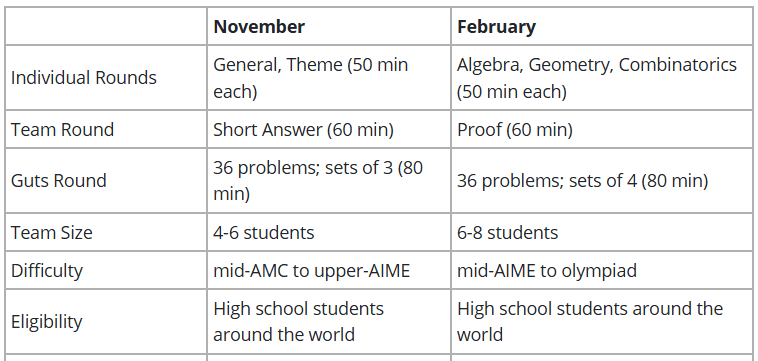
The competition typically includes both individual and team rounds. The individual rounds consist of challenging problems that test participants' ability to solve mathematical puzzles and proofs independently.
The team rounds require collaboration and teamwork among teammates to solve complex problems within a given time frame. Additionally, there may be special events, such as math relays or math-related activities, to foster a sense of camaraderie and mathematical exploration.
Eligibility: The HMMT is open to high school students from all over the globe. Students compete individually or as part of a team representing their school or math club.
You must be under 21, and enrolled in high school. The tournament is designed to challenge students with varying levels of mathematical proficiency, offering multiple divisions to accommodate participants of different skill levels.
In 2026: Dates haven’t been announced yet, but the deadline to apply in 2025 was in September, so keep checking their website if you want to participate.
Chemistry High School Exams
The Chemistry High School Exams are annual competitions that test high school students' knowledge of chemistry. The exam is organized by the University of Waterloo's Centre for Education in Mathematics and Computing (CEMC) and aims to promote interest and proficiency in chemistry among high school students.
They have two exams, the Chem 13 News Exam Contest is designed for Grade 12 high school chemistry students, and Avogadro Exam Contest, which is designed for grade 11.
It consists of a two-hour written exam, with questions that test a student's knowledge of chemistry concepts and problem-solving skills. The exam is designed to challenge students and requires a solid understanding of chemistry topics covered in high school curricula. The exam consists of multiple-choice and short-answer questions and covers topics such as stoichiometry, chemical bonding, and acid-base reactions. It is quite difficult but can definitely help receive admission into UWaterloo.
In 2026: Your teacher must order the exams in advance, then the actual test is online. It is usually held in May each year, but 2026 dates haven’t been announced.
Modeling the Future Challenge
The Modeling the Future Challenge is an annual competition that invites high school students to develop and apply mathematical modeling skills to solve real-world problems. The challenge provides a platform for students to explore the intersection of mathematics and practical applications, fostering critical thinking, problem-solving, and collaboration. If you’re thinking of getting into actuarial sciences, this is a great synthesis of mathematics and an intro to the field!
Eligibility: The Modeling the Future Challenge is open to high school students in the United States who are taking junior or senior level mathematics classes such as statistics, probability, pre-calc, calculus or other similar high-level math classes. You can compete individually, or in a team of up to five people.
In 2026: The 2025-2026 season submissions have closed. Based on last year, registration will open at the end of August for 2026-2027.
VEX Worlds
The VEX Robotics World Championship is an annual robotics competition and celebration organized by the Robotics Education & Competition (REC) Foundation. It brings together students from around the world who participate in the VEX Robotics program to showcase their engineering and problem-solving skills.
VEX Worlds showcases the culmination of the VEX Robotics season, where teams compete in a thrilling robotics challenge. The competition involves designing, building, and programming robots to complete specific tasks or objectives on a designated field.
The challenges test participants' abilities to strategize, collaborate, and troubleshoot while showcasing their engineering and programming prowess. Teams compete in alliance-based matches, where multiple teams work together to achieve shared goals.
Matches are scored based on a combination of autonomous robot operation and driver-controlled actions. In addition to the main robotics competition, VEX Worlds also features additional events and activities, such as skills challenges, workshops, and exhibitions, where students can further engage with STEM-related content and interact with like-minded individuals.
Eligibility: There are three categories for VEX Worlds, for high school, middle school, plus middle and elementary school.
In 2026: The competition will be held in St Louis, Missouri, from April 21-30, with different dates for each category. There are grants available, so check their website for more information.
Global AI Hackathon
The Global AI Hackathon, was started in 2024 and is hosted by MIT RAISE and the App Inventor Foundation. The goal is to develop an AI app that aligns with the theme and helps a cause.
Eligibility: It’s open to anyone below 18, and there is also an adult category. You can participate as an individual or team.
In 2026: Based on 2025, registrations should open in March. Keep checking the website!
Princeton University Mathematics Competition (PUMaC)
The Princeton University Mathematics Competition (PUMaC) is an annual mathematics competition organized by Princeton University's undergraduate math club, the Princeton University Math Club. The competition attracts high school students from around the world and provides an opportunity for them to showcase their mathematical abilities and problem-solving skills.
he PUMaC consists of several rounds designed to test participants' mathematical knowledge, problem-solving abilities, and mathematical reasoning skills. The competition includes individual rounds, team rounds, and a power round.
The individual rounds typically consist of a series of challenging problems that cover various areas of mathematics, such as algebra, geometry, number theory, and combinatorics. The team round involves collaboration among teammates to solve complex problems within a time limit.
The power round focuses on in-depth exploration of a specific topic in mathematics. Additionally, there may be guest lectures, math-related activities, and opportunities to interact with mathematicians and students from other schools.
Eligibility: The PUMaC is open to high school students in grades 9-12, regardless of their geographic location or educational background. Participants can compete as part of a team representing their school or math club, with a maximum of eight members. The competition welcomes students with a passion for mathematics and challenges them with a range of mathematical problems.
In 2026: Based on 2025, registration will open in September, and the competition will be towards the end of November.
Carnegie Mellon Informatics and Mathematics Competition (CMIMC)
The Carnegie Mellon Informatics and Mathematics Competition (CMIMC) is an annual mathematics and computer science competition organized by Carnegie Mellon University. The competition aims to challenge and inspire high school students in the fields of mathematics, computer science, and problem-solving.
The CMIMC features a variety of individual and team-based competitions in mathematics and computer science. The mathematics component includes challenging problem-solving rounds that cover various mathematics.
The computer science component involves programming challenges and algorithmic problem-solving tasks. In addition to the main competitions, there may be other activities, workshops, and lectures designed to engage participants and expand their knowledge in mathematics and computer science.
Eligibility: The CMIMC is open to high school students from around the world. Students can participate individually or as part of a team of up to 6 people, representing their school or math club. The competition welcomes students with an interest in mathematics and computer science, regardless of their geographical location or educational background.
In 2026: Registrations are currently open and the competition will take place on March 28, 2026 at Carnegie Mellon University in Pittsburgh, Pennsylvania.
AAPT High School Physics Photo Contest
The AAPT High School Photo Contest is an annual competition organized by the American Association of Physics Teachers (AAPT). This unique contest allows high school students to showcase their photography skills while creatively incorporating physics concepts into their photographs. If you have a passion for both photography and physics, this contest offers an exciting opportunity to blend your interests and demonstrate your creativity.
Eligibility: The AAPT High School Photo Contest is open to high school students from all around the world who are enthusiastic about photography and physics. Whether you're an aspiring photographer or a physics enthusiast, this contest welcomes students with diverse backgrounds and skill levels. It's a chance to combine your artistic vision with scientific principles and create captivating photographs.
In 2026: Last year, registration was from March to May, so keep your eyes peeled for news.
National High School Design Challenge
The National High School Design Challenge is an annual competition that provides high school students with an opportunity to showcase their design and problem-solving skills in a real-world context. The challenge aims to foster creativity, innovation, and collaboration while addressing significant design challenges in various fields.
The National High School Design Challenge typically involves solving a specific design problem or addressing a pressing issue in a particular field or industry. Participants are given a design brief, which outlines the problem statement, goals, and constraints.
They are then required to develop a comprehensive design solution that demonstrates their creativity, technical proficiency, and understanding of the problem at hand. Projects may involve designing physical products, creating digital prototypes, developing architectural plans, or proposing innovative systems or services. Submissions are evaluated based on criteria such as creativity, functionality, feasibility, sustainability, and overall design quality.
Eligibility: The National High School Design Challenge is open to high school students from across the country. Participants can compete individually or as part of a team, representing their school or a designated organization. The competition welcomes students with diverse backgrounds and interests, including but not limited to design, engineering, architecture, and art.
In 2026: The deadline to register is February 2, 2026. Five regional winners will be selected from the entries and will be required to participate in additional activities. They will attend a Virtual Regional Winners Day on Saturday, May 16, 2026. And Select entries from across the nation will be featured on an interactive map on Cooper Hewitt’s website.
US Cyber Patriot
US Cyber Patriot is a national cybersecurity competition for high school students organized by the Air Force Association (AFA). The competition aims to educate and inspire students to pursue careers in cybersecurity, develop critical thinking and technical skills, and foster a deeper understanding of cybersecurity principles.
The competition consists of a series of online rounds and a national championship. Participants are tasked with securing virtual networks and systems against simulated cyber threats.
They must identify vulnerabilities, apply patches and configurations, and defend against cyber attacks. The competition covers various aspects of cybersecurity, including operating system hardening, network security, digital forensics, and ethical hacking. Teams are scored based on their ability to identify and fix vulnerabilities, maintain system functionality, and adhere to strict competition rules and guidelines.
Eligibility: The US Cyber Patriot competition is open to high school students in the United States, including homeschoolers and youth organizations. Students can participate individually or as part of a team, representing their school or other approved organizations. The competition offers various divisions to accommodate students with different levels of cybersecurity knowledge and experience.
In 2026: Registrations are closed for 2025-2026, keep an eye on their website or social media for the 2026-2027 registrations. They should open in April.
BIEA International STEM Youth Innovation Competition
The British International Education Association (BIEA) does an annual global STEM Youth Innovation Competition for students between the ages of 6 and 18. Their theme changes every year, and in 2026 it is food waste. Your team of 3-5 people has to design an innovative solution to reduce food waste at any point of the food supply chain.
It’s a great chance for you to solve real problems, show teamwork, and hopefully, win an award!
In 2026: You can register now and you have to complete the project by May 30, 2026.
Genes in Space
Genes in Space is a national competition and educational initiative that challenges high school students to propose innovative experiments that utilize the unique environment of space to advance our understanding of genetics and molecular biology.
The competition provides an opportunity for students to engage in real-world scientific research and contribute to space exploration efforts. Students will explore topics from the effect of cosmic radiation on DNA to the detection of alien life forms.
The Genes in Space competition requires participants to develop a research proposal outlining an experiment that investigates a specific question related to genetics or molecular biology. The proposed experiment should leverage the unique characteristics of the space environment, such as microgravity or radiation exposure, to gain new insights or advance our understanding of genetic processes.
Students are encouraged to think creatively, consider the practical feasibility of their experiment, and demonstrate a solid scientific foundation in their proposals. Finalists have the opportunity to present their proposals to a panel of judges at a national conference, where a winner is selected.
Eligibility: The Genes in Space competition is open to Grade 7 to Grade 12 students in the United States. Students can participate individually or as part of a team of up to two students. The competition welcomes students with a passion for biology, genetics, and space science. No prior experience in conducting space-related research is required to participate.
In 2026: The competition opens on January 5, 2026 and you have to submit by April 14, 2026. Finalists are announced in May, those finalists get mentoring before winners are announced in July. In the fall, those winners participate in the Space Biology Camp. Then, if approved by the ISS, the winner’s experiment will be done in space.
International Mathematical Modeling Challenge
The International Mathematical Modeling Challenge, or IM2C, promotes the teaching of mathematical modeling and applications at all educational levels for all students. It’s a multi-level global competition. To participate, you have to be chosen by your country and you’ll be part of a team of four students.
The Awards Ceremony is held at the IM2C Summit, which was held in Hong Kong in 2025.
It’s a great opportunity for students interested in the practical application of math and who want to solve practical problems.
In 2026: The contest will run from February 2 to April 27, 2026. Your team chooses 5 consecutive days to work on the challenge, then the winners will be notified in June.
The American Rocketry Challenge
The American Rocketry Challenge is an annual rocket-building competition for high school and middle school students in the United States. It is the largest and most prestigious rocketry competition in the US!
It’s organized by the Aerospace Industries Association (AIA) and the National Association of Rocketry (NAR) to promote STEM education and inspire students to pursue careers in aerospace.
The competition consists of two rounds. In the first round, teams design, build, and launch a model rocket that must meet specific design and performance requirements.
The top 100 scoring teams advance to the national finals, where they compete in a fly-off at a location in the United States. The competition differs slightly each year, with a different challenge for the participants each time. The prizes are usually up to $100,000.
Eligibility: The competition is open to teams of 3-10 students enrolled in US middle schools or high schools (grades 6-12). Each team must have a teacher or mentor as an advisor. Participants must be US citizens or permanent residents.
In 2026: Based on 2025, you’ll be able to register starting in July. Then the finalists are announced in April and the national finals are in May.
PhysicsBowl
The PhysicsBowl is an annual international physics competition designed for high school students. It aims to challenge students' knowledge and understanding of physics concepts, theories, and problem-solving skills in a competitive setting. PhysicsBowl is organized by the American Association of Physics Teachers (AAPT) and provides an opportunity for students to showcase their physics prowess.
It consists of a multiple-choice exam that covers a wide range of physics topics, including mechanics, electricity and magnetism, waves, optics, thermodynamics, and modern physics.
The exam consists of challenging questions that test conceptual understanding, problem-solving abilities, and application of physics principles. Participating teams or individuals take the PhysicsBowl exam under proctored conditions within a specified time frame.
The exam is usually conducted at their respective schools or designated testing centers. After completion, the answer sheets are collected and submitted for scoring.
Eligibility: PhysicsBowl is open to high school students from around the world. Students typically participate as a team representing their school or physics club, although individual participation is also allowed. The competition is designed to accommodate students at various levels of physics knowledge, from introductory to advanced.
In 2026: The deadline to register is February 23, 2026. The exam will happen between March 18 and April 3, 2026.
DNA Day Essay Contest
The DNA Day Essay Contest is an annual competition that provides high school students with the opportunity to explore and express their knowledge and understanding of genetics and genomics. The contest is organized by the American Society of Human Genetics.
The essay should demonstrate a solid understanding of the subject matter and showcase critical thinking, creativity, and clear communication skills. The essays are judged based on scientific accuracy, clarity of writing, organization, and originality. Their website also contains a few common pitfalls that one should avoid, such as inaccuracy in technical language, sweeping statements with regard to the future of genetics, and the use of out of date references.
Eligibility: Grade 9-12 students from around the world are eligible to apply.
In 2026: Submissions open January 9, 2026, and close March 4, 2026. The results are announced April 24.
iGEM (Genetically Engineered Machines)
iGEM (Genetically Engineered Machines) is an international competition in synthetic biology that brings together teams of students from around the world to design, build, and test genetically engineered systems using standard biological parts. The competition aims to foster collaboration, creativity, and innovation in the field of synthetic biology while addressing real-world challenges through biological engineering.
iGEM challenges teams to develop and present original projects that leverage synthetic biology techniques to solve real-world problems. Participants work on a wide range of projects, such as creating novel biosensors, developing sustainable biomaterials, designing microbial systems for bioremediation, or engineering new therapeutic approaches.
Teams are provided with a standard toolkit of biological parts known as BioBricks, which they can use to assemble and modify genetic systems. Throughout the competition, teams engage in research, experimental design, lab work, and modeling to develop their projects. They document their progress, results, and methodologies on a publicly accessible wiki. The teams also attend regional and international jamborees where they present their work through presentations, posters, and demonstrations. Judges evaluate the projects based on scientific rigor, innovation, implementation, and societal impact.
Eligibility: There are two iGEM categories: Collegiate and high school. For both, the teams can be linked to an educational institution, community lab, or organized by companies).
Participants can form interdisciplinary teams that combine expertise in biology, computer science, engineering, and other relevant fields. The competition welcomes students from diverse backgrounds, including biology, biochemistry, biotechnology, and computer science.
In 2026: Dates haven’t yet been announced, but based on 2025, the deadline will be at the end of May.
International Brain Bee (IBB)
The International Brain Bee (IBB) is a global neuroscience competition for high school students that aims to inspire and motivate young minds to learn about the brain and pursue careers in neuroscience. The competition provides a platform for students to showcase their knowledge, critical thinking, and passion for understanding the complexities of the human brain.
The International Brain Bee consists of multiple rounds, starting at the local or regional level and progressing to national and international levels. The competition tests students' knowledge of neuroscience, including areas such as brain anatomy, physiology, pathology, neurochemistry, and cognitive functions. Participants study from a designated resource book that covers the required material.
Eligibility: With over 25,000 competitors and 40+ represented countries, the IBB is open to high school students typically between the ages of 13 and 19. Students from around the world can participate, either individually or as representatives of their schools or regions. The competition welcomes students with an interest in neuroscience, biology, psychology, and related fields.
In 2026: Nothing has been announced yet, but in 2025 it was online in November.
Davidson Fellows [Scholarship]
The Davidson Fellows Scholarship is a prestigious scholarship program that recognizes and supports exceptional students who have demonstrated outstanding achievements in their fields of study, research, or creative endeavors. The scholarship is awarded by the Davidson Institute for Talent Development, a nonprofit organization dedicated to nurturing and supporting gifted young individuals. They offer $100,000, $50,000 and $25,000 scholarships!
The Scholarship is highly competitive and seeks to recognize individuals who have made significant contributions in their areas of expertise. Applicants are evaluated based on the quality, depth, and impact of their projects, research, or creative endeavors. These may include scientific research papers, inventions, technological innovations, social initiatives, artistic creations, or academic achievements.
Eligibility: The Davidson Fellows Scholarship is open to students who are 18 years or younger at the time of application. Applicants must be U.S. citizens or permanent residents of the United States. The scholarship welcomes students from various academic disciplines, including science, technology, engineering, mathematics (STEM), humanities, music, and fine arts. To be eligible, students must have completed a significant piece of work in their respective field that demonstrates exceptional ability, creativity, and impact, and have a good high school academic record.
You can apply in teams of two, but if you apply in a team, email DAVIDSONFELLOWS@DAVIDSONGIFTED.ORG before beginning your application.
In 2026: Applications are open until February 11, 2026. You must describe your project/portfolio to ensure eligibility. Then, the second part of the application is where you input your nominators’ information, send them their forms, and submit all the category requirements.
ScienceFair Mentor Note: Eli Hanechak, 2025 Davidson Fellow Laureate
Eli notes that Davidson isn't looking for a good science project, what it asks is whether your work matters to the field, a far higher bar than most students expect. The "benefit to society" essay is where that case gets made or lost: many applicants undersell themselves, describing what they did instead of why it changes anything. Davidson rewards depth, so the strongest applications come from research that's had years to go somewhere, not a project started the year you apply.
MathWorks Math Modeling Challenge
The MathWorks Math Modeling Challenge, often referred to as the MathWorks M3 Challenge, is an annual mathematical modeling competition for high school students in the United States. The challenge encourages students to tackle real-world problems using mathematical modeling techniques and promotes critical thinking, teamwork, and problem-solving skills. SIAM and MathWorks are offering $100,000 scholarships to winning students!
It revolves around a real-world problem that requires mathematical modeling to find a solution or make informed decisions. Participating teams are given a specific problem statement and must use mathematical modeling techniques to analyze, interpret, and develop a solution to the problem.
Teams have 14 hours to work on the problem, during which they research the topic, formulate mathematical models, collect and analyze data, and develop their solution. The teams submit a comprehensive report that details their problem-solving approach, the mathematical models used, and their findings and recommendations. The reports are evaluated by a panel of judges who assess the teams' mathematical modeling skills, clarity of communication, and the feasibility and practicality of their solutions.
Eligibility: The MathWorks Math Modeling Challenge is open to high school juniors or seniors in the United States, and sixth form students in England and Wales. Participants form teams of three to five students, and each team must have an adult coach or advisor who supervises the team's activities. The competition welcomes students with an interest in mathematics, data analysis, and problem-solving.
In 2026: Registration is open until February 20, 2026. The first challenge is February 27-March 2, 2026. Finalist, Semi-finalist, Honorable Mention, SPARK, and Technical Computing Awardee teams and coaches are notified on March 25. Then presentations and confirmations are in NYC on April 27, 2026.
Ten80 STEM Challenge Season
Ten80 STEM Challenge Season can compete in virtual and in-person competitions, and an online points race.
Online Points Race: Without leaving school, students share work on a secure server to get feedback from remote STEM mentors, earn points, share ideas with other teams and swap assets such as 3-D printer time or CAD files.
Ten80 Face-to-Face Competitions: Teams meet face-to-face at local events, regional, and national events. Face-to-face events combine the excitement of head-to-head racing with the innovative energy of a STEM Fair and business startup.
Micro and 1-Day Challenges: Ten80 partners with organizations like the Denver Bronco’s, SME, and SEMA to host students in one-day or short-form micro competitions.
In 2026: Check their calendar for all their different events throughout the year.
Neuroscience Research Prize (AAN)
The Neuroscience Research Prize is a prestigious award that recognizes outstanding research contributions in the field of neuroscience. It serves to encourage and celebrate innovative and impactful research conducted by individuals or teams in advancing our understanding of the brain and nervous system. Organised by the American Academy of Neuroscience (AAN), it is an excellent way to showcase meaningful research work!
The Neuroscience Research Prize competition typically involves the submission of original research work that contributes to the understanding of the brain and nervous system.
The research can cover a wide range of topics, including but not limited to neurobiology, cognitive neuroscience, neuroimaging, or computational neuroscience.
Applicants are required to submit a detailed research proposal or summary, highlighting the objectives, methods, results, and significance of their work. The submissions are reviewed by a panel of experts in the field who assess the quality, innovation, and impact of the research.
Eligibility: The Neuroscience Research Prize is open to high school students from Grade 9 to Grade 12 in the United States, but AAN has various other awards for undergrads, grad students, and researchers.
In 2026: Dates haven’t been announced yet, but in 2025, applications were between August and October.
Global Innovation Challenge
The Global Information Challenge (GIC) is an international competition that aims to foster innovative solutions to global challenges through the use of information and communication technologies (ICT). The competition encourages participants to leverage their skills and creativity to address pressing global issues using the power of information and technology.
GIC invites participants to propose and develop innovative projects or solutions that address specific global challenges. These challenges can range from areas such as education, healthcare, environment, poverty alleviation, access to information, and social justice. Participants are encouraged to think creatively, incorporating technological tools, data analysis, artificial intelligence, or other relevant approaches to tackle the chosen challenge. The projects should demonstrate the potential for real-world impact and scalability.
In 2026: Nothing has been announced yet, but in 2025 the application guidelines were released in February, and the contest was held in Japan.
STEM Racing
STEM Racing is a competition, supported by Formula 1, is a global, hands‑on STEM competition where students aged 9-19 form teams to design, build, brand, and race miniature racing cars, through real-world engineering, marketing, and project management.
It’s split into three categories:
STEM Racing Discovery: Is a classroom project for students 6+ which introduces students to the principles of design, test, make and race with an engaging and interactive programme of work.
STEM Racing Primary: Students aged 9-11 create paper cars that can be raced at events or in class, alongside wider project work including portfolios, verbal presentations and pit displays.
STEM Racing Secondary: Offers three classes for students aged 11-19, Entry, Development, and Professional. Each stage builds on the last, enabling students to strengthen their technical skills, advance their engineering capabilities, expand their knowledge and build their confidence as they progress through the programme.
Eligibility: Students from any country, in the ages above, are welcome to get involved.
In 2026: No dates have been shared, but you can fill in a contact form to learn more.
Roboboat
RoboBoat is an annual autonomous boat competition that challenges teams of students to design, build, and program autonomous boats to navigate through a series of water-based challenges. The competition is organized by the Association for Unmanned Vehicle Systems International (AUVSI) and the Office of Naval Research (ONR).
RoboBoat requires teams to design and construct autonomous boats that can navigate through a predefined course and complete specific tasks. The challenges include obstacle avoidance, target identification, navigation through markers or buoys, and other aquatic-related missions.
Teams must develop advanced algorithms and software to control their boats' movements, perception, and decision-making. The boats are typically equipped with various sensors, such as cameras, sonar, and GPS, to gather data and make informed decisions. The goal is to develop autonomous systems that can effectively navigate and accomplish tasks in a complex and dynamic water environment.
The competition takes place in a controlled water area, where teams have the opportunity to demonstrate the capabilities of their autonomous boats. Judges assess the performance of the boats based on factors such as navigation accuracy, completion of tasks, speed, obstacle avoidance, and overall system reliability.
In 2026: Registration is closed for 2026, the competition will be on February 19-24, 2026 in Sarasota, Florida.
Help your Chances of Winning
ScienceFair provides unique, elite science fair coaching with past winners. Our mentors support you from ideation to presentation, and are here to guide you at every step of the way.
Schedule a consultation call to connect with one of our academic advisors and build a winning STEM project today.