If you want to compete in science fairs, do research, and get into the best universities on the planet, doing summer programs is a great way to help you reach those goals.
You can learn more about your area of interest from incredible faculty members, improve your college application, and meet loads of amazing people.
Here I’ve pulled together 51 STEM summer programs for high school students that are happening in 2026.
Tips when Choosing Summer Courses
When you’re looking at summer programs, make sure to always do your research to make sure that it is an interesting, useful program for you.
Think about what you want to study, and what sort of course you want to do.
Using your summer break wisely will help you have an edge when you’re applying to college, so take advantage of your “time off” to get ahead.
Free STEM Summer Programs for High School Students
Cost is often the first filter, so here are the programs on this list that are free to attend in 2026. A few go further and pay you a stipend. Do note that "free" usually means no tuition or program fee; most still expect you to cover travel, and some cover housing while others don't.
Research Science Institute (RSI): Free, and MIT covers dorms and food. Six weeks, one of the most selective programs anywhere.
Stanford Institutes of Medicine Summer Research (SIMR): No participation cost (a $50 application fee applies and is waivable). Students receive a small stipend; housing and travel are on you.
MITES Summer (MIT): Fully funded. You only pay transportation to and from MIT. Open to US citizens and permanent residents only.
MIT PRIMES: Free, year-long research for students within driving distance of Boston, with a national option (PRIMES USA).
Clark Scholars Program (Texas Tech): No program fees ($25 to apply), covers room, board, and activities, and pays a $750 stipend.
Telluride Association Summer Seminar (TASS): Completely free except travel.
European Space Camp (Norway): Free to participate. You may need to cover transport if you don't receive financial support.
The Jackson Laboratory Summer Student Program: Free, plus a $7,000 stipend and room, board, and travel.
NYU ARISE: Free 10-week program for NYC students, with a $1,000 stipend.
YUVIKA (ISRO, India): Free. The ISRO covers transportation, housing, and food.
Lodha Genius Program (India): Completely free program for math and science students.
The Summer Science Program (SSP) scales cost to what your family can afford rather than being free outright, so neither sits neatly in this list, but both keep costs low.
STEM Summer Programs for International Students
Many of the best-known US programs are restricted to citizens and permanent residents. These are the programs on this list open to international students, plus the strong options based outside the US.
Science Internship Program (SIP, UC Santa Cruz): International students are welcome to apply.
SSRP at Rockefeller University: International students can apply, though SSRP does not help with visas.
BU PROMYS: Open internationally, with dedicated PROMYS India and PROMYS Europe programs.
Canada/USA Mathcamp: Open to high school students internationally.
Ross Mathematics Program: Open to international students with a good command of English.
Secondary Student Training Program (SSTP, University of Iowa): International students are welcome.
MathILy (Bryn Mawr): Open internationally; students needing visas are advised to apply early.
Telluride Association Summer Seminar (TASS): Both US and international students welcome.
European Space Camp (Norway): Open internationally; requires fluency in English.
ISSET Mission Discovery (UK): Based in London and open to international students.
Immerse Education Summer Schools: Run in Oxford, Cambridge, New York, Sydney, Singapore, and more; open to anyone, though less selective.
Lodha Genius Program & YUVIKA (India): Strong options for students based in India who can't access US-citizen-only programs.
Young Technology Scholars (Plaksha, India): Residential program in Mohali, a good fit for students in India.
A note on RSI: it does accept international applicants (it receives roughly 600 international applications a year), but its international acceptance is extraordinarily competitive, so treat it as a reach rather than a core plan.
Research Science Institute (RSI)
The Research Science Institute (RSI) has GOT to be one of the best programs there are. It’s a world-renowned program and some incredibly cool people have done this program.
RSI is one of the most selective summer programs in the United States. The program receives over 2,500 U.S. applications and 600 international applications each year and accepts less than 2.5% of applicants for its six-week summer program.
The first week of RSI is composed of tutorials and seminars on contemporary research of interest by esteemed Professors from top universities, many of whom are alumni.
The next four weeks are centered on individual research projects, mentored by experts in the Boston area, with the majority of labs located at MIT, Harvard, and other local universities. The last week is devoted to paper and presentation writing, followed by the RSI Final Symposium and encore presentations, which feature the top 10 presentations selected by academic staff at RSI. After that, the top 5 presentations are determined by a panel of industry leaders in research and STEM.
The RSI Distinguished Lecture Series, which continues throughout the program, brings distinguished professors, scientists, and industry leaders in STEM, including a number of Nobel laureates, many of whom are RSI alumni, to speak to RSI students in evening lecture-style format.
OKAY! So, how do you apply / get in?!
The deadline is typically on the second Wednesday of December at 11.59 pm ET, but make sure you read the rules on their website so you don’t miss it.
Cost: Free + MIT gives you dorms and food!
Program Dates: 6 weeks from around June 26 to August 6.
I have made a video breaking down my full application for the Research Science Institute. It’s super helpful as I literally tell you what my activities were and what I said for each of the essays. It will also help you for ANY of the programs that are listed below. So, go watch it:
My personal experience with RSI was positive. It is very intensive. You do a lot of research and work with world-class institutes and professors. This program may or may not change your life.
This was one of the few programs I’ve applied to.
Stanford Institutes of Medicine Summer Research Program (SIMR)
Students at SIMR collaborate with Stanford academics and researchers to conduct medical research.
SIMR is an 8-week summer internship program open to high school juniors and seniors. The program consists of hands-on research under the direct guidance of a one-on-one mentor at a top-class lab within the Institutes of Medicine at Stanford University, as well as select departments.
Students select one of eight study fields and are then allocated to a lab where they receive one-on-one mentorship. The program is open to current juniors and seniors, and is 8 weeks long. Each year, about 50 students are accepted. Students must be 16 years or older at the start of the program.
Students applying to the program can choose from eight areas of research (institutes). After being accepted, they are then assigned to a specific institute based on their choices. Some examples include neurobiology, bioengineering, and stem cell and regenerative medicine.
Another option students in SIMR have is participating in the bioengineering bootcamp. This is a hands-on learning experience in bioengineering that does not involve a lab research component.
The program is free, and a limited number of stipends are available on a grant-based need.
Eligibility requirements for SIMR:
All three of the following requirements must be met (no exceptions):
1) Students must currently be juniors or seniors at the time of application (as of the fall of the year you’re applying).
2) Students must also be 16 years old or older by the start of the program.
3) Students must be living in the U.S. AND must be U.S. citizens or permanent residents with a green card to apply.
In 2026: You can apply by February, 21, 2026.
Summer Science Program (SSP)
Although I didn't attend this program myself, I've heard some pretty incredible things about it and wanted to share some of that with you. I’ve had a few friends who have attended this.
So, what exactly is SSP? Well, it's a program designed for high school students who are passionate about science, technology, engineering, and math (STEM). The program is intense, challenging, and hands-on, and takes place over the course of six weeks during the summer.
One of the coolest things about SSP is that it's not just your typical classroom-style learning experience.
Instead, you get to work on real research projects alongside other passionate students, using state-of-the-art equipment and techniques. You'll be learning from some of the brightest minds in the STEM field, including PhDs, postdocs, and other experts.
And don't worry, it's not all work and no play! You'll have plenty of opportunities to socialize and have fun with your fellow students outside of the lab. Plus, the program takes place on some of the most beautiful college campuses in the country, so you'll have plenty of chances to explore and enjoy the scenery.
But don't just take my word for it - SSP has a proven track record of success. Many alumni of the program have gone on to attend some of the most prestigious universities in the world and pursue successful careers in STEM fields.
Cost: SSP’s cost is scaled based on what your family can afford. The maximum price was $9,800 in 2025.
Eligibility requirements for SSP:
SSP is open to current high school juniors (and a few truly exceptional sophomores) who have completed the pre-requisites by summer, and will be at least 15 years old, but not yet 19, during the program.
In recent years, the admission rate has been around 10%, so definitely have an alternate plan for your summer. However, some applicants are surprised that they are admitted, and others are surprised that they are not. Besides academic preparation, SSP considers character, motivation, and how much the experience would impact you.
Indigo Research Innovator Global Lab
Indigo Research runs a 10-day intensive biotechnology research course, Innovator Global Lab, in a wet lab in Pasadena.
As well as getting to do hands-on research in a lab in a small cohort of 20 students, the program also helps you create a publication-ready paper.
Before you start the in-person course, you first do an online bootcamp where you decide your research question, learn the foundations of research methodology, and get ready to start in a lab. The afterwards you get one-on-one publication support.
In 2026, the program runs from June 21 to July 3. The cost is a bit high, it’s $13,600, not including transport to get to Pasadena.
BU PROMYS
PROMYS and RSI played a bit of a “friendly rivalry” in a frisbee game during my time at RSI in 2022, (they won…). I don’t have any friends who did PROMYS, however, I’ve heard a lot about it and know that it’s a great program for math students.
BU PROMYS is hosted at BU, Boston University. It’s similar to RSI in the length and counselors.
Except, it’s for mathematics.
It’s a 6-week summer program in mathematics for high school students from across the U.S. and around the world.
Around 25 college undergraduate mathematics majors to mentor students in the PROMYS high school program.
PROMYS is even international, PROMYS India and PROMYS Europe exist!
To be eligible, students must, by the start of the program, have completed at least 9th grade (or its equivalent) and be at least 14 years old.
The cost of PROMYS is $6,000. Even though it's a bit high, it is already subsidized by around $2,500 thanks to donors and sponsors.
Applications are due in March.
Stanford University Mathematics Camp
For rising juniors and seniors. If you’re a math kid, it’s probably worth applying to SUMaC and PROMYS.

There are two sessions over the summer. There are also two options for each of these sessions: online and residential.
In the 3-week online program, 64 participants meet for daily live, online class sessions with the instructor and their peers. At the end, you present a final research project.
There are two programs in 2026, one is on Abstract Algebra & Number Theory, and the other is Algebraic Topology.
The 4-week program at Stanford’s campus is made up of daily problem-set sessions, then evening and weekend social activities.
Like the online program, the 40 participants present a final research project at the end of the program.
In 2026: Applications close on February 2, 2026, and participants are notified mid-April.
BU Rise
BU is kinda cool because they have several summer programs.
Research in Science & Engineering (RISE) is an opportunity for those who are interested in hands-on research to spend 6 weeks delving into the world of university laboratory research across various fields.
This internship provides a unique experience that allows interns to immerse themselves in the research process, gain practical skills, and acquire a deeper understanding of the intricacies of scientific investigation.
Cost: $75 application fee and $5,930 program fee in 2026… but MOST of these programs that have these steep costs also offer financial aid for low-income families!
They have two tracks: practicum and internship. Internship is 40 hours of research a week. Then Practicum is more structured; it has the research aspect, in computational neurobiology or Data Science, you also have to do lectures, and it follows a syllabus.
In 2026: The deadline to apply is February 4, 2026.
NASA Internships
NASA has internships in all sorts of disciplines/fields!
I have some friends interested in aerospace engineering and broader non-biological fields. A lot of the high achievers in this regard seem to get involved with NASA or the Department of Defense.
There are literally hundreds of these in a variety of disciplines. From computer science to engineering, remote and in-person; high schooler to undergraduate. There are an absurd number of opportunities here.
For high school students, the OSTEM intern program gives you practical experience at such a prestigious institution.
In 2026, the summer program deadline is February 27, and for the fall program, apply by May 22, 2026.
For most of them, you are actually getting paid, not the other way around. That’s what I like to see! Paid internships & paid research opportunities. Get paid for the work you’re putting in!
Science Internship Program
Spend your summer working on open-ended research at UC Santa Cruz with the Science Internship Program (SIP).
If you're interested in learning more about research, getting real experience in coding, presenting, and actually research, this is a great program. You'll spend 8 weeks researching, one online and the seven in a lab.
If you're not from Santa Cruz, the university provides accommodation for you.
Eligibility requirements for SIP
Students must be 14–17 years old on the program start date (Monday, June 15, 2026).
International students are welcome to apply
Some research project placements require students to be at least 16 years old.
Students must be currently enrolled in high school.
While many SIP interns are rising seniors (summer between junior and senior year), this is not required.
Students who expect to have already graduated high school by this summer are generally ineligible.
A limited number of partial and full need-based scholarships are available.
In 2026, applications open on January 16th.
HOPP at Memorial Sloan Kettering Cancer Center
Did you know that my 7th grade science fair project that led to me being named ‘America’s Top Young Scientist’ used data from the Memorial Sloan Kettering Cancer Center?!
As you might guess, the HOPP Summer Student program is related to cancer research.
Students conduct independent research projects and attend enriching training sessions and tours designed to support their interest in the clinical side of translational research and fuel their curiosity for science.
Similar to other research programs, it has two main aspects:
First is independent research, where students complete a project under the guidance of a PI. This is excellent to use for science competitions.
Extracurricular events, tours, training, and luncheons.
Eligibility requirements for HOPP Summer Student Program:
Demographic eligibility: The applicant must live in New York, New Jersey, or Connecticut within 25 miles of the Main Campus of Memorial Sloan Kettering Cancer Center on the Upper East Side in Manhattan
The program offers a stipend but no housing.
Currently enrolled as a high school junior
Legally authorized to work in the United States
A 3.5 grade point average in science subjects
Must be 14 or older by June 2026
Submission of application materials by the deadlines
Eight-week commitment to the program
A genuine interest in science and laboratory research
In 2025: Apply by February 6th.
SSRP at Rockefeller University
I have a friend who did SSRP and had a great experience!
SSRP scholars work with a team of 8-10 students, with trainees from the Tri-Institutions (Rockefeller, MSK, and WCMC) overseeing, along with at least 3 dedicated research mentors. Each team has its own space and resources in one of the dedicated RockEDU teaching laboratories. You also have elective courses, guest lectures, workshops, networking opportunities, and social events.
As for eligibility, you have to be a junior or senior in high school, and you have to commit to the full seven-week program. International students can apply too, but SSRP does not help with visas.
In 2026, you have to apply by January 2nd.
Simons at Stony Brook University
This is a competitive program.
The Simons Summer Research Program is 6 weeks long. Applicants must currently be in their junior year (11th grade) of high school at the time of applying; must be US citizens and/or permanent residents; and must be at least 16 years of age by the start of the program.
Simons Fellows are matched with Stony Brook faculty mentors, join a research group or team, and assume responsibility for a project. The Simons Fellows conclude their apprenticeship by producing a written research abstract and a research poster.
In 2026: The costs will be around $2450 based on dorm fees, the meal plan, and student health fees.
Clark Scholar Summer Program
The Anson L. Clark Scholars Program offered by Texas Tech University is highly selective, with an acceptance rate of less than 3%.
This program is designed for high-achieving students who are interested in conducting research across various fields. Participants will be part of a small cohort of 12 students and receive personalized mentorship from renowned scholars in the country for 7 weeks. In addition, they will attend seminars, discussions, and field visits as part of the curriculum.
Costs: There are no program fees, but it costs $25 to apply. The program covers on-campus meals, on-campus room and board, and weekend activities/programming.
The selected participants will receive a stipend of $750, and the program will take place at Texas Tech University in Lubbock, TX.
That’s when you know the program is good—they give YOU a stipend. That means they VALUE your work. They WANT top high schoolers to come do work. Not to make money off of you!
Eligibility for Clark Scholars
Eligible applicants must be U.S. citizens or permanent residents who are at least 17 years old by the program start date. It’s intended for students in the summer before senior year or the summer immediately after finishing high school.
In 2026: You have to apply by February 16.
UPenn Management & Technology Summer Institute
This program costs $9,000. However, it directly gives students who are interested in UPenn’s highly coveted (and competitive) M&T undergraduate program a chance to experience what UPenn is like from this side of things.
M&TSI is an extremely rigorous, non-stop, fast-paced college course that introduces students to the fundamental knowledge and skills necessary for successfully linking technology and management concepts in just three weeks.
You also get college credit at the end of the course, which is why this costs so much.
Courses taught by full-time Wharton and Penn Engineering faculty
Attendees explore Penn’s business and engineering offerings, hearing guest lectures from prominent faculty recognized as leaders in their field
Students build and present a prototype and go-to-market plan for their own high-tech venture
Project presentations are evaluated by Penn faculty, receiving feedback from seasoned entrepreneurs and investors
Students participate in simulations led by industry innovators such as Google
In 2026: You can apply between January 28th and March 25th.
MITES Summer (MIT Introduction to Technology, Engineering, and Science)
MITES Summer, or MIT Introduction to Technology, Engineering, and Science, is a six-week program for high school juniors who are U.S. citizens or permanent residents. Students from underrepresented backgrounds are encouraged to apply.
Cost: Free - MITES covers all program-related expenses, including tuition, room and board, and transportation to and from campus.
Typical Dates: Late June to early August (six weeks)
What MITES offers
Academic Courses: MITES offers rigorous academic courses in mathematics, physics, chemistry, and biology, designed to challenge and inspire students interested in science, engineering, and technology.
Research Projects: Students work in teams on research projects that allow them to apply the concepts learned in class to real-world problems. They are paired with a mentor from the MIT community who guides them through the research process.
Guest Lectures: Students attend lectures and workshops given by MIT faculty members, researchers, and industry professionals.
College Admissions Counseling: Students receive guidance on the college application process, including help with writing college essays, preparing for standardized tests, and choosing the right college.
Social and Cultural Activities: MITES organizes a variety of social and cultural activities, including field trips to local museums, outdoor activities, and other events designed to help students build friendships and explore the MIT campus as well as nearby Boston.
Housing and Meals: Students live in MIT dormitories and receive three meals a day in the campus dining halls.
Prestige: MITES is a highly competitive program, with an acceptance rate of less than 10%.
MIT Beaver Works Summer Institute
MIT Beaver Works Summer Institute offers different 4-week courses based on different interests.
What MIT Beaver Offers
Hands-On Projects: They offer hands-on projects in robotics, cybersecurity, data science, and engineering, allowing students to work in teams on real-world problems. I hugely recommend this as it is a great opportunity for STEM exploration.
Mentorship: Additionally, you get paired with MIT mentors who will guide you throughout the project development process
Technical Workshops: Another benefit is that you’ll get exposure to technical workshops on topics like CAD, electronics, etc, allowing you to gain practical skills and knowledge to apply to your projects.
Industry/Guest Speakers: You will have the opportunity to hear from industry experts and innovators in fields related to their projects, learning about cutting-edge research and technology.
College Preparation: They also provide college preparation workshops, including guidance on the college application process, college essays, and financial aid.
Social and Cultural Activities: You also can participate in a range of activities from visiting local museums and cultural events to building friendships and exploring the amazing city of Boston (seriously, it’s an amazing city to live in!)
Eligibility requirements for MIT Beaver Works Summer Institute
MIT Beaver Works Summer Institute is open to students between 9th and 11th grade who are US citizens or permanent residents.
You need a strong academic record in math and science courses, with a relatively high GPA
Since it's a STEM programme, they will be looking for your interest in various STEM fields and whether you are eager to learn about robotics, cybersecurity, data science, and engineering.
MIT PRIMES
MIT PRIMES program is different from other programs here as it’s year-long.
It’s highly recommended for students passionate about mathematics and computer science; it’ll be the perfect fit if you live within driving distance from Boston!
It involves a lot of active research, independent study, and receiving guidance from graduate students and PhD mentors. You also have many networking opportunities here. (This is sometimes underrated when people talk about these summer programmes, but from personal experience, this is super important!)
Cost: Free
Eligibility requirements for MIR PRIMES
You have to live within driving distance of Boston. However, there is also MIT PRIMES USA, which is a program open to students across the country.
You need to solve a problem set they provide—if it is for math, you need to answer at least 70% of it, and for CS and computational biology, it has to be 100%. The problem sets are available here in case you’re interested.
You need to show academic rigor through test scores, grades, etc, as admissions are competitive!
It’s a bit of a time commitment as you will have to be present on some weekdays in the evenings and weekends, but it is worth it, as you will be publishing an independent research paper by January 15 in the following year.
They also run √mathroots for 14 days over the summer as a mathematical talent accelerator.
Johns Hopkins University Center for Talented Youth (CTY)
The Center for Talented Youth offers different courses for different ages. But their residential program is a three-week course for grades 5-12.
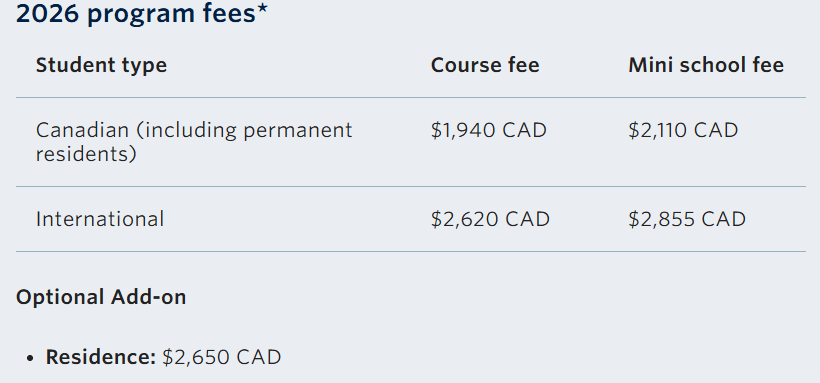
Cost: This is paid course, according to their website, it can cost between $800-$1500.
What CTY offers
Research Experience: Students work on projects related to polymer science and engineering, such as materials synthesis, characterization, and processing, under the guidance of faculty mentors.
Workshops: Students learn scientific writing and presentation skills and attend seminars on topics related to polymer science and engineering.
Networking Opportunities: Students interact with faculty, postdocs, and graduate students in the center, as well as with researchers from other universities and industry partners.
Housing and Meals: Students live in university housing and receive a stipend for meals.
Garcia Center for Polymers at Engineered Interfaces @ Stony Brook
The Garcia Program is a seven-week course for gifted high school students. It includes practical research, workshops on presentations, scientific writing, and other topics like polymer science and engineering.
You also get the opportunity to network with faculty, postdocs, and graduate students in the center, as well as with researchers from other universities and industry partners.
Plus, you live at the Stony Brook campus in NY for seven weeks.
Typical Dates: Mid-June to mid-August (seven weeks)
Eligibility for the Garcia Program
The program is open to high school students who are at least 16 years old on or before July 4.
An unweighted GPA of 95/100 (3.8/4.0)
You must have taken at least three of the following subjects at an Honors or AP level: English, Chemistry, Mathematics or Calculus, Physics, and Biology (optional).
Standardized test scores (SAT/ACT and/or Regents) must be 60% or above.
To get special consideration, you should show evidence of leadership, special talents or interests, and other personal qualities through extracurricular activities, volunteer work, etc.
Remember - it’s quite competitive, so make sure to stand out :)
Brookhaven National Laboratories - High School Research Program
The High School Research Program (HSRP) at Brookhaven National Laboratory is a six-week summer program for high schoolers interested in STEM.
You get to collaborate with scientific, engineering, and technical staff on hands-on projects that support Brookhaven Lab and the Department of Energy. You also do a presentation at the end of the program.
Eligibility for HSRP
The program is open to high school students in the US who are at least 16 years old on or before the start of the program. (You need to be a US citizen or permanent resident.)
It’s recommended for students who have completed 11th grade.
You also need two letters of recommendation for your application, a STEM mentor is preferred and they require your school district’s superintendent name and email address.
In 2026, you must apply by March 20th.
High School Summer Research Experience in Cancer (SURE-CAN) Program
As you can tell by the name, the High School Summer Research Experience in Cancer (SURE-CAN) Program is for high school students interested in cancer research. (It’s right up my alley, and perhaps yours too😀).
The program aims to inspire and cultivate the next generation of cancer researchers at the Comprehensive Cancer Center in Upstate New York.
It’s a 6-week program made up of lectures, group discussions, seminars, development activities, and research in both dry and wet labs.
You’ll learn a lot about cancer research, research ethics, and statistics. You’ll also explore how other areas (including math, physics, and engineering) interact with it.
Eligibility for SURE-CAN
Must be enrolled in the junior year of high school (at least 15 years old in June).
Resident of Western New York, as it’s a commuter program.
Have to be a US citizen or permanent resident
The application deadline is very early January.
Canada/USA Mathcamp
Mathcamp is a 5-week program for high school students who are talented at mathematics to learn advanced mathematics and new ways of thinking.
The curriculum in Mathcamp is broad; students can choose what they’re most interested in. They do courses 5 days a week, covering introductory material, like Proof Techniques, in some core subjects that will be prerequisites for many future classes: for example, Linear Algebra, Group Theory, Number Theory, and Graph Theory. They also do clusters of classes on topics (eg pure mathematics) and others on the application of math.
They also do field trips on two days.
In 2026, it will be held at Champlain College in Burlington, VT.
Eligibility for Mathcamp
High School Students: The program is open to high school and middle school students between 13 and 18 years old who have not yet begun college.
Academic Requirements: Applicants must have a strong academic record in math, have taken Precalculus (or the equivalent), and solve a qualifying quiz.
Personal Qualities: Applicants should demonstrate curiosity, creativity, and a love of learning. After all, that’s what’s important :)
Ross Mathematics Program
The Ross Mathematics Program is a 6-week intensive summer experience designed to encourage motivated pre-college students to explore mathematics.
There tend to be two sites with different dates for this course, and each accepts around 60 students.
The program costs $7000, and there is financial support available. It’s also open to international students who have a good understanding of English.
COSMOS: California State Summer School for Mathematics and Science
The COSMOS program is a challenging and immersive STEM curriculum in areas such as biology, chemistry, computer science, engineering, and physics.
Students engage in hands-on experiments, research projects, and other activities to deepen their knowledge and skills in these fields.
It emphasizes collaboration and teamwork, as students work on group projects and participate in discussions and presentations with their peers and instructors.
Like a lot of summer programs, it includes field trips to nearby research institutions, universities, and industry partners to expose students to the latest developments in STEM fields and potential career paths.
Students also receive mentorship and guidance from experienced educators and researchers who provide personalized support and advice on academic and career goals.
Eligibility for COSMOS
High School Students: The program is open to high school students who have completed at least one year of high school and are in good academic standing.
California: You must be residing in California, as COSMOS is held by the UCs, and it is a residential program.
Academic Requirements: Applicants must have a strong academic record in math and science and demonstrate their passion for STEM fields through their extracurricular activities and personal essays.
MathILy @ Bryn Mawr College, PA
MathILy is a five-week program over summer (and winter!) Over the course, you’ll do classes where instructors provide the framework, and you get to make (and prove!) the conjectures.
MathILy promises a focused and individually tailored effort that elicits massive learning, enormous fun, and significant personal growth.
Students also receive instruction in mathematical writing, which includes writing proofs and presenting mathematical arguments clearly and concisely.
Plus, students have the opportunity to engage in research projects and collaborate with instructors and peers on original mathematics research.
Eligibility for MathILy
This is primarily for those between 14–17. While there is no restriction for non-high school students, they recommend taking Algebra 2.
Applicants should have a strong academic record in mathematics (duh)
International students who need visas are advised to apply early to ensure they can get a visa.
Hofstra University Summer Science Research Program
Hofstra University's Summer Science Research Program (HUSSRP) is an opportunity to do research in Biology, Chemistry, Psychology, Computer Science, Engineering, Sociology, Geology, Mathematics, and Public Health.
The program also includes seminars and workshops on scientific writing, research ethics, and presentation skills. Students also have the opportunity to attend lectures by guest speakers and visit research facilities in the area.
It costs $2315 total, not including transportation or housing for the 4-week program.
Eligibility for HUSSRP
The program is open to high school students who are rising sophomores or juniors (10th or 11th grade), and be at least 15 years old when the program begins
You must be a US citizen or permanent resident
Have had at least one year of a high school research course;
Have demonstrated an interest in their requested subject topic;
Be willing and able to commit four weeks to full-time research; and
Have demonstrated the ability to work independently.
Secondary Student Training Program at University of Iowa
SSTP provides high school students with the opportunity to engage in hands-on research in a variety of fields, including biology, chemistry, engineering, and physics. Students work on projects under the guidance of faculty mentors and gain experience in scientific methodology, data analysis, and scientific communication.
The program includes seminars and workshops on scientific writing, research ethics, and presentation skills. Students also have the opportunity to attend lectures by guest speakers and visit research facilities in the area.
It’s designed to help prepare students for the college application process and for success in college-level coursework. Students receive guidance on college admissions and financial aid, and they have the opportunity to learn about the academic and social aspects of college life.
It costs $7,500, including room, board, materials, activities, and three hours of undergraduate credit. But it’s a bit on the pricey side, so always research whether this is the right program for you.
Eligibility for SSTP
Students in grade 10 or 11
International students are welcome
In 2026: You must apply by February 16.
Delve by Delta Careers
Delta Careers offers virtual work experience at top companies to give you real-world exposure in your area of interest.
They offer them year-round at major companies, such as Ferrari, AWS, Adobe, Stripe, and many more.
Delta offers different programs, but I chose Delve because it’s more hands-on with a mentor, and they specifically have some opportunities over the summer.
Research Experience at CIERA @ Northwestern
REACH (Research Experiences in Astronomy at CIERA for High School Students) is a program that provides high school students with experience with astronomy research in an atmosphere of team-style learning, hands-on training, and mentorship from professional scientists.
Students participate in astronomy research projects with CIERA astronomers. You’ll also do intensive Python programming and learn about astronomy, and participate in solar observing at Dearborn Observatory.
It’s an introductory course and is great for students who are thinking about exploring astronomy, computer science, physics, and more.
There are two courses over the summer, with around 25 people per course.
Eligibility for REACH
The program is open to high school students between grades 10-12.
You must have your own housing, as it is not provided by Northwestern.
It costs $2500 with financial aid available. The deadline to apply in 2026 is March 9th.
Immerse Education Summer Schools
The Immerse Education Summer Schools are well-known programs offered at different locations around the world, including Oxford, Cambridge, New York, Sydney, Singapore, and more.
(A note - anyone can pay and go, so it’s not as selective, but it’s still good to get university experience).
You get to live and learn in top universities, doing courses as wide-ranging as veterinary studies, biotechnology, medicine, or engineering.
International Space School Educational Trust - UK
The International Space School Educational Trust (ISSET) offers a unique 5-day program called Mission Discovery, which provides high school students with a chance to experience a range of activities related to space exploration and technology. I know some of you are international students, so I hope this is useful for you if you’re interested in astrophysics!
These activities include:
Team Projects: Students work in teams to develop a concept for a space mission, designing a spacecraft and its instrumentation.
Lectures and Workshops: Participants attend lectures and workshops on topics such as astronomy, astrobiology, and space exploration, as well as leadership and team-building skills.
Hands-on Activities: Students engage in hands-on activities, including building and launching model rockets, programming robots, and using virtual reality to simulate space missions.
Housing and Meals: Students stay in King’s Caollege London university dormitories and receive meals throughout the program.
Eligibility for ISSET
The program is open to high school students aged 14-18 years old.
Interested students must submit an online application form, which includes a statement of interest and a letter of recommendation from a teacher or mentor.
Note: This isn’t too selective of a program, so keep that in mind.
If you stay in KCL dorms, then the program costs $2550.68, if you choose the commuter option, it decreases to $1019.
European Space Camp - Norway
The European Space Camp in Andøya, Norway, provides high school students with a unique opportunity to learn about space exploration and technology through a range of activities, including:
Lectures and Workshops: Participants attend lectures and workshops on topics such as rocket design, robotics, and life support systems.
Hands-on Activities: Students engage in hands-on activities, including building and launching rockets, programming robots, and using virtual reality to simulate space missions.
Visits: Participants visit various space-related facilities, such as the Andoya Space Center and the Northern Lights Observatory. (It’s during the summer, though, so you aren’t going to be seeing Aurora Borealis :P just in case you were wondering)
It’s free to participate, but you may have to pay for transport if you don’t receive financial support.
Eligibility for European Space Camp
The program is open to students aged 17-20 years old.
You must be fluent in English
All candidates have to have a well-documented passion for science
In 2026: The deadline to apply is February, 8th.
UBC Future Global Leaders
The UBC Future Global Leaders program is a two-week summer program designed for high-achieving high school students who are interested in exploring global issues, developing leadership skills, and gaining university experience.
It’s not fully STEM, but it does offer some public health and engineering classes.
This program also offers an online option.
Lodha Genius Program - India
The Lodha Genius program at Ashoka University is a completely free program for math and science students that involves interdisciplinary learning.
This is especially for some of my readers from India who may not be able to access the other programs due to their price or not being citizens. This is a program for those planning to study science and mathematics. It includes olympiad-level problem solving and is rigorous over the course of a month.
It also involves quite a bit of mentorship from professors to build a strong conceptual foundation for students.
Eligibility for Lodha Genius Program
You must be in grades 8-11.
A transcript will have to be submitted, so high academic performance is necessary, especially in math and science subjects.
A letter of recommendation (optional: from the head of school) is also useful when applying.
The Lodha Genius program also exists at IISER Pune for grades 8-10.
Yale Young Global Scholars
Yale Young Global Scholars (YYGS) is a two-week academic enrichment program for outstanding high school students from around the world.
They offer three courses, three times during the summer. Innovations in Science Technology is the one focused on STEM.
Students explore a wide variety of scientific fields such as physics, molecular biology, chemistry, biochemistry, astronomy, engineering, neuroscience, immunology, psychology, and earth science. You also look at the interdisciplinary applications across the many scientific fields, ranging from the nanoscopic to the astronomical in scale.
Eligibility requirements for YYGS
Age: Be between 16-18 byJuly 19, 2026.
Language: Be fluent enough in English to participate
Grade: Be a high school sophomore or junior (or the equivalent)
Graduation: Be graduating in May/June 2027 or 2028 in the Northern Hemisphere, or Nov/Dec 2026/2027 in the Southern Hemisphere
Participation: You must be a first-time participant of YYGS
The cost of the program is $7,000 for everything except travel.
Summer Academy for Math and Science (SAMS)
The Summer Academy for Mathematics and Science (SAMS) is a six-week summer program offered by Carnegie Mellon University (CMU) for high school students interested in pursuing STEM fields. The program is designed to provide talented students with a rigorous academic experience and to expose them to the research opportunities available at CMU.
Like other programs here, SAMS students attend classes taught by CMU faculty members and engage in hands-on research projects in areas such as robotics, computer science, mathematics, and engineering.
SAMS students have access to CMU's state-of-the-art research facilities, including laboratories, libraries, and computing resources, allowing them to gain valuable research experience.
The program is divided into three parts:
Before it fully starts, there are two days of online skill-building for participants.
The six-week residential program
Then afterwards, there are ongoing virtual enrichment sessions and college prep information.
Eligibility for SAMS
You must be at least 16 years old to participate
Be a US citizen or permanent resident
Be in 11th grade when you apply
The Jackson Laboratory Summer Student Program
The Jackson Laboratory Summer Student Program is a highly competitive 10-week research internship program offered by The Jackson Laboratory, a non-profit research institution focused on genetics and genomics. (Paging fellow bio lovers!)
It’s offered at The Jackson Laboratory's campuses in Bar Harbor, Maine, and Farmington, Connecticut.
Students must be 18 years old at the start of the program (May 31st). They have the opportunity to work on cutting-edge research projects alongside experienced scientists and researchers at The Jackson Laboratory.
It has a competitive application process, with applications due at the end of January. It’s also a free program. In fact, students get a $7,000 stipend, plus room, board, and travel.
The program is a great opportunity for students interested in pursuing careers in genetics and genomics research to gain hands-on experience and develop valuable skills and connections in the field.
Notre Dame Leadership Seminars
The leadership seminars are a 10-day program at the Notre Dame campus, Indiana for gifted students who show leadership. So even though it isn’t STEM, it’s a transferable skill that can be very useful.
Plus, it offers transferable college credit to everyone that completes the program.
Eligibility for the leadership seminars
You must be a current high school junior entering your senior year in the fall of 2026 and planning to attend college immediately after high school.
Admitted students are generally in the top 10% of their class, having pursued the most rigorous curriculum offered in their high schools. The mid-range SAT score for math & reading is 1300-1500 or 31 and above for the ACT. Please note, standardized test scores are not required, but are preferred in order to enhance a student's application.
Demonstrated leadership abilities in school, church, community, and/or social organizations.
At least 16 years old by or on August 1, 2026
The university covers your tuition, housing, and meals. You just need to pay $75 to apply, $150 when you’re accepted, and your travel expenses. There is very limited financial assistance available, and at the very least, you will have to pay the $150.
Telluride Association Summer Seminar (TASS)
The Telluride Association Summer Seminar (TASS) is a program offered by the Telluride Association, a nonprofit organization dedicated to promoting democratic values and intellectual curiosity.
TASS is designed to challenge participants academically, with a rigorous curriculum that explores a variety of topics in the humanities, social sciences, and natural sciences.
They also teach students to think critically and create a more just world by building community and promoting collaboration, with small seminar-style classes, group projects, and social activities.
It’s also completely free, except for your travel.
Eligibility for TASS
High school sophomores and juniors (“rising juniors” and “rising seniors”).
Participants must be at least age 15 at the start of the program and no older than 17 by the end of the program.
Both US and international students are welcome to apply.
Horizon Academic Research Program
Horizon is a prestigious, online research program for high school students who want to do undergraduate-level research. The program's capstone project is a 20-page research paper that will help you excel in academia and college applications.
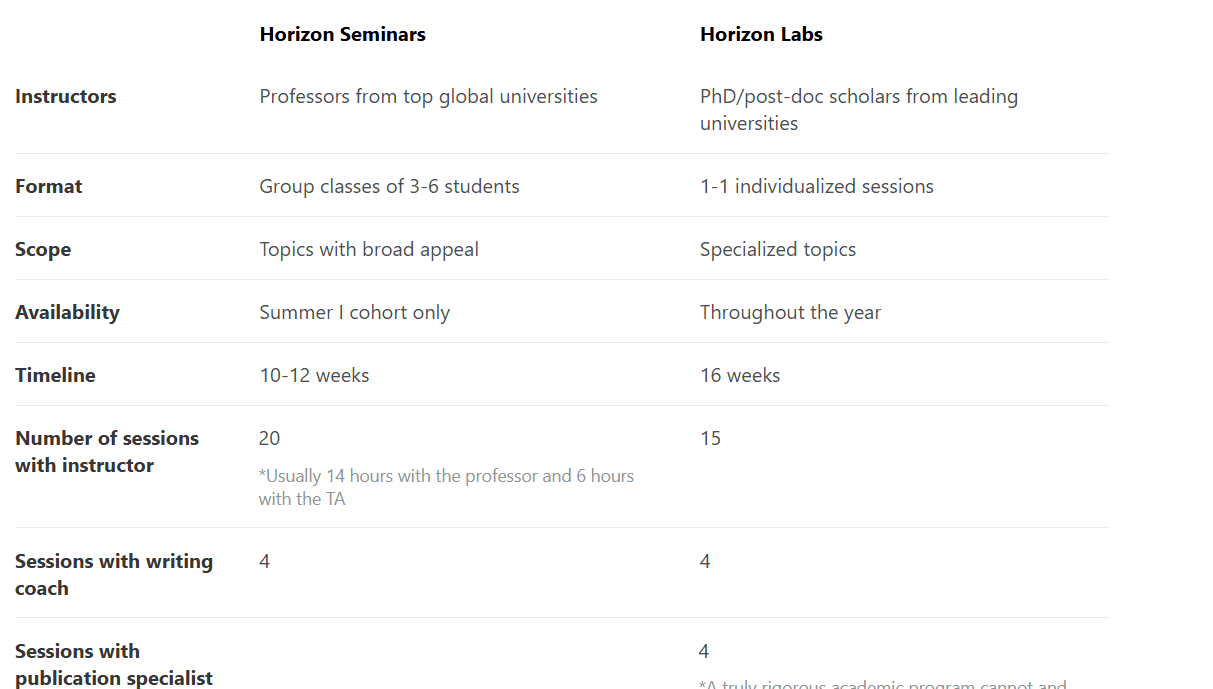
They offer Horizon Seminar and Horizon Labs. Horizon Seminar is a broader, summer program, whereas Labs is focused on helping you create a publication-worthy paper.
Since it’s online, all research projects use publicly available data, so you don’t get hands-on experience, but it’s still super valuable and very prestigious. Only 26% of applicants actually get accepted.
Eligibility for Horizon
You must be in grades 9-12, most are in grade 10 or 11
Your GPA should be 3.67 unweighted or equivalent
You need to show a strong interest or achievements in the area you want to research
You have to have taken challenging classes and have a basic understanding of the subject you’ll research
Some courses have prerequisites:
Protein Biophysics: AP Chemistry or equivalent
Advanced Theoretical Math & Knot Theory: AP Calculus A/B or equivalent (B/C is also accepted)
Fluid Dynamics: One year of Calculus and one year of high school Physics (Mechanics)
Application of Machine Learning: at least beginner-level coding experience (6 months or more) in 1 or more languages: Java, Python, R, etc.
Costs: A Horizon Labs course is $6,450. A Seminars course is also $6,450. They do offer financial assistance for both courses.
YUVIKA - India
YUVIKA (Yuva Vigyani Karyakram) is a summer science program offered by the Indian Space Research Organization (ISRO) for high school students in India. Some of my fans are interested in space research and are from India (and thus can’t attend NASA’s programs), so this is a good fit!
The program is designed to inspire and nurture young students' interest in science and space technology, and to encourage them to pursue careers in these fields.
YUVIKA is a two-week residential program held at various ISRO centers across India, with participants selected through a competitive application process.
During the program, students have the opportunity to learn from ISRO scientists and engineers and work on hands-on projects related to space technology and science.
The program includes lectures, workshops, and laboratory sessions, as well as visits to ISRO facilities and interactions with scientists and engineers.
YUVIKA covers a wide range of topics, including space science, rocketry, satellite technology, remote sensing, and astronomy, among others.
The program is a great opportunity for high school students in India with a passion for science and space technology to learn from the best and gain valuable experience and exposure in these fields.
Eligibility for YUKIVA
It is open to high school students between grades 9 and 12.
YUVIKA has specific criteria for eligibility. Admission is primarily determined by the marksheet you send (50%), participation in science fairs, and participation in olympiads.
They also have a preference for those from rural areas.
Cost: Free (ISRO covers transportation, housing, food, etc)
In 2025, registrations were open for a month between the end of February and the end of March, so keep an eye on the website for more information in 2026.
Clinical Neuroscience Immersion Experience (CNI-X) @ Stanford
The Clinical Neuroscience Immersion Experience (CNI-X) is a summer program offered by the Stanford School of Medicine's Department of Psychiatry and Behavioral Sciences.
CNI-X is designed for sophomores, juniors, and seniors who are interested in pursuing a career in clinical neuroscience research or clinical practice.
The program is an immersive experience that provides students with exposure to clinical research, patient care, and neuroscience education at Stanford.
CNI-X is a two-week program that includes both didactic coursework and hands-on clinical experience, such as shadowing clinicians and participating in patient care.
The program covers a range of topics related to clinical neuroscience, including neuropsychology, psychopharmacology, and brain imaging techniques.
With regard to eligibility, this is competitive, and a strong GPA will help during the application process.
Seattle Children’s Research Training Program
The Research Training Program (RTP) provides high school students with the opportunity to work with experienced researchers at Seattle Children's Research Institute.
You get to work at the Research Institute, learn about biochemistry, infectious diseases, and more. You also participate in workshops and do your own independent research.
The program is highly competitive, with only a limited number of positions available each year, and is designed to provide a comprehensive research experience for students.
Eligibility for RTP
You must be in grade 10-11.
You must be within driving distance (living in Seattle).
JHU Explore Engineering Innovation
The JHU Explore Engineering Innovation Program is a summer program offered by the Johns Hopkins University Whiting School of Engineering.
It’s for high school students who are interested in pursuing a career in engineering and provides them with a hands-on introduction to the field.
The program is a residential program that takes place on the Johns Hopkins University campus in Baltimore, Maryland, and includes both classroom instruction and hands-on engineering projects. There is also an online option available.
Participants in the program work in teams to design and build their own engineering projects, such as robots, prosthetic limbs, and energy-efficient buildings. Personally, I find this especially interesting, as someone that’s always loved engineering. If you do as well, this might be a good fit for you!
Eligibility for JHU Explore Engineering Innovation
A minimum GPA of 3.0, completion of high school-level math and science courses, and a strong interest in engineering. (You have to have taken Algebra II, covered trigonmetric functions, etc)
They are mainly looking for rising juniors and rising seniors.
The program includes an application process that involves a personal statement, letters of recommendation, and transcripts.
PS: They also have an online biomedical engineering program, if you’re interested in that.
MIT Women’s Technology Program
The MIT Women's Technology Program (WTP) is a four-week summer program designed for high school girls interested in STEM. The program provides participants with an immersive learning experience in which they take courses, attend workshops, and participate in hands-on projects.
WTP is offered by MIT’s School of Engineering and is highly competitive, with a rigorous application process that includes a personal statement, teacher recommendation, and transcript.
The WTP is a residential program, and participants live on the MIT campus for the duration of the program.
It offers two tracks: Electrical Engineering and Computer Science (EECS) or Mechanical Engineering (ME). Participants take two courses in their chosen track and attend workshops on topics such as engineering design, entrepreneurship, and leadership.
The program also offers hands-on projects, such as building a robot or designing a mobile app, and provides opportunities to visit local tech companies and meet with women leaders in STEM fields.
The WTP is a highly respected program that provides an excellent opportunity for high school girls interested in STEM to gain valuable experience, meet other talented young women, and develop skills that will serve them well in their future academic and professional pursuits.
Eligibility for the program includes being a girl in high school who has completed their junior year and having a strong academic record in math and science courses.
Rose-Hulman Operation Catapult
Rose-Hulman Institute of Technology's Operation Catapult is a ten-day summer program that provides high school students with hands-on experience in STEM fields and engineering. The program is residential, and participants live on the Rose-Hulman campus for the duration of the program.
The program is designed for students who have completed their junior year of high school and who have a strong academic record in math and science courses.
During the program, students work on projects in areas such as robotics, computer science, and biomedical engineering, and attend lectures and workshops on topics such as engineering design and professional development.
The program culminates in a presentation of the participants' projects, which are evaluated by a panel of judges.
They do three camps over the summer and cost $2700 as of 2025.
Young Technology Scholars
The Young Tech Scholars (YTS) program at Plaksha University is a two-week summer program designed for high school students interested in technology, engineering, and innovation. Plaksha University is in Mohali (their program is residential), and is a good fit if you’re from India and the other programs above aren’t as accessible.
The program is open to students who have completed their sophomore or junior year of high school and who have a strong academic record in math and science courses.
During the program, participants attend lectures and workshops on topics such as artificial intelligence, data science, and entrepreneurship, and engage in hands-on projects and team activities designed to develop their critical thinking and problem-solving skills.
Quick note: The interdisciplinary approach does result in the program being somewhat generalized; I do advise that you do your own research, just like any other program, before committing to one.
ARISE
The NYU Applied Research Innovations in Science and Engineering (ARISE) is a free program at NYU Tandon for high school students in NYC.
It’s a free, 10-week summer program funded by the Pinkerton Foundation. The first 4 weeks focus on safety training, college writing workshops, and research skills development. During the remaining 6 weeks, participants work in over 80 NYU research labs, assisting faculty and researchers on real-world projects.
At the end of the program, you gain a whole load of experience and a $1,000 stipend.
Eligibility for ARISE
Rising juniors and seniors in the upcoming school year
Fulltime NYC residents who go to NYC schools
Applications open on January 6th, 2026 and the deadline is February 21st.
If you’d like to do a program at NYU, they offer a lot of other courses, some of which are paid and open to international students.
Tufts Summer Research Experience
The Tufts Summer Research Experience (TSRE) for high school juniors and seniors is a six-week summer program that provides an opportunity for high school students to gain hands-on research experience in a variety of fields at Tufts University.
TSRE participants work closely with faculty mentors to design and carry out their own research projects, which may include experiments, data analysis, or literature reviews, under the guidance of experienced researchers.
In addition to conducting research, TSRE participants attend seminars and workshops on research methods and scientific communication, and have the opportunity to present their research findings to faculty and peers.
Eligibility requirements include a minimum GPA of 3.0, a strong interest in research, and completion of high school-level math and science courses.
Cost: $11,790 residential, $9,196 commuter (Yes, this is an extremely expensive program. Even if only taken virtually, it exceeds $7000. Thus, it is quite important to make an informed decision if you do choose to go here. Limited need-based aid is available.)
AIRES
AI Research & Entrepreneurship Scholars (AIRES) is a summer program where participants dive into AI foundations, theory, hear from experts, and work in interdisciplinary groups to investigate impactful problems using AI.
The program is held at Yale, MIT (commuter-only), and UC Berkeley, with two- and three-week options. It will have three tracks for students to choose from:
AI Engineering & Innovation: Explore AI and robotics
AI in Biomedicine and Health: Focus on medical innovation and global wellbeing
AI Society, and Entrepreneurship: Use AI to drive creative solutions and inspire policy change.
If you choose the three-week option, you get an extra week focused AI application on a specific topic relevant to your track. It’s ideal for students who want to leave the program with close to publishable research or a working business prototype.
In both programs, you’ll work with students on other tracks on projects based on urban resilience, global health, or culture and communications. You can choose whether your project will be research or entrepreneurship-focused.
Eligibility for AIRES
It's designed for rising grade 11 and 12 students. Exceptional rising grade 10 students will also be considered.
For rising grades 8 and 9, they offer AIRES Junior, which is an introductory 2-week summer course at Yale and UCB focused on AI and design thinking.
Cost: The program costs between $5,650 and $9,250, depending on campus and course length, plus a non-refundable $750 deposit. There are scholarships and financial aid available.
In 2026: AIRES will do a rolling admissions process. The first round of applications closes on February 28th.
Turn a Great Summer Into a Winning Project
A summer program gets you into the lab. What you do with that experience, how you shape it into research that places at science fairs and stands out on college applications, is where it counts. Our coaches are past science fair winners, and our mentors are university researchers, and that's exactly the work they help students with.
Frequently Asked Questions
Are there any free STEM summer programs for high school students?
Yes. Several of the most respected programs are completely free, and a few pay a stipend. Fully funded options include RSI (free, with housing and meals at MIT), MITES Summer, MIT PRIMES, Stanford's SIMR, Telluride's TASS, and the Jackson Laboratory program, which pays a $7,000 stipend. Free usually means no tuition; most still expect you to cover travel. See the full list in the Free STEM Summer Programs section above.
Which STEM summer programs accept international students?
Many US programs are limited to citizens and permanent residents, but a good number are open internationally, including UC Santa Cruz's SIP, Rockefeller's SSRP, PROMYS (with India and Europe programs), Canada/USA Mathcamp, Ross, and the University of Iowa's SSTP. There are also strong programs based outside the US, such as ISSET in the UK, European Space Camp in Norway, and the India-based Lodha Genius Program and YUVIKA. The International Students section above lists them all.
When are the application deadlines for 2026 summer programs?
Most deadlines fall between early December and late February of the same year as the program, so a summer 2026 program typically closes its application in Dec 2025 to Feb 2026. Some open later, and a few run rolling admissions. Because the most competitive programs close earliest, treat December and January as your real planning window rather than spring.
How competitive are the top STEM summer programs?
The most selective are extremely competitive. RSI accepts under 2.5% of applicants, Texas Tech's Clark Scholars under 3%, MIT's MITES roughly 1.5–4%, and Memorial Sloan Kettering's HOPP around 2%. Many others don't publish acceptance rates but describe themselves as highly selective. Selectivity often tracks with cost, so the free, prestigious programs tend to be the hardest to get into.
What is the acceptance rate for the Hofstra Summer Science Research Program?
Hofstra does not publish an official acceptance rate for HUSSRP. The program describes admission as competitive and notes it receives more applications than available spots, so acceptance is not guaranteed even for strong candidates. Its 2025 cohort was a record year with more than 200 students selected. Selection is based on academic record, a teacher recommendation, an interview, and mentor availability.
Do STEM summer programs help with college admissions?
They can, but attendance alone is rarely the deciding factor. Admissions officers respond most to what you produced: original research, a paper, a competition result, or a project that shows genuine initiative. A program that places you in a lab is the starting point; turning that experience into a competitive research outcome is what actually moves an application. That distinction is where our winner coaches and university research mentors focus. Explore our coaching.