

If you're at an Australian school and want to compete at the Regeneron International Science and Engineering Fair, you'll go through the Australian Science and Engineering Fair (AUSSEF). It's the ISEF-affiliated national fair for Australia. Nine projects a year win an all-expenses-paid trip to ISEF, and for AUSSEF 2026 that means Los Angeles, 8 to 14 May 2027.
I'm a New Zealander, which needs explaining. In 2024/25, AUSSEF briefly opened to Kiwi students while New Zealand had no national fair of its own, and I was one of the test dummies. I did the online entry in the middle of NCEA exams, then the staged judging, the video interview, and the trip. New Zealand has its own route now, so AUSSEF is back to Australian schools only. But I've seen the whole thing from the inside, and there are a few bits I'd do differently.
What AUSSEF Is, and Isn't
It's a national fair for Years 9 to 12 who've done a substantial project in science, technology, engineering or maths. Three things make it different from the fairs you've probably done.
It's online from start to finish. You upload documents, and national panels mark them. Then the shortlisted projects get a video interview. You never have a booth, you don't do a poster session, and you only talk to a judge in person until the very last stage.
It's for projects that have already done well. AUSSEF expects prize-winners from state or national STEM competitions (for instance, the STANSW Young Scientist Awards or the Oliphant Science Awards), or projects a school judges to be of that standard. A school can also enter a project directly if it's strong enough to represent Australia.
And it uses ISEF's categories and follows ISEF's rules. We'll dive into this later.
Normally, the Australian team does well over at ISEF. In 2023, the first time Australia went to ISEF, the team won three Grand Awards, including a first in Robotics. A record five in 2024. Two first places in 2025, the year the New Zealanders travelled with them.
Then in 2026, they won three Grand Awards and two Special Awards in 2026. Grand Awards only go to roughly the top quarter of each category, so for nine projects a year that's a strong run. AUSSEF also goes out of its way to encourage entries from regional and remote Australia and from First Nations students.
Who Can Enter AUSSEF
There are four key rules to participate in AUSSEF:
You need to be in Year 9 to 12, and not 20 on or before 1 May 2027.
You must go to an Australian school, or an Australian passport at an international school.
Your passport must be in the US Visa Waiver Program, which Australian and New Zealand passports both are; if yours isn't, you'll need evidence of a US visa interview before March 2027 or Australian citizenship before April 2027.
Your experimentation must have started on or after 1 January 2026, with no more than 12 months of continuous research.
Project Rules at AUSSEF
You can do a project in teams of up to three, from different states if you like, and membership can't change mid-year except in extenuating circumstances.
Continuation projects are allowed, but you must document the pre-2026 work separately, and only the 2026 work is judged. Background reading and feasibility trials before 1 January are fine, but experimentation and construction are not.
Vertebrate animal projects have to meet Animals in Schools requirements before the research starts, and releasing non-native or genetically altered species, pathogens, or toxic chemicals into the environment is out. AUSSEF doesn't accept demonstrations, library research, explanation models, or kit builds.
Your submitted files must be anonymous.
If you're a Kiwi at an Australian school: you're eligible. Kiwis at New Zealand schools are no longer eligible. Instead, you must use the NZ route.
How Selection Works
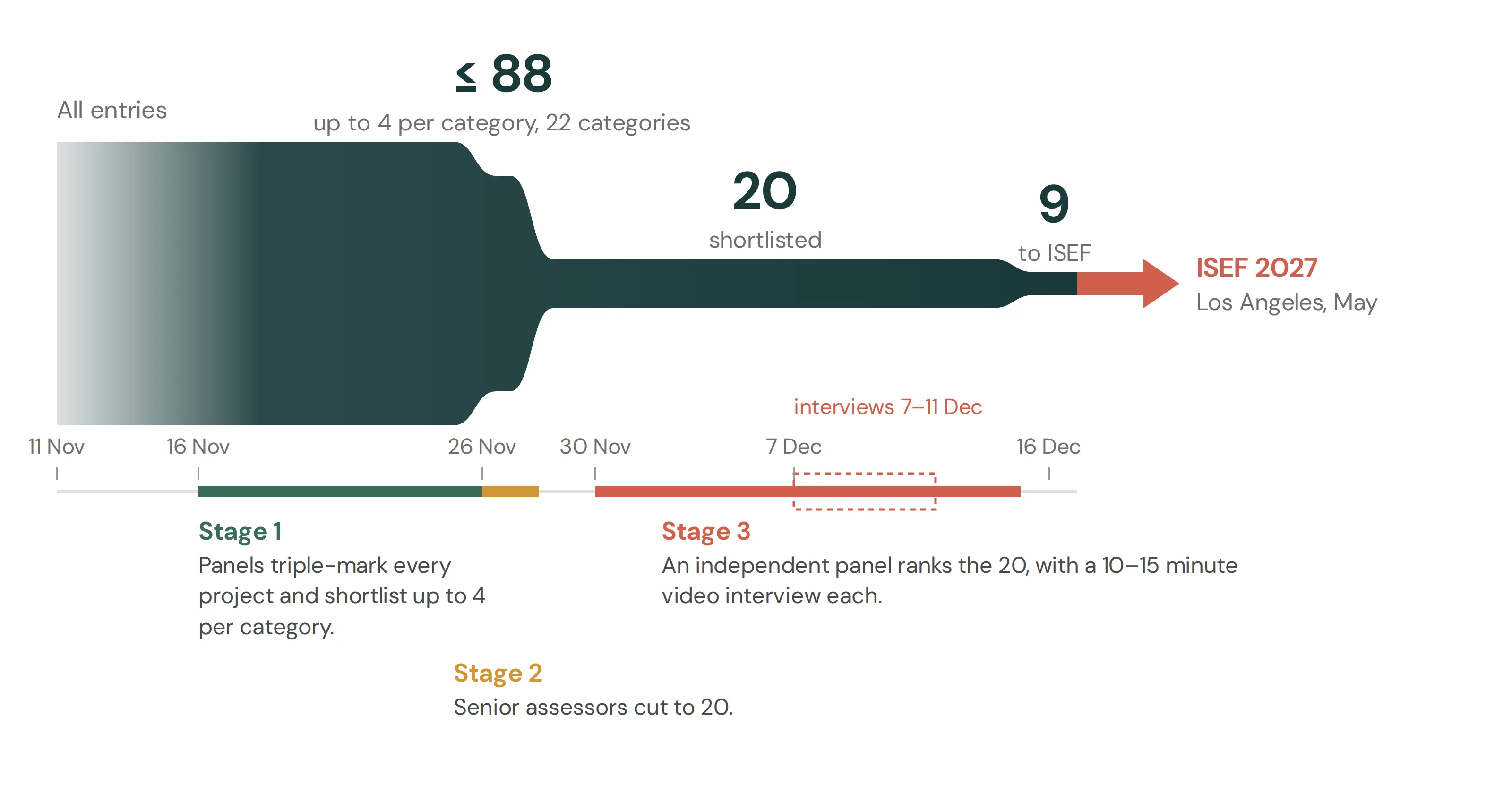
Entries close at 11:59:59 pm on Wednesday 11 November 2026, in your state or territory's time zone. After that, it moves fast: there are three cuts in five weeks.
Stage 1, 16 to 25 November: There are national panels, one per ISEF category, triple-mark every project and shortlist up to four per category.
Stage 2, 26 and 27 November: Senior assessors cut the shortlist to 20.
Stage 3, 30 November to 14 December: An independent ISEF Selection Panel ranks the top 20, and every shortlisted student or team gets a 10- to 15-minute video interview on the evenings of 7 to 11 December between 5 and 8:30 pm. On 16 December, the final top nine, their teachers and their adult sponsors get an email.
Two things that you need to plan around. Firstly, the interview window lands right in the end-of-year exam period for a lot of Year 11s and 12s, so block those evenings now. Second, late entries aren't judged unless an appeal to AUSSEF's Scientific Review Committee succeeds, so don't upload at 11:58.
How AUSSEF Works
Since AUSSEF is completely online, your PDFs are your booth. Until Stage 3, the PDFs you upload do all the explaining a poster and a conversation normally would.
Scientific or maths investigation | Engineering, technology or ICT | |
|---|---|---|
Required | Research report, plus a separate logbook or journal | Design portfolio or journal showing each stage of the design |
Recommended | Photos or short video links in the logbook showing how the project developed | A video or photos of the thing working; for software, run and platform instructions |
Optional | Supporting files, such as spreadsheets of raw data |
AUSSEF doesn't accept Google Drive and Docs links, so make sure everything is correctly formatted as a PDF. An Adult Sponsor (a teacher, parent, mentor, or qualified scientist) signs a declaration that the work is yours, and any help you had goes in your Acknowledgements.
The rule that catches people is that your project must be anonymous. Every trace of who you are has to come out of the documents, including the file names.
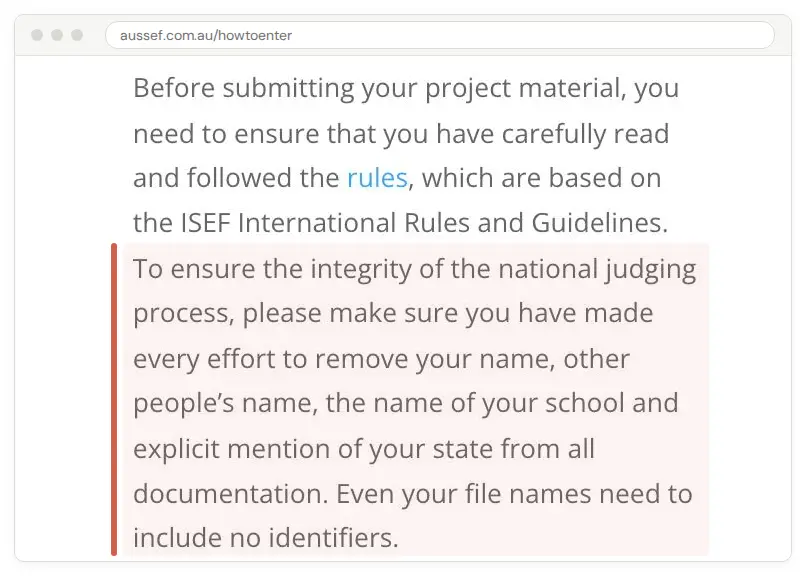
Before you upload, check your photos for school uniforms and logos, clear the author field in the PDF properties, and search the report for your suburb.
Before Entries to AUSSEF Close
Check all four eligibility boxes: year level, school, passport, research start date.
Pick your category by your main finding, and email AUSSEF if you're torn.
Prepare your report and logbook, or your design portfolio, as anonymised PDFs.
Score yourself against the rubric for your project type.
Line up your Adult Sponsor to sign the declaration.
Keep the evenings of 7 to 11 December free.
Upload early, keep your name out of everything, and write for the judge reading your PDF at the end of a long day.
How AUSSEF Scores Your Project
AUSSEF's judging criteria are adapted from ISEF's Grand Award criteria, with separate rubrics for scientific investigations, engineering and technology, and maths. Every stage uses the same rubric. Each criterion scores 1 to 5, the criteria are weighted, and the total is out of 100. AUSSEF is unusually frank about what the numbers mean.
Make sure that you spend time scoring your project honestly against the right criteria for your category. Then treat them as a job to do so you improve.

Five Things That I'd Do Differently
Write for a judge with twenty PDFs open and a cold cup of tea. Make sure that your summary and question are on page one. Include your results before discussion. Check that every single figure is labelled. Make it obvious which parts were yours and which were a mentor's.
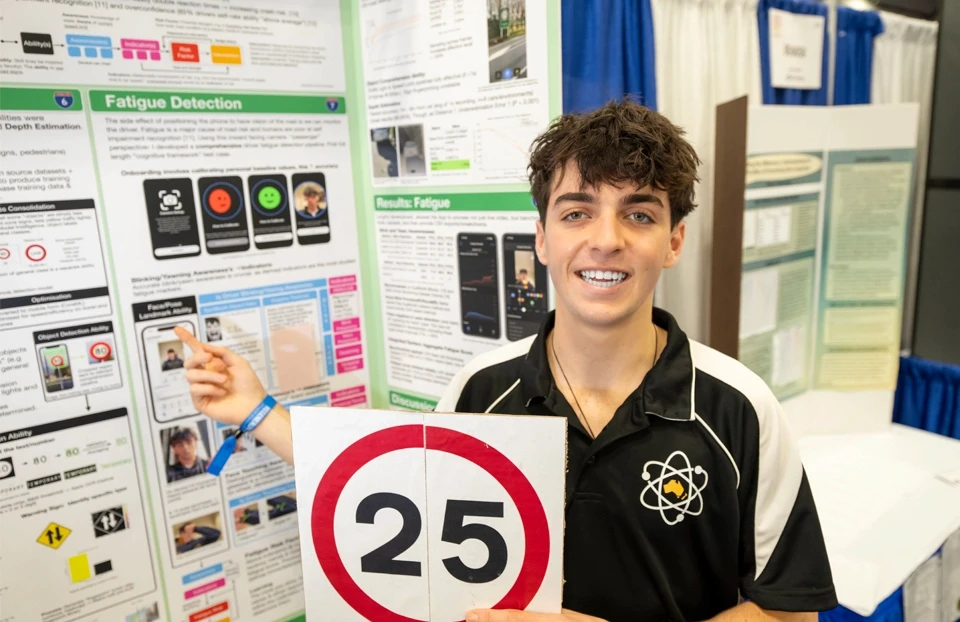
Pick your category by your main finding, not your tools. My project was an app, so my first instinct was Engineering and Technology. But what I'd actually found was about driver behaviour. It competed in Behavioral and Social Sciences at ISEF and won there. Stage 1 judges can move a misfiled project, but you're better off emailing info@aussef.com.au before the deadline.
Build the logbook as you go. Include dated entries, photos of the setup, dead ends, and what you changed. A logbook written the week before the deadline reads like one.
Treat the interview like ISEF. Have a thirty-second version for your pitch ready. Make sure that you're clear about what you did, where the results stop, and what you'd test next.
Sort ISEF's paperwork from day one. AUSSEF's rules follow ISEF's, and its Selection Panel checks that recommended projects meet them. People, vertebrate animals, microbes, and tissue all require approval before you start, not before you upload. The ISEF Rules Wizard tells you what applies in ten minutes.
If You Make the AUSSEF Team
AUSSEF travels as a team and arrives early to adjust. In 2026 that meant visiting the Grand Canyon before registration. Then the fair itself: set-up and the pin exchange, the opening ceremony with its country shout-outs, press and panel sessions, judging day, the public day with the Special Awards, and the Grand Awards ceremony.
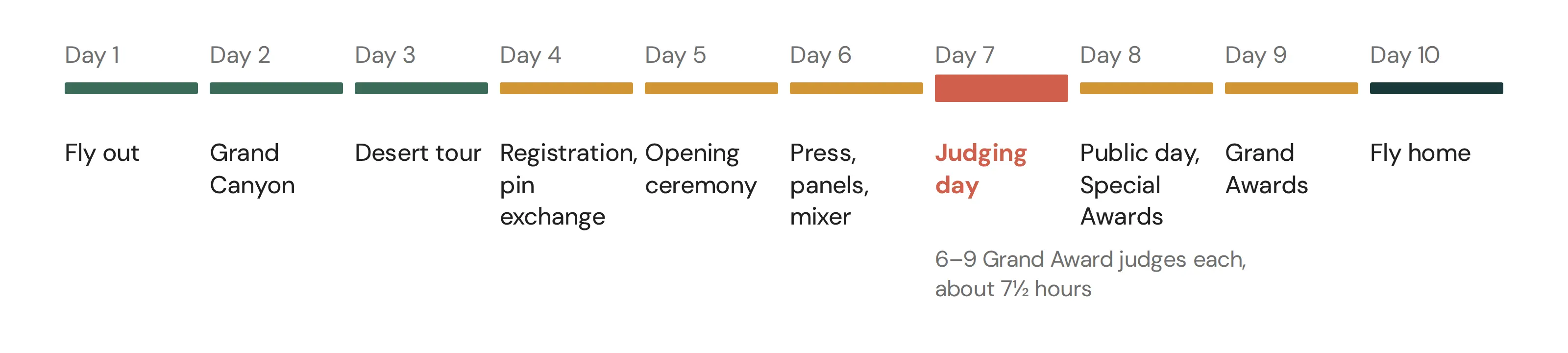
Bear in mind that judging day is long. In 2025, most AUSSEF finalists had eight or nine scheduled Grand Award judges, one had fourteen, and Special Award judges wander through in between. But it's one day of ten. What people remember is the hall: fourteen hundred projects, students from sixty-odd countries, and a lot of conversations that start with "so what's yours about?"
ScienceFair Helps You Go From Australia to ISEF
Every coach on our team is a past science fair winner, and alongside our Ivy League research mentors, they'll help you refine your idea, strengthen your research, and prepare for judging so that you have the right preparation and strategy in place to win at every level of science fair.
Ready to make your run at AUSSEF? Schedule a call with our academic advisor.
FAQ
Is there an entry fee? None listed on AUSSEF's entry pages as of September 2026. Email info@aussef.com.au if you're unsure. The top nine's trip is paid for by AUSSEF's sponsors and donors.
Can Year 9s enter? Yes, and it's a good rehearsal even if you don't make the shortlist.
I'm a Kiwi at an Australian school. You're in. What matters is where you go to school.
I'm at a school in New Zealand. Not anymore. Use the NZ route.
Can I enter AUSSEF and another affiliated fair? No. ISEF allows one affiliated fair a year.
