
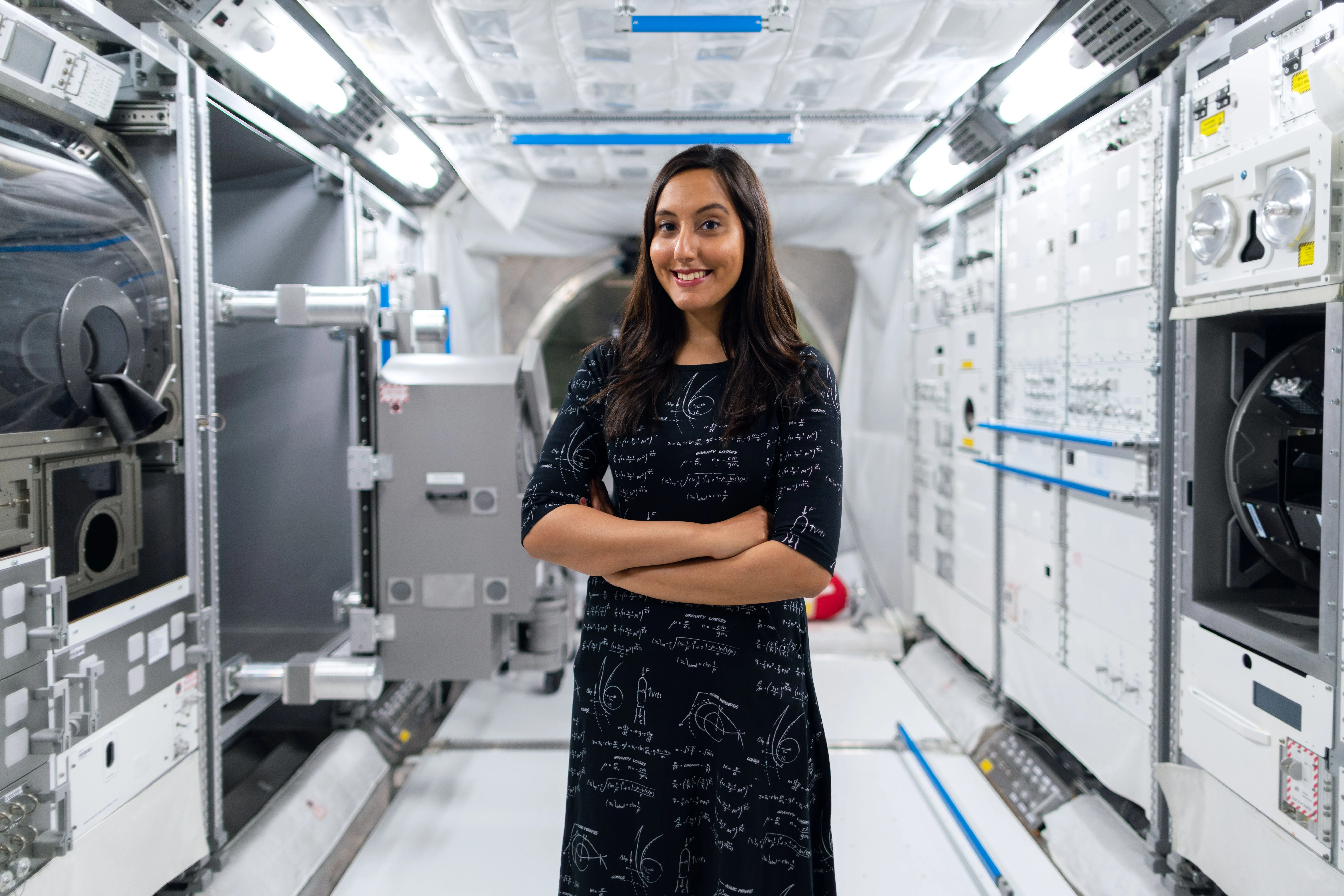
The question I hear most from students is some version of this: don't you need a university lab to do real aerospace research? Well, not necessarily.
I spent four years in high school researching life support systems for Martian habitats, and half of that project happened during COVID, when I didn't have access to a lab, a classroom, or even a spare space at school. I built my lab in my garage. That project went on to win two Grand Awards at Regeneron ISEF, and the skills it taught me still show up in my day job as an aerospace engineer.
I've written before about how I found my research idea. This post is about the other side of the equation: how to do aerospace research with the resources a high school student realistically has.
That comes down to four things: Planning around your constraints, building a setup that fits them, finding people who can guide you, and presenting the work in a way that competes at the highest levels.
Start With Your Boundary Conditions
The term “Boundary Conditions” is a phrase you'll hear constantly in engineering, and it's the single most useful planning concept for a student researcher or engineer. It just means this: what can you control, and what can't you?
When I lost access to any formal workspace, I had to answer that question honestly. My research required a method of controlling the environment, or boundary conditions, like temperature and light levels. I needed to know which of those conditions I could realistically maintain in a garage and what assumptions I would have to make instead.
That sounds like a limitation. In practice, it was the opposite. Being forced to define exactly what I could and couldn't control made me understand my experiment far more deeply than I would have in a fully equipped lab where the environment is handled for you. I had to justify every assumption, and each justification strengthened the research.
So before you order a single component, sit down and answer four questions:
What Conditions Do You Need to Control?
For aerospace projects, this is often environmental: pressure, temperature, flow rate, or vibration. Define these clearly (quantitatively, if possible) and decide which ones you can realistically maintain.
For those you cannot realistically maintain, express clearly in your conclusions how these limitations could have affected your results and how you could control them better with additional equipment, time, etc.
What Variables Are You Measuring?
The data you want to collect determines almost everything else about your setup. Decide this early and let it drive your equipment decisions rather than the other way around. This will also drive your “Bill of Materials”, also known as BOM, which is a list of all of the equipment and materials you use.
What Are The Logistics?
What's your budget? What do you already have access to? Components left over from a previous project, equipment you can borrow, materials your school can lend you. Include these in your BOM, and treat sourcing as part of the research plan, not an afterthought, because it isn’t always straightforward. Sometimes, with specialized equipment or materials, they can take a while to arrive.
How Much Time Do You Really Have?
You have classes, other extracurriculars, responsibilities, and eventually college applications. Be honest about your bandwidth and frame the research so it fits. A well-scoped project you can finish beats an ambitious one you can't.
Defining boundary conditions, sourcing materials, and getting a setup running is slow the first time. If you continue your project into a second or third year, all of that carries over, and the research gets easier and deeper at the same time.
Build a Realistic Lab
A makeshift lab is not a lesser version of a university lab.
There are real things to work through. If your project involves anything hazardous, you need a real plan to handle it safely, and science fairs take safety documentation seriously anyway. You need to think about where sensitive equipment lives, how you'll keep your controlled environment stable, and what happens when you share your lab space with others.
But every one of those problems is solvable, and solving them is legitimate engineering work. Some students do have access to impressive resources, and that's great. At the competition level, what matters isn't what you had access to, but what you did with it. Judges can tell the difference between a student who used a professional lab and a student who understood their experiment down to the details because they had to build their apparatus themselves.
Find Guidance Without Connections
The second myth that stops students: I don't know anyone in aerospace, so I can't get help.
I had no connection to any university or professional resource when I started. All I did was cold email. I reached out to university student clubs in my area, professionals, and academics, and asked people for feedback or for referrals to someone else who might help.
I also leaned on my own teachers, who have large networks of their own that students rarely think to ask about. Networking platforms like LinkedIn or Handshake are genuinely useful here too, especially for asking industry professionals a specific question or getting feedback on where to start. We all started somewhere!
I also got involved in a student-led rocketry club at my high school, which gave me a lot of initial engineering experience and helped me to meet people in the industry.
Mentoring in Aerospace
Two things make this easier in aerospace specifically.
First, you don't necessarily need an aerospace specialist to mentor you. Aerospace engineering is built on fluid mechanics, thermodynamics, materials, and software, and anyone working in those areas (mechanical engineering, electrical engineering, materials engineering, etc.) has enormous crossover value for your project. Aerospace is just a specific engineering niche, and in an actual aerospace engineering degree, you have similar curricula to mechanical, materials, and software engineering. Cast a wide net. If you only hear back from your high school science teacher, work with them! They will likely have research experience that will help you.
Second, your mentor doesn't have to be a professor. Aerospace spans academia and industry, and engineers do research constantly as part of their work. They test, document, write procedures, and report results as part of the job, even if nothing gets published. Engineers, scientists, and even people in roles like supply chain or project management can give you perspectives on your work that a purely academic reviewer won't.
And one resource almost every student overlooks: your judges. Judging conversations at fairs are nerve-racking, but the people on the other side of the table are often industry professionals or professors in exactly your area. Talk to them afterward. If you plan to continue your project into next year, they are one of the best sources of specific, expert feedback you will get.
Most importantly, be patient with all of this, and start early. People are busy, and outreach is a numbers game. But many of the people you contact have been exactly where you are, and more of them are willing to help than you'd expect.
Make the Research Competitive
Doing aerospace research and winning with it at science fairs are related but separate skills. At the ISEF level, a winning project has two sides.
Technical Depth
You need to understand your background research thoroughly, know your data, and defend every assumption, especially the ones your boundary conditions forced you to make. This usually comes easiest to students, as they love science and spend so many hours deep in their projects. These scientific fundamentals will benefit you greatly as an engineer or researcher in the future!
Communication
The second side is the one students underestimate: you have to present the impact of your work so clearly that the judges can follow your vision exactly. Hand it to the judges on a silver platter. What problem does this research serve? How could it be used? What are the next steps if someone carried it forward? How could it be scaled to serve real-world use-cases?
That combination, credible technical work plus a clear story about why it matters, is what made my project competitive, and it's the thing I work on most with the students I coach. If you want to sharpen that side of your project, practicing with mock judging is one of the highest-leverage things you can do before a fair.
The Biggest Mistake Is Not Starting
Aerospace has a lot of hype around it, and a lot of intimidation. The concepts are genuinely hard. You cannot learn fluid mechanics overnight, and nobody expects you to.
But that's exactly the argument for starting now. These skills compound, and things I learned in ninth grade showed up in my college classes, in my internships, and in my work as an engineer today. You may never feel ready to start, but that doesn’t mean that you can’t win science fairs with your research. The best time to start is now.
Get Aerospace Research Support With ScienceFair
When I was doing this in high school, I would have loved for someone who had been through ISEF to look at my work and tell me what the judges would actually care about. That's the resource I try to be for my students now.
If you'd like support with your aerospace research or your science fair strategy, the first step is to schedule a free consultation call with a ScienceFair academic advisor. I hope to work with you soon!
