
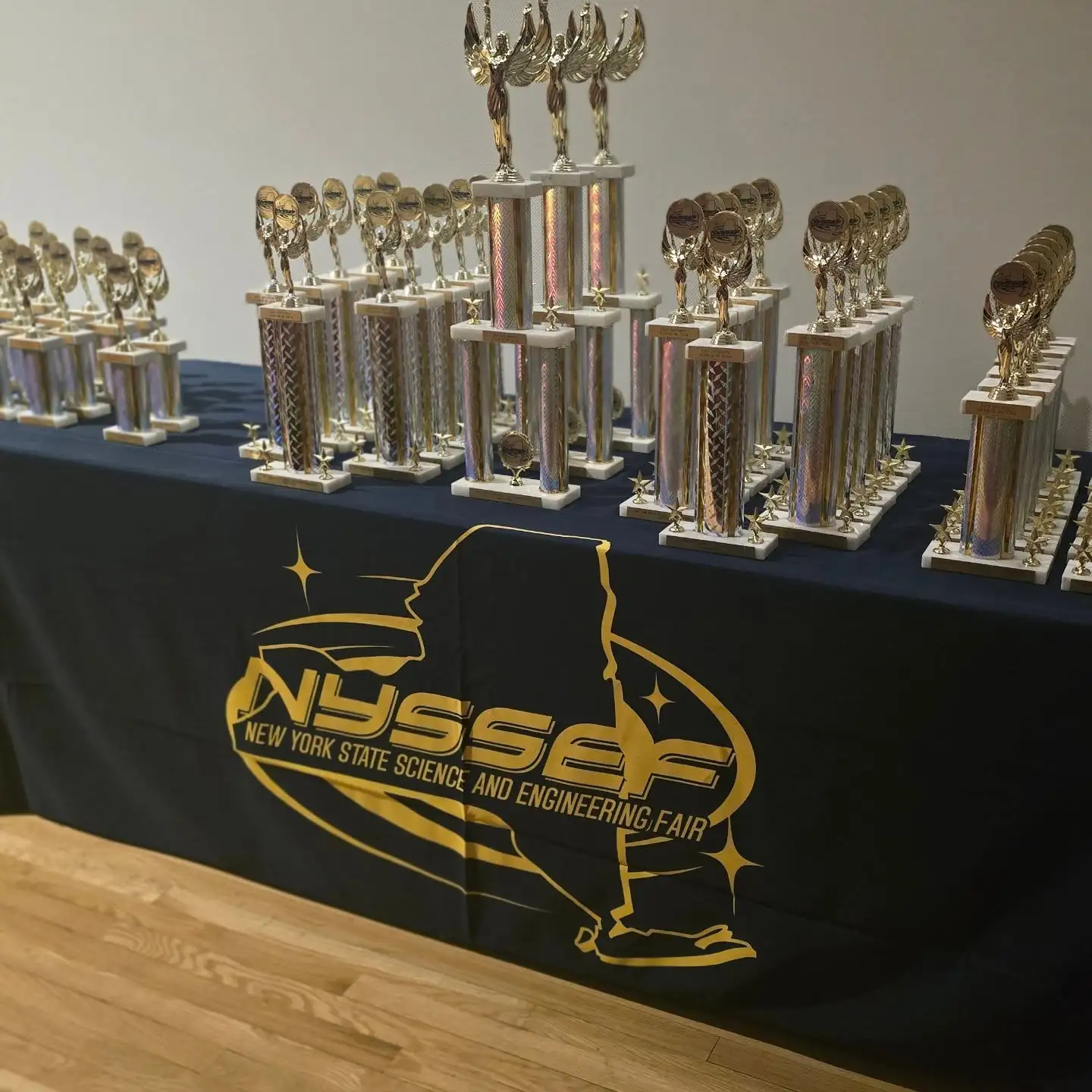
The New York Science Fair is one of the most competitive STEM events in the state, giving students a platform to showcase their scientific knowledge, innovation, and problem-solving. Winning can open doors to scholarships, internships, and national and international contests like the Regeneron International Science and Engineering Fair (ISEF). But with stiff competition and high expectations from judges, a winning project takes more than a good idea. It demands careful planning, thorough research, strong execution, and a compelling presentation.
New York's science fairs run as a network of regional fairs that feed into the state-level New York State Science and Engineering Fair (NYSSEF), the ISEF-affiliated fair. Students first compete at their regional fair based on their county, and top projects advance toward the state fair and, ultimately, the chance to represent New York at ISEF. This guide walks you through each step.
New York's Regional Science Fairs
Find your regional fair by county, then aim to advance toward the state NYSSEF. Dates below are for the 2026 cycle, always confirm the current schedule and deadlines on each fair's official site, as they shift annually.
Regional fair | Location | 2026 competition dates | Entry deadline | Territory |
|---|---|---|---|---|
Long Island | Jan 28 – Mar 12 | Dec 2, 2025 | Nassau and Suffolk counties | |
New York City | Dec 15 – Mar 29 | Dec 15, 2025 | All five boroughs (Bronx, Brooklyn, Manhattan, Queens, Staten Island) | |
Somers | Mar 13 – 14 | Dec 15, 2025 | Westchester, Putnam, Sullivan counties | |
Poughkeepsie | Apr 11 | Mar 21, 2026 | Dutchess County | |
Troy | Mar 28 | Jan 23, 2026 | Albany, Saratoga, Rensselaer, Orange, Ulster + surrounding counties | |
Syracuse | Mar 29 | Mar 20, 2026 | Onondaga, Broome, Tompkins, Oswego + surrounding counties | |
Utica | Mar 21 | Mar 9, 2026 | Oneida, Herkimer, Lewis, Otsego counties | |
Rochester | Mar 21 | Mar 1, 2026 | Monroe, Ontario, Wayne, Livingston + Finger Lakes counties | |
Buffalo | Mar 7 | Feb 28, 2026 | Erie, Niagara, Chautauqua, Cattaraugus + Western NY counties | |
Paul Smith's | Mar 28 | Feb 27, 2026 | Clinton, Essex, Franklin, St. Lawrence counties (incl. Akwesasne) | |
Corona | Feb 3 – Mar 30 | Jan 30, 2026 | Statewide |
Choose the Right Topic
The journey begins with a topic that both interests you and captivates the judges. Here's how to choose one that stands out.
Focus on Interdisciplinary Projects
One way to make your project shine is to combine multiple fields rather than staying in one. If you're passionate about urban development and biology, for instance, you might study the effect of green rooftops on air quality in New York City, analyzing how green infrastructure reduces urban heat islands using both environmental science and data analytics.
A project like that shows you can connect different fields to tackle complex, real-world problems. If you need help landing on an idea, our guide to coming up with a winning science fair idea walks through how to find one worth pursuing.
Leverage New York's resources
New York is a hub of scientific innovation, with universities, research centers, and organizations that can strengthen your project. Reach out for access to specialized equipment, mentorship, or unique datasets.
A project on pollution in local waterways, for example, might draw on Columbia University's Earth Institute or the Hudson River Foundation. Partnerships like these lend real credibility and can surface insights that set your work apart.
Tackle New York-specific issues
Judges are drawn to projects that address local concerns, since they show awareness of and commitment to solving real problems. Consider issues especially relevant to New York, like public transportation efficiency, waste management, or climate change's impact on city infrastructure. You might investigate how effective the city's bike-sharing programs are at reducing carbon emissions, work that highlights your interest in your community and aligns with New York's sustainability efforts.
Conduct Thorough Research
Once you've chosen your topic, dive into the research that forms the foundation of any successful entry.
Develop a clear research question
These are the core of your project, so aim for something specific, original, and relevant rather than broad. Instead of "how does pollution affect air quality?", narrow it to something like: "How do different types of urban green spaces in Manhattan impact local air quality?" A well-defined question guides your work and makes its significance clear to judges.
Go beyond the basics
To truly impress, go beyond the basics. Depending on your project, that might mean GIS for spatial analysis, machine learning for predictive modeling, or spectrometry for chemical analysis.
A project tracking pollution across New York, for instance, could use GIS to map the data and reveal pollution hotspots visually. Techniques like these add depth and demonstrate real proficiency with sophisticated tools.
Execute Your Project
With your plan in place, execution is where experiments happen, data gets collected, and results take shape.
Run multiple tests
Your project's success hinges on accurate collection and analysis. Make your data reliable by running multiple trials and maintaining strict controls, and document your process thoroughly, since judges look for evidence that your experiment was methodical and your conclusions backed by solid data.
Once collected, analyze it with appropriate statistical methods and use graphs, charts, and infographics to make your findings clear, the clarity of your presentation can matter as much as the data itself.
Have an iterative process
Stay ready to adjust based on your results. If your initial data doesn't support your hypothesis, revisit your methodology or explore a new angle. This iterative process improves your project and demonstrates the critical thinking and adaptability judges value highly.
Create a Compelling Presentation
Your presentation is where all your work comes together and your chance to make a lasting impression.
Have a clear poster
Your board should be both visually appealing and informative, with high-quality images, a clear layout, and concise text. Interactive elements like live demonstrations, models, or digital presentations engage judges and make your project more memorable. If your work involves a new technology or engineering solution, a working prototype or 3D model is far more effective than diagrams alone.
For a full walkthrough, our guide to building a standout science fair poster covers how to design a board that stands out.
Build a narrative
A successful project is more than data, it's a story. Tie your research question, methodology, results, and conclusions into a compelling arc: introduce the problem you set out to solve, explain how your research addresses it, and close with the broader implications. A strong narrative makes your project engaging and helps judges grasp why it matters.
Prepare for the judges' Q&A
The question-and-answer session is your chance to show your knowledge and passion. Anticipate likely questions and rehearse your answers, ready to discuss your methods, the challenges you faced, and the implications of your findings. Being well-prepared lets you navigate the Q&A confidently and reinforce your project's strengths.
Learn From Past Winners
One of the best ways to understand what a winning project looks like is to study projects that have actually taken home top awards.
Our roundup of winning science fair projects and real ISEF examples breaks down several award-winning projects across different fields, what made each stand out, and how to approach something similar yourself.
Beyond New York: Other Fairs and Competitions
Doing well at a New York science fair can be a springboard to bigger stages. Our roundup of the top science competitions for high school students maps out the national and international options a strong project can lead to. And if you're curious how other states run their fairs, our guides to winning the Virginia, Oregon (Northwest Science Expo), and Southern Arizona (SARSEF) fairs are all worth a read.
Stand Out at the New York Fair with ScienceFair
Winning a New York science fair takes meticulous preparation, flawless execution, and a compelling presentation, and that's exactly what ScienceFair helps you build.
Our mentors have competed in and won the top STEM competitions, including ISEF, JSHS, and the Thermo Fisher JIC, and they offer personalized, one-on-one guidance whether you need help choosing a topic, refining your research plan, or preparing for the Q&A. That expert feedback is often the difference between a good project and a winning one.
Ready to make your run at the New York Science Fair? Schedule a call with our academic advisor.
