
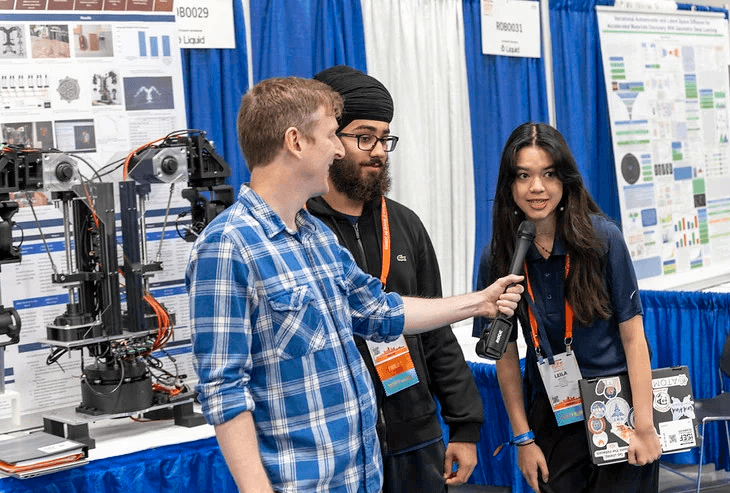
You’d think that science fairs wouldn’t place so much emphasis on public speaking. I mean, you did all the research. You wrote a paper and made a poster. And on top of all of that, you have to learn to pitch your research.
But fear not, my brilliant science fair students: honing your public speaking skills is a learned talent. It is something you can practice and get better at if you are not naturally inclined to it.
My name’s Eli Hanechak, I’m currently a Biochemistry and Biological Physics double major at Brandeis University and a Davidson Fellow Laureate. I also won 2nd Place in Microbiology at ISEF.
Presenting your project pitch and speaking confidently is what tells a judge that you believe in your work and you are enthusiastic about how it could change the world. Getting these professionals to believe in the work as much as you do is the ticket to science fair success.
Start with a solid pitch
A good presentation starts with a firm foundation, in this case, a rock-solid pitch. So let’s start drafting.
Aim for 3-5 minutes of concise information. Your pitch should first frame the problem, then highlight all the ways you are solving the problem with your project. Start by explaining the context of your project and why it’s needed in the world, then spend a lot of time discussing your particular methods and why they are a unique innovation.
Don’t spend time on excessive details. Instead, give a summary of the most important information and leave room for judges to ask questions later on. End the pitch by discussing any future projects you’d like to pursue or describing how you see the work being implemented in the world.
Practice your science fair presentation
Now that your pitch is written, it’s time to PRACTICE.
As I said, public speaking is a skill, and it is one that you need to acquire well in order to do well in the science fair. The only way to do that is to practice a lot.
Rehearse your pitch in front of friends, family, or teachers. Ask for advice on what you can do better, and have them ask you questions about your work to get an idea of where you may need to add more information.
Record yourself saying your pitch, with all the right intonations and inflections, and listen to the recording often to get the timing right.
Practice in front of your poster so you can rehearse your hand gestures to certain figures or graphs. Most importantly, practice speaking SLOWLY.
On the day of the science fair, you will likely be nervous, and that usually translates to speaking much faster than normal. If you’ve practiced slowly, though, you will be more able to relax and fall back into a measured talking speed, which is ideal for science fairs.
What to do on the day of your presentation at science fair
Once the day arrives, easing your nerves is paramount. Put on some nice business attire and get ready, because the adage “Look good, feel good” is just as applicable to the science fair.
Don’t try to cram any more practice sessions with your pitch; by that point, you should know your stuff and let your brain relax before the big day.
And most of all, don’t let the judges intimidate you. These people may have more professional experience than you, but at the end of the day, they are just people who have volunteered because they want to get to know the next generation of scientists. No one knows your work better than you, and you should always take confidence in that and let it drive you during your presentations.
Plus, this blog will help you to prepare for all the judges’ questions.
So, as we head into the season of science fair competitions, I encourage all of you to take a deep breath and try to relax your nerves. If you practice enough and have put in a significant effort into your project, the research will speak for itself. Be confident in your abilities to discuss your work at a high level.
And most of all, enjoy your moment in the spotlight; you’ve worked so hard, and now it is your time to shine and let the world know all about your project. You got this!
Science fair support with ScienceFair
Get expert support from past ISEF winners and competitors, like myself, at every stage of your science fair project.
Our comprehensive coaching helps to unlock your potential. We work with you at every stage, brainstorming innovative ideas, building your poster, and presenting your final work with confidence.
Schedule a consultation call to connect with one of our team members and create a personalized plan tailored to your needs.
