
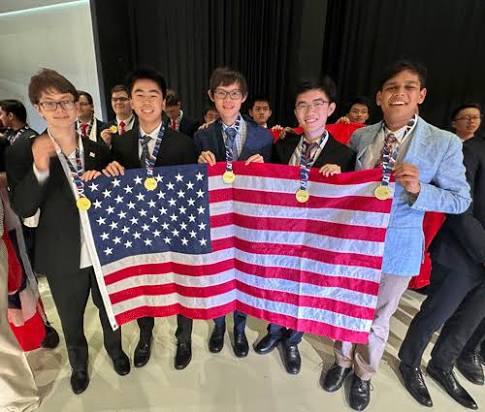
The USA Physics Olympiad (USAPhO) is the highest-level physics competition an American high school student can reach before the international stage. Roughly 6,000 students sit the qualifying exam each year, only around 400 earn an invitation to the USAPhO itself, and the exam then decides who joins the US Physics Team and, ultimately, who represents the United States at the International Physics Olympiad.
Two things make the USAPhO stand out: the sheer difficulty of the exam, and what a strong result signals. A USAPhO medal tells top universities you can thrive in the most academically demanding environments in the world. This guide covers who is eligible, how the exam works, what to study, and how to prepare for it strategically.
How to Qualify: The F=ma Exam
You cannot register for the USAPhO directly. The only path in is a qualifying score on the F=ma exam, a 75-minute, 25-question multiple-choice mechanics exam administered each winter through schools registered with the American Association of Physics Teachers (AAPT). Approximately 400 students are invited to the USAPhO based on their F=ma scores, with the cutoff set after each administration; in the 2026 cycle the qualifying score was reported as 16 out of 25, with around 440 of roughly 6,700 test takers making it. Two versions, F=ma A and F=ma B, are offered, and students who take both must meet the cutoff on both to advance.
We cover the qualifying exam in full, including format, registration, and preparation strategy, in our guide to the F=ma exam, so this post focuses on what comes after you qualify.
Eligibility
The eligibility rules tighten as you advance, and this catches students by surprise. The F=ma exam is open to US citizens, permanent residents, and any student currently attending a US school, but the USAPhO exam itself is restricted to US citizens and green card holders, and you must be physically located in the United States to sit either exam.
An invitation to the US Physics Team training camp additionally requires eligibility for the International Physics Olympiad, meaning citizenship or a green card and an age under 20 by June 30 of the competition year. Students in grades 9 through 12 can compete, home-schooled students are eligible, and both exams must be proctored, with parents and relatives excluded as proctors.
If you are an international student on a visa attending a US school, you can take the F=ma exam, but you cannot advance to the USAPhO. Knowing that before you invest a year of preparation matters.
The USAPhO Exam Format
The USAPhO is a three-hour free-response exam divided into two 90-minute parts, typically administered at your school in the spring. Unlike the multiple-choice F=ma, every problem demands written solutions with your reasoning shown logically, though the standard is physical argument rather than the formal proof rigor of math olympiads. A simple scientific calculator with cleared memory is permitted, but the problems are engineered so that insight, not computation, is the bottleneck.
Recognition follows the international model. Nominally, the top 10 to 12 percent of USAPhO scorers earn gold medals, the next 14 to 16 percent silver, the next 19 to 21 percent bronze, and the next 24 to 26 percent honorable mentions. From the medalist pool, approximately 20 students are invited to the US Physics Team's ten-day training camp at the University of Maryland, and five are selected there to represent the United States at the International Physics Olympiad.
What to Study
The F=ma exam tests mechanics: kinematics, Newton's laws, work and energy, momentum, rotational motion, gravitation, simple harmonic motion, statics, and fluids. The USAPhO assumes all of that and expands across the full physics syllabus, and it assumes fluency with calculus throughout.
The new territory falls into four blocks. Electromagnetism is the largest, spanning electrostatics, circuits, and magnetism, and it is where most first-time qualifiers lose the most points. Thermodynamics covers the laws of thermodynamics and kinetic theory of gases. Optics includes both geometrical and wave optics. Modern physics rounds out the syllabus with quantum mechanics, atomic and nuclear physics, and special relativity.
A calculus-based introductory textbook covers most of the required concepts, and AAPT's own advice to students is exactly what experienced competitors recommend: work through past USAPhO exams, which are published with solutions on the AAPT website, and study with friends rather than alone.
A Strategic Study Plan
Structure your preparation in three phases.
First, close the content gaps: if you qualified through F=ma, your mechanics is strong, so front-load electromagnetism and thermodynamics, where the free-response format punishes shallow understanding.
Second, convert knowledge into written fluency. The jump from selecting answers to constructing solutions is the single biggest adjustment, so from the start, write out full solutions to past USAPhO problems and compare them line by line against the official ones, noting where your arguments skip steps a grader needs to see.
Third, simulate the real thing: full three-hour sittings of past exams, split into the two 90-minute parts, under exam conditions.
Timing matters as much as content. With scores released about a month after the winter F=ma administration and the USAPhO following in the spring, you have a short runway between learning you qualified and sitting the exam. The students who medal are the ones who prepared for the USAPhO before knowing they would qualify.
From Olympiad Physics to Original Research
The USAPhO measures how deeply you can reason about physics that is already understood. Original research is the complementary challenge: asking a question no one has answered and building the experiment or model that answers it. Many strong olympiad physicists take that step, developing projects that compete at science fairs like the Regeneron International Science and Engineering Fair (ISEF).
Interested in Physics Research?
We do not coach for olympiads, but if you want to channel your physics ability into an original research project, our coaches include ISEF Grand Awardees and Regeneron STS Scholars who have built award-winning projects of their own.
Book a free consultation to talk with an academic advisor about what a research project could look like for you.
