
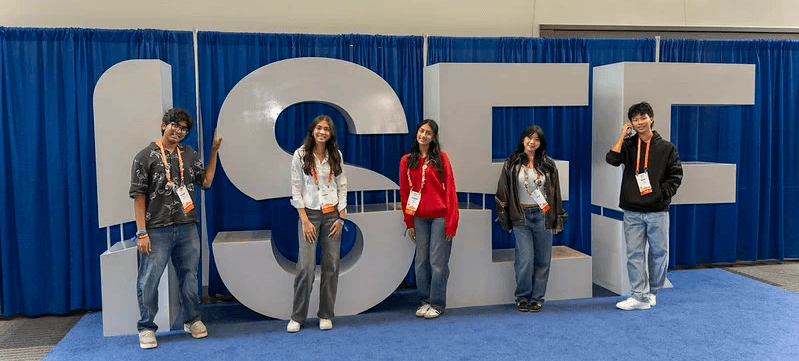
If you've just qualified for the Regeneron International Science and Engineering Fair (ISEF), congratulations! You're now among a small group of students worldwide who have reached this level.
Many students underestimate the gap between what wins an affiliated fair and what performs at ISEF. The science matters, but so does validation rigor, communication clarity, and professional presentation. The weeks or months before ISEF are your opportunity to close that gap.
I'm Anthony Efthimiadis, an ISEF First Place Grand Award winner, and I mentor students who are serious about reaching the top levels of science fair competition.
If you didn't qualify for ISEF this year, keep reading. Everything here applies equally to building a stronger project for next season.
This guide covers essential steps every finalist should take, along with highly recommended upgrades that can significantly strengthen your project if time allows. Not every suggestion will apply to every project. Use your judgment based on your work and timeline, focusing on what will most meaningfully improve your project.
Understand science fair rules
Once you've competed at your regional affiliated fair, your project must remain the same. You cannot change your research question, experimental design, variables, or procedures. However, under Rule 8, you are allowed to collect additional data using the same previously approved methodology.
You can't reinvent your project, but you can refine it. Think of this phase like revising a research paper: improving evidence, analysis, and presentation without altering the core study.
Essential Steps Before ISEF
Start your online ProjectBoard early
Every ISEF finalist must upload their abstract and materials to ProjectBoard. Judges see this information before judging day, and while ISEF doesn't publicly explain exactly how it's used, experienced mentors believe submissions may be reviewed in advance to help ISEF judge thousands of projects efficiently.
ProjectBoard is also used in special award selection, which can involve substantial money, scholarships, and opportunities you don't want to miss.
Treat this like a serious final submission rather than administrative paperwork.
Revise your science project’s title and abstract
This is among the simplest upgrades and easily the most powerful.
Many affiliated-fair projects have casual or vague titles. At ISEF, a strong title sets the tone by communicating method, goal, and technical focus. Your abstract should read like a condensed research paper: clearly explaining the problem, your approach, what distinguishes your work, and your key results.
If you're unsure what "good" looks like, spend time reading past winners' abstracts on ProjectBoard. You'll quickly notice that top projects sound cohesive, precise, and intentional.
This step alone will significantly improve how judges perceive your work.
Discover what else to focus on before ISEF begins.
Four Top Upgrades to Your Science Fair Project
Build something judges can interact with
If your project is engineering, software, or applied science, this is among the most underrated upgrades.
Judges walk past hundreds of posters. What makes them remember one is something interesting they can see or touch: an interactive software demo, a small physical prototype, a live visualization, or a simple interface where they can try inputs and observe outputs.
It doesn't have to be sophisticated. The goal is to make your project tangible.
Even for AI or computational projects, having something concrete on the table (for example, a real-time prediction demo) makes a substantial difference compared to static screenshots. At ISEF, many projects are impressive on paper. The ones that stand out feel real.
Improve how you interpret your results
At affiliated regional fairs, showing a final metric is often sufficient. At ISEF, judges expect more.
They want to understand consistency, whether improvements are statistically meaningful, where your method fails, and its limitations.
You don't need graduate-level statistics, but you should extend beyond a single number. Run experiments multiple times, report averages, add standard deviation or error bars, include confidence intervals when possible, and consider p-values or simple statistical tests when comparing methods.
Demonstrating uncertainty and statistical rigor signals that you're thinking like a researcher rather than merely reporting performance.
Utilize ablations to emphasize your contribution
If your project involves a system with multiple components (as is common in engineering and computational projects), ablation studies are among the most powerful tools available.
Most engineering projects build on existing ideas. Your contribution typically comes from modifying or adding specific components. An ablation study isolates those components by removing or disabling them while keeping everything else fixed, then measuring how performance changes.
In practice, this often involves comparing:
A baseline system
Your full system
Versions where individual components you introduced are removed
Because the dataset, evaluation protocol, and metrics remain constant, any performance difference can be attributed directly to that component. This allows you to quantify how much your contributions improve the baseline.
As long as you're using the same datasets and metrics, this satisfies ISEF's requirement that the project remain the same and that additional experiments follow the approved methodology.
Many past ISEF winners use this approach because it provides some of the clearest, most quantitative evidence that their specific ideas meaningfully improve a system.
Upgrade your display and presentation
Tri-fold poster boards are common at affiliated fairs, but at ISEF, many finalists switch to roll-up banners. They're easier to read, more professional, and closer to what you'd see at a research conference.
You can design a science fair banner entirely in PowerPoint by setting a custom slide size and organizing content into clear sections: problem, method, results, and conclusions. Follow the official Display & Safety Rules, including what must be displayed and what is restricted.
You should also be comfortable explaining your project at different depths: a brief overview, a clear two-minute explanation, and a deeper technical discussion. Presentation doesn't replace good science, but it does impact how judges perceive your work.
Now you know how to prepare, we also have a blog on what ISEF is really like.
Preparing for ISEF with ScienceFair
Preparing for ISEF can feel overwhelming, especially if you're navigating it alone. You're suddenly expected to think like a researcher, communicate like a scientist, and present like a professional.
You've already accomplished something impressive by qualifying. The goal now is to present your work at the level it deserves.
And I now coach students going through this process. If you want targeted feedback on your project, help with abstracts, technical development, ProjectBoard, or judging strategy, learning from mentors who've been through ISEF can save you months of trial and error.
Schedule a consultation call to connect with one of our team members and create a personalized plan tailored to your needs.
