
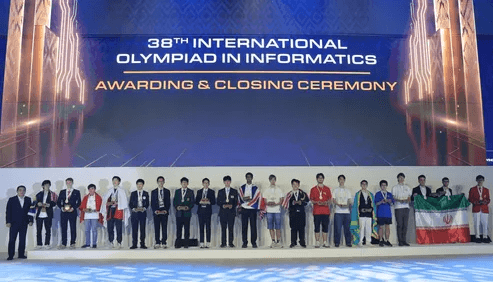
The International Olympiad in Informatics (IOI) is the most prestigious competitive programming competition in the world for secondary school students, and one of the five major international science olympiads. Every year, national teams of the strongest young programmers on the planet gather to solve algorithmic problems that would challenge many professional software engineers.
An IOI medal is one of the rarest credentials a high school student can earn. It signals world-class problem-solving ability to universities and employers alike, and the preparation journey builds a depth of algorithmic understanding that pays off for years. This guide covers who can compete, how the qualification path works, what the exam actually looks like, and how to prepare.
What Is the IOI?
The IOI is an annual, individual competition in which each participating country sends a national team of up to four students.
The 38th edition, IOI 2026, was held in Tashkent, Uzbekistan, from August 9 to 16, 2026, with 386 contestants from 97 countries, a record for the competition. Upcoming editions have already been announced, with Germany hosting IOI 2027 and Japan hosting IOI 2028.
Contestants compete individually rather than as teams, writing programs to solve complex algorithmic problems under strict time limits, with solutions judged automatically for correctness and efficiency.
Eligibility and the Qualification Path
You cannot register for the IOI directly. Every contestant reaches the IOI by earning a place on their country's national team, and each country runs its own selection process.
The general eligibility guidelines require that you are a secondary school (high school) student and not enrolled full-time at a university, with an age limit of under 20 years old, though exact requirements vary by country. Your national informatics olympiad organization is the authority on the rules that apply to you.
In the United States, the path runs through USACO. Students compete through the USACO season's online contests, and top performers are invited to the national training camp, from which the four-member US team is selected. If that is your route, our guide on how to win USACO covers the strategic preparation the American qualification path demands.
Other countries run equivalent national olympiads, and your school, teachers, or national organizing body can point you to registration details, deadlines, and any applicable fees.
Exam Format and Scoring
The IOI competition runs across two days. On each day, contestants face three algorithmic problems and have five hours to solve them, for six problems in total. Each problem is worth 100 points, making the maximum possible score 600.
Scoring rewards partial progress. Problems are divided into subtasks with test cases of increasing difficulty, and your program earns points for each subtask it handles correctly, even if it cannot solve the full problem under the largest constraints. There is no penalty for incorrect submissions, so refining your solution over the course of the session is expected.
This scoring structure shapes strategy. Because efficiency matters as much as correctness, a brute-force solution that works only on small inputs still earns real points, and strong competitors secure that partial credit early before investing time in the optimal approach. Reading all three problems at the start, banking the accessible subtasks, and then committing deep focus to the problem where you see the clearest path to full marks is the pattern most medalists follow.
How to Prepare for the IOI
Consistent, structured practice across a wide range of algorithmic problems is the only reliable preparation. Four resources stand out.
Past IOI problems are the single most valuable resource, since nothing simulates the real difficulty and style better than the actual archive maintained on the official IOI website.
Online judges like Codeforces, CodeChef, and AtCoder offer thousands of problems with regular rated contests that simulate competition pressure and let you benchmark yourself against the global field. Books like Competitive Programming by Steven Halim and Felix Halim provide systematic coverage of the algorithms and data structures the IOI syllabus demands, from dynamic programming to advanced graph algorithms. And the competitive programming community itself, through forums and editorial discussions, will teach you alternative approaches to problems you thought you had fully solved.
Because IOI qualification runs through your national olympiad, your preparation calendar should be built backwards from those national contest dates. For American students, that means treating the USACO season as the real proving ground.
Building a Complete Computer Science Profile
The IOI sits at the very top of the competitive programming pyramid, and even students who never reach the international team gain enormously from climbing it. The skills transfer directly to computer science internships, to selective computer science programs for high schoolers, and to original research.
Research is where many strong competitive programmers find their next challenge. Structured computer science research programs can turn algorithmic skill into a novel project, and those projects can compete at science fairs like the Regeneron International Science and Engineering Fair (ISEF), the world's largest pre-college STEM research competition, or at research-based competitions like the GENIUS Olympiad.
Where an olympiad measures how fast you can solve problems someone else designed, a research project shows you can ask and answer a question no one has asked before. Together, they are a formidable combination.
Interested in Research?
We do not coach for olympiads, but if you want to turn your programming ability into an original research project, our coaches include ISEF Grand Awardees and Regeneron STS Scholars who have built winning projects of their own. Book a free consultation to talk with an academic advisor about what a research project could look like for you.
