
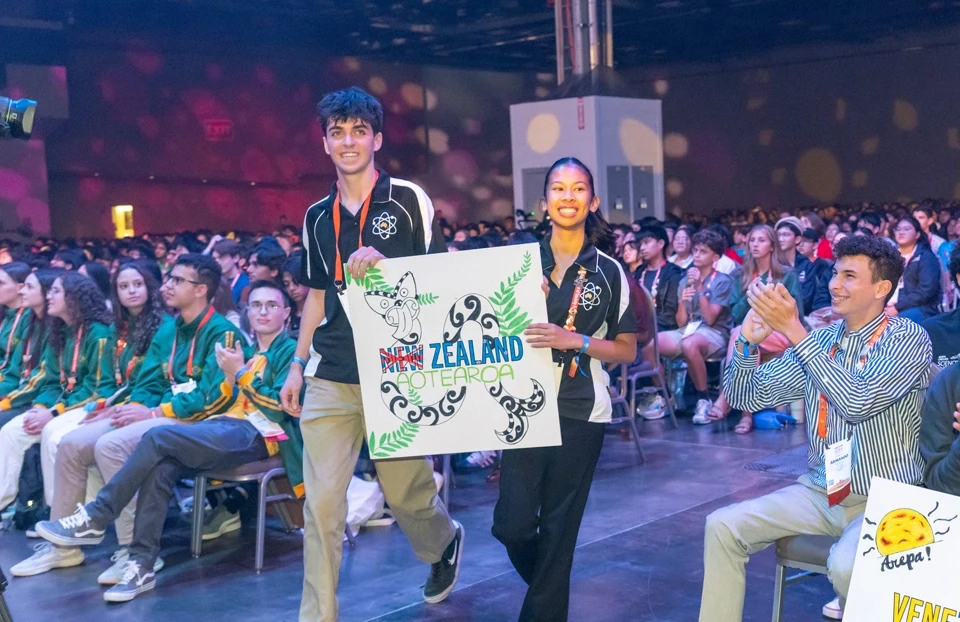
For most of my time at school, the honest answer to “how does a Kiwi get to ISEF?” was that you don’t.
The Regeneron International Science and Engineering Fair only takes students through affiliated fairs. New Zealand hadn’t run a national fair since 2014, so there was nothing to affiliate. You could win your regional fair, and people did, with very good work, and that was the end of the road.
I found this out in Taipei in early 2024, asking fair directors from Alaska to Guam how a New Zealander might get in. Everyone was lovely about it. Nobody had an answer.
The few of us who did make it went through workarounds. In 2024/25, Australia’s AUSSEF opened a temporary door, and two New Zealand projects went to ISEF 2025 that way, travelling with the Australian team.
That is now fixed. Royal Society Te Apārangi has become New Zealand’s ISEF-affiliated fair. It runs the Aotearoa Science and Technology Fair, and up to three Kiwi projects go to ISEF every year. Society for Science made it official in April 2026.

I’ve done both versions, the workaround in 2025 and the new route in 2026, and I spent most of 2024 emailing people about why a national fair needed to exist. So I’m not a neutral party. But I do know where the traps are, and nearly all of them are in the first month.
How the New NZ Route Works
Two rules shape everything. You can’t enter ISEF directly, and you can’t apply to the national fair yourself. Every project starts at a regional fair and is nominated upward from there.
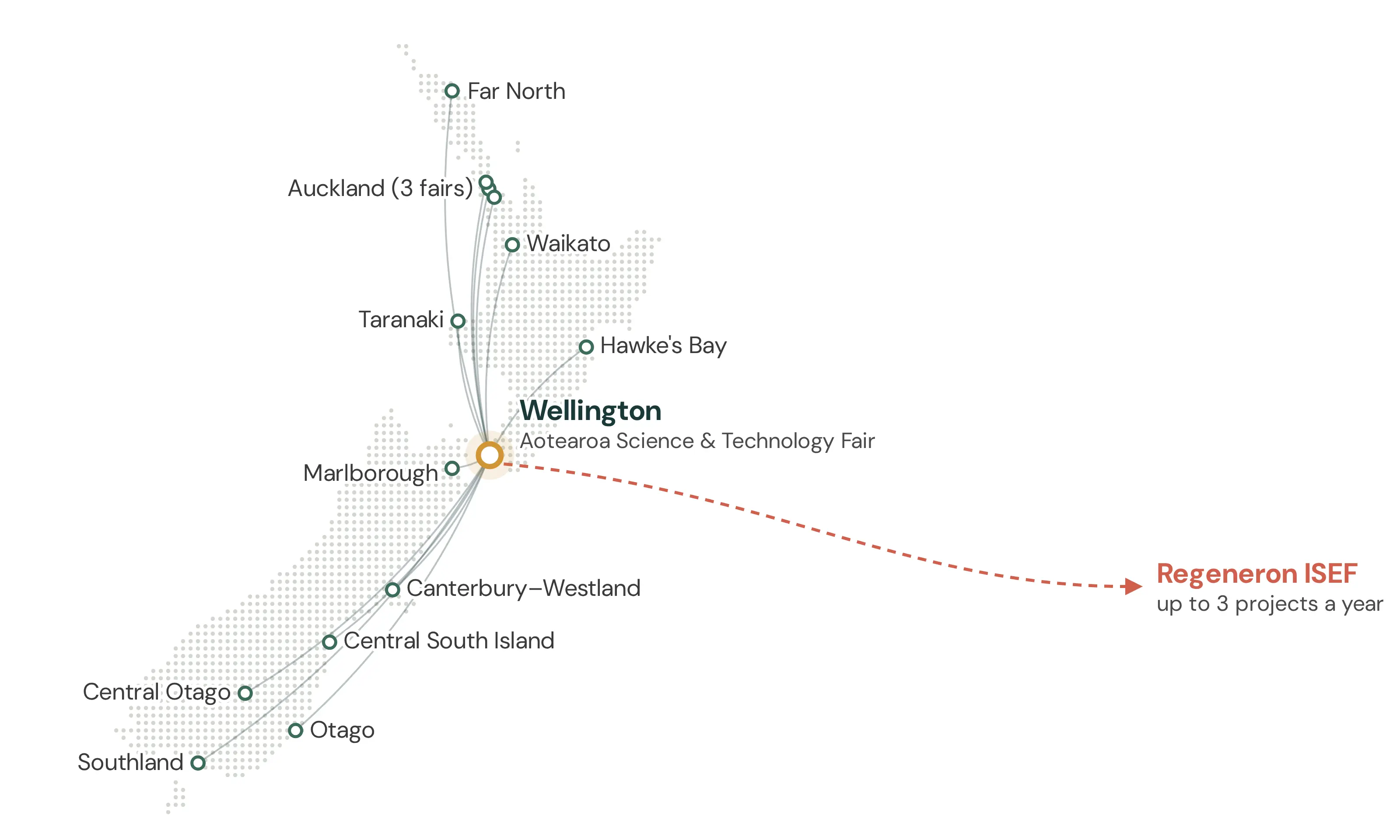
Regional Fair
They run from the Far North to Southland, mostly in late August and September. Many are run or sponsored by Earth Sciences New Zealand (NIWA, until recently), and its fair page is the quickest way to find yours.
Wellington and Auckland take students from Year 7, so you can get a practice run in long before you’re old enough for the national fair. The Te Tūkohu Ngāwhā Mātauranga Māori Science and Design Fair also fed into the first national selection.

How to Be Nominated
Your regional fair’s organisers nominate their strongest projects. So you don’t apply.
In 2026, the Royal Society’s key dates had nominations due on 9 September, with Stage 1 assessment done by 25 September, though at least one regional fair published a later date, so check with yours. Either way it’s weeks after your regional fair, not months. Your write-up has to be national-ready on the day of your regional fair.
Each fair decides how it picks nominees: category winners, overall winners, or whatever looks closest to ISEF standard. Ask early, because the answer changes what you aim at.
The New Zealand National Fair
The Aotearoa Science and Technology Fair runs in two stages.
Stage 1 is judged online.
Stage 2 is in person in Wellington, in October, with interviews, field trips with researchers around the city, and a couple of days with other students who care about the same strange problems you do.
Prizes cover innovation, potential for impact, and communicating the value of what you did. The first selection panel brought people from science teaching, ethics, and research, and said plainly that they were looking for curiosity, creativity, dedication, and investigative skill.
Expect questions about how you ran the project safely, not just what came out of it.
ISEF
Up to three projects go to ISEF from New Zealand, and a team counts as one project. The 2026 national fair feeds ISEF 2027, which runs 8 to 14 May at the Los Angeles Convention Center.
Year 13s are not locked out, because ISEF falls in the May after you finish. In 2026, the Royal Society’s Scientific Review Committee mentored the two finalists, and the committee chair travelled with them to Phoenix.
Who Can Enter
Years 11 to 13
New Zealand citizen or permanent resident
Solo or in a team of up to three
You need to be under 20 on 1 May before ISEF
You can only compete at one ISEF-affiliated fair in a year, so no doubling up with another country’s route.
If you’re in a team, keep it the same team all the way through. ISEF requires the people who compete there to be the people who competed at the affiliated fair.
The Science Fair Clock Starts in January
This is where New Zealand projects get caught out. ISEF allows no more than 12 months of continuous research, and none of it can be done before 1 January of the year before ISEF. For ISEF 2027, that means no experiments before 1 January 2026. For ISEF 2028, nothing before 1 January 2027.
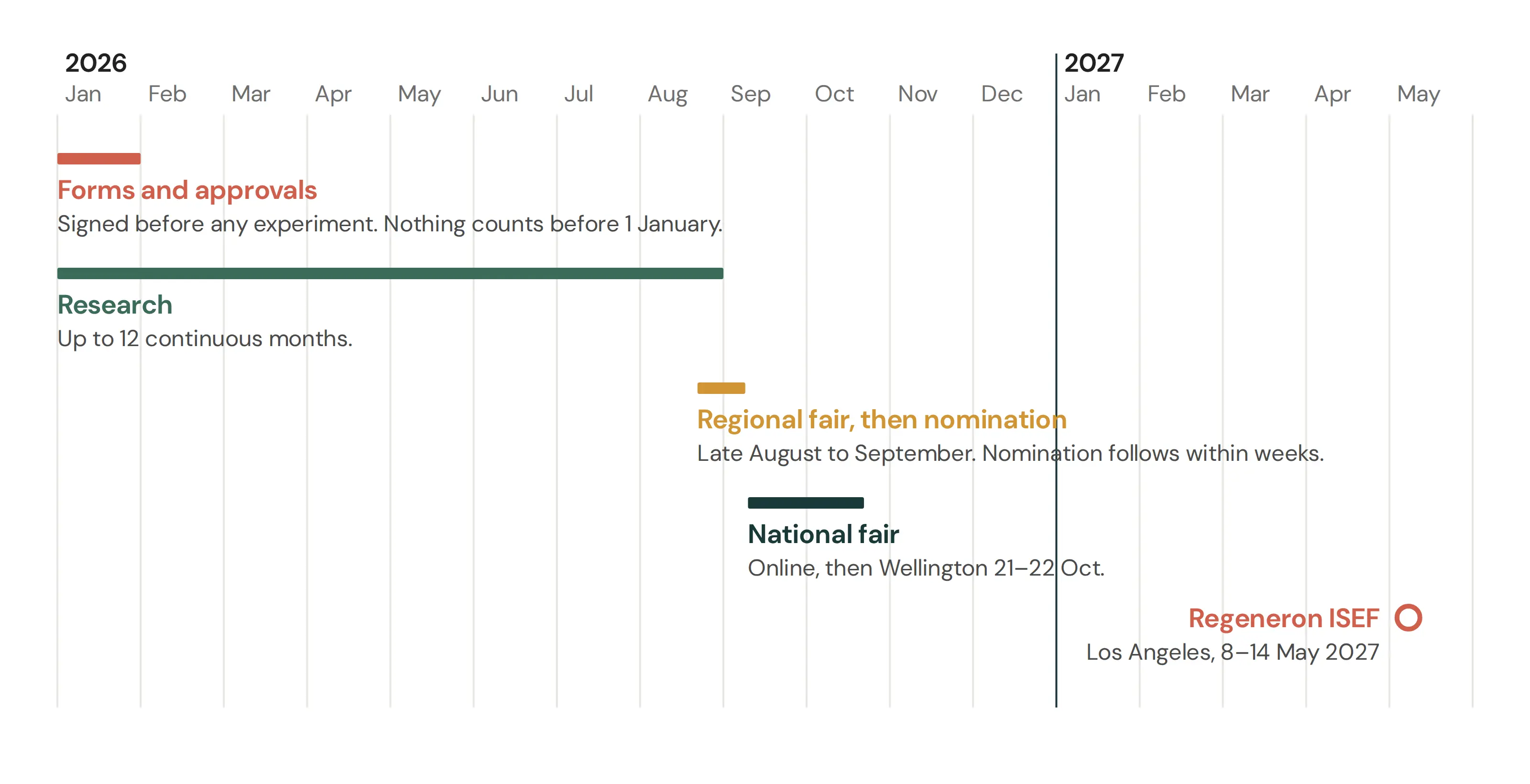
The timing suits our school year, which is lucky. The catch is at the other end. ISEF’s forms have to be signed before you start experimenting, which is months before anyone at a fair knows your name.
If you want to carry last year’s project forward, you can, but only the new work gets judged, and you’ll have to document the old work separately.
The Science Fair Forms You Need
Royal Society, as an affiliated fair, follows Society for Science’s rules, and those rules are built around prior approval. I know how dull this sounds. It’s also the thing most likely to sink a good project.
Every project needs four forms signed before experimentation:
Form 1 (the Adult Sponsor checklist),
Form 1A (your checklist and research plan),
Form 1B (approval)
Form 2A (support disclosure, which includes any AI use).
Depending on the project, you may need some more forms.
If your project involves | You also need | Before you |
|---|---|---|
People: surveys, interviews, app or product trials | Form 4 and IRB approval | recruit anyone or collect data |
Vertebrate animals, including fish | Form 5A and SRC approval | start |
Microbes, rDNA, tissue or blood | Form 6A or 6B and SRC approval | start |
Hazardous chemicals, activities or devices | Form 3 risk assessment | start |
A university or industry lab | Form 2C, plus Form 2B before you start if a qualified scientist supervises you | finish (2C comes after) |
Last year’s project | Form 7 continuation | finish (7 comes after) |
Two things trip people up:
Firstly, anything with people in it is human participants research. That includes surveys and app trials. My road-safety project put software in front of real drivers, which meant approval before I could recruit a single one.

Secondly, AI: you can use it as a resource if you cite and disclose it, but you can’t use generative AI to write your research plan, abstract or poster, or to produce your citations.
Regional fairs add their own rules on top. Wellington needs NZ Association of Science Educators approval for projects where vertebrate animals’ normal routines are affected. If you’re unsure what applies, the ISEF Rules Wizard takes ten minutes. Then email your regional fair a one-paragraph description and get the answer in writing.
What a Competitive Project From New Zealand Looks Like
Nobody has a decade of national fair results to pattern-match against. But the national fair exists to feed ISEF, and ISEF’s judging criteria are public, so the same things count.
Start from a problem you can see. Local problems are easier to care about for a year and easier to explain to a judge. I’ve written about how to find one.
Test the riskiest assumption first. A cheap pilot that fails in March is useful. The same failure in August is a disaster.
Keep a dated logbook, including the dead ends. It’s the evidence that the work is yours, and judges read it.
Claim only what your data supports. Judges at this level go straight for the gap between your results and your conclusion. Say what you found, how sure you are, and what you’d test next.
Then, make sure to practise the pitch at three lengths: 30 seconds, two minutes, ten minutes. At ISEF 2026, the Australian and New Zealand finalists each saw six to nine Grand Award judges over about seven and a half hours, with Special Award judges wandering through in between.
Questions Kiwis Ask Me About Science Fairs
Do I have to win my regional fair? Not necessarily. Each fair nominates its own way. Ask.
Is the national fair online? Stage 1 is. Stage 2, in 2026, is in person in Wellington.
How many Kiwis go to ISEF? Up to three projects a year. A team is one project.
Does it cost anything? I couldn’t find a published entry fee. For ISEF travel costs and what’s covered, ask the Royal Society directly rather than assuming it works the way it did for us.
I’m a Kiwi at school in Australia. Then your route is AUSSEF, not this one.
What You Need To Do Before Science Fairs Start
Find your regional fair, its dates, and how it nominates to the national fair.
Turn your topic into one precise question or engineering goal.
Get forms and any approvals signed before experimenting, and not before 1 January 2027.
Start a dated logbook on day one.
Have a national-ready write-up by the day of your regional fair.
The route is new, and the dates will move around while it settles. The students who understand it early have the edge. Find a problem you care about, and sort the paperwork in January.
Get Personalized Support With ScienceFair
Every ScienceFair mentor is a past science fair winner, and alongside our Ivy League research mentors, they’ll help you refine your idea, strengthen your research, and prepare for judging so that you have the right preparation and strategy in place to win at every level of science fair.
Ready to make your run at ISEF from New Zealand? Schedule a call with our academic advisor.
