
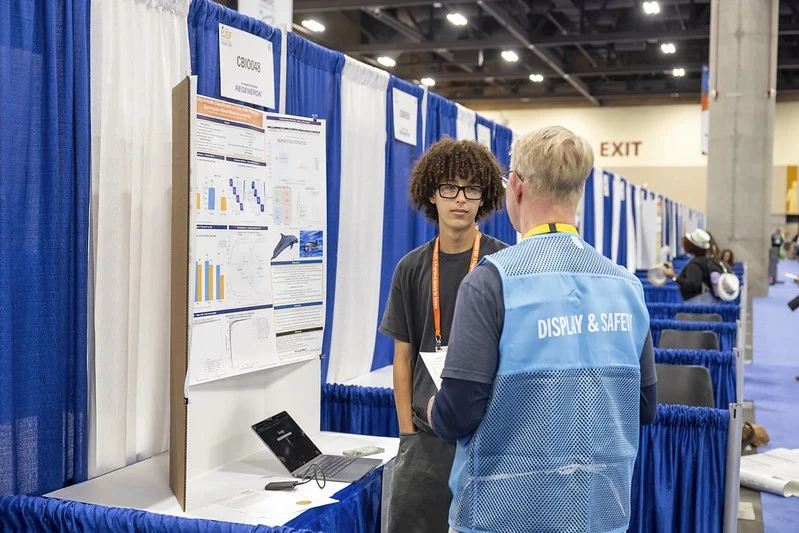
Whether you're competing locally, statewide, or nationally, science fairs are no joke. If your project is done, congratulations, you're halfway there. But to take it to the next level and win big at competitions like Regeneron STS and ISEF, you need one more thing: a compelling presentation. To give your project real "wow factor," you need a narrative that makes judges care. Here's how to build one.
Why Storytelling Matters in Science
At a science fair, you might assume judges care only about your content. You wouldn't be entirely wrong, a judge should focus on what you're saying, but part of your score also depends on how you say it.
Every contestant is trying to stand out among dozens of competitors, and presenting your scientific "story" in a way that makes judges genuinely care is harder than it sounds. Done well, storytelling helps you in three ways:
Memorability. Our brains are wired to forget stand-alone facts, and a complex project has a lot of them. Woven into an engaging story or context, those facts become far easier for judges to remember.
Passion. Presenting with real enthusiasm signals genuine investment in your work, and judges consistently respond to students who clearly care.
Clear communication. Storytelling has been used to convey important ideas since the beginning of humanity. If a judge can follow a clear "storyline" through your presentation, you're far more likely to make an impact.
How to Create a Compelling Narrative at Science Fairs
Science fair judges evaluate five core criteria: creative ability, scientific thought, thoroughness, skill, and clarity. A well-built narrative, presented well, can hit all five.
Map Out Your Story
Before you build your board or draft a script, sketch a mind map of how each idea flows into the next.
If you jump from topic to topic with no clear links, you won't fully demonstrate your understanding. Instead, you'll confuse the judges and make you look confused too. Rather than word-vomiting your results and hoping judges piece them together, weave the facts into a well-connected, well-articulated narrative. A loose guideline for how your ideas should connect:
Strong opening → the problem → strategy → results → impact.
Stay flexible, though. Formulas like this guide you, but be ready to reroute based on what judges ask and what feels right in the moment. Have a plan, but don't be afraid to branch off.
Argue for Your Project's Importance
To make judges believe in your project, you have to convince them your research is both relevant and impactful. Three ways to do that:
Be concise and use meaningful details. Less is more, so know your core message and stick to it.
Use evidence, statistics, graphs, charts, any data showing your project had the effect you intended, balanced against the storytelling.
And emphasize the most important parts through problem and solution: Who does this impact? Why is it a problem? How does your research contribute to the solution, and why is your work particularly important?
This kind of concise, persuasive framing is the heart of a strong pitch.
Use Contradictions
One of the most powerful tools a scientist has is the word "but." Contradictions introduce tension and drama, grabbing the otherwise wandering attention of judges.
A monologue with no contradicting statements won't do you any favors. If you string results together with an endless series of "and"s, it sounds like you're listing facts rather than making meaningful connections.
As Bruce Kirchoff put it in his book, Presenting Science Concisely, an ideal introduction runs: "X is the current state of knowledge, and we know Y. But Z problem remains. Therefore, we carried out ABC research." Giving background first, then introducing the problem with those conjunctions, lets you assemble your project's most important opening components into a few smooth sentences.
Know Your Work and Your Field
Aim for both technical depth and technical breadth. Knowing the intricacies of your own project makes for a much stronger conversation with judges, but understanding the broader field matters just as much.
Explore the different avenues of your scientific field as you go deeper, read articles, follow journals and forums, and understand how it all connects. Judges want to see enthusiasm, and being able to go in-depth on both your project and its field is one of the best ways to show genuine passion and to explain the whys and hows of your research convincingly.
Being ready for wherever judges take the conversation is its own skill, and our guide to the science fair Q&A with judges covers how to prepare for the questions they'll ask.
Make Your Poster Clear and Straightforward
Even though your focus is verbal delivery, judges will also want to pick out the most important points and evidence from your poster.
The easier to comprehend your poster board is, the better: use visuals like graphs, tables, photos, and 3D models, create clear sections, and make everything readable, all of which breaks complicated concepts into digestible chunks.
Prepare for the Judges' Q&A
The Q&A section is where judges probe how deeply you understand your work, push on your methodology, and see how you think on your feet. Even a flawless rehearsed pitch can fall flat if you freeze the moment a judge asks something you didn't script.
Anticipate the obvious questions about your methods, your results, and your project's limitations, and practice answering them out loud. And if a judge drills into one weakness, don't let it rattle you. Take a deep breath and try to answer as well as you can.
Make Your Presentation Stick
Good storytelling paired with polished, diligent research will take you far in any competition. So map your narrative, argue your importance, build in tension, know your field, and let your board carry your evidence. Then go out there and make yourself memorable. The accomplishment of participating is rewarding in itself, but aim to bring home a medal anyway.
From Strong Research to a Standout Presentation with ScienceFair
If you'd like expert help getting your project from an idea to an award-winning research & presentation, that's exactly what ScienceFair offers.
Every coach on our team is a past science fair winner who has presented on the biggest stages, and alongside our Ivy League research mentors, they'll help you sharpen your narrative, strengthen your research, and walk in ready for the judges' questions.
Ready to take the next step? Schedule a call with our academic advisor.
