
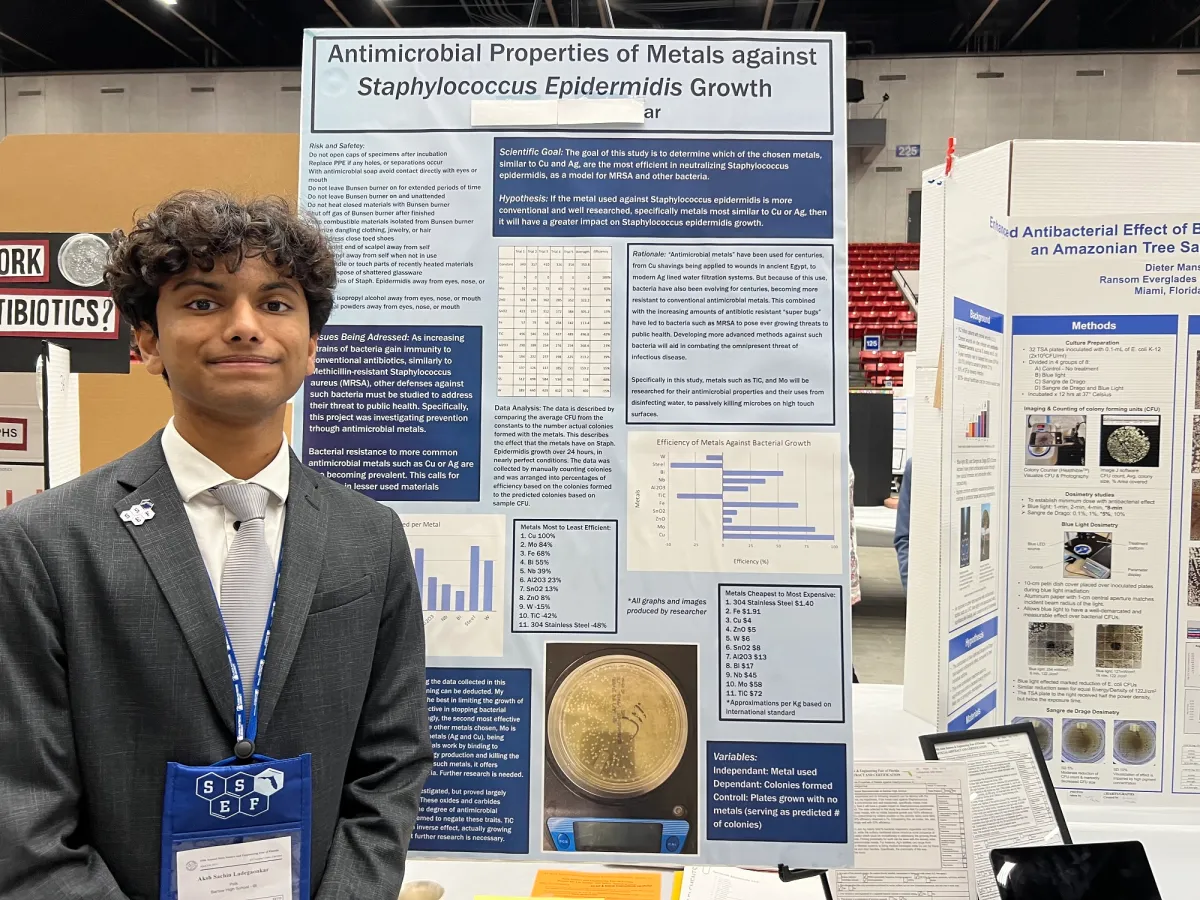
The Florida Science Fair (SSEF) is one of the most prestigious STEM competitions in the state, giving young scientists a stage to showcase their creativity, innovation, and problem-solving skills.
Winning opens doors to scholarships and internships, and it's a genuine stepping stone to national and international competitions like the Regeneron International Science and Engineering Fair (ISEF). But with competition tougher than ever, a win takes more than a good idea. You need a well-planned project, thorough research, meticulous execution, and a compelling presentation. This guide walks you through every step.
Step 1: Choosing the Right Topic
Your science fair journey begins with the right topic, and this decision lays the foundation for everything that follows. Here's how to choose one that captivates the judges and shows off your scientific ability.
Go interdisciplinary. One of the most effective ways to stand out is to blend fields rather than staying inside a single one. If you're passionate about marine biology, for instance, you might combine it with environmental science to study how coastal development affects Florida's coral reefs, using data science techniques to model nutrient pollution and predict future bleaching. A project like that shows critical thinking and versatility across different kinds of scientific inquiry. If you need help finding an angle, our guide to coming up with a science fair project idea and our roundup of the best science fair project ideas for high schoolers are good starting points.
Leverage local resources. Florida is home to a wealth of scientific institutions that can give your project an edge. Reaching out to local universities, research institutions, or environmental organizations can get you access to specialized equipment, data, or mentorship. A project on climate change and Florida's coastal ecosystems, for example, might draw on the University of Florida's Institute of Food and Agricultural Sciences (IFAS) or a conservation group like the Florida Wildlife Federation. These collaborations add real credibility and depth.
Tackle Florida-specific issues. Judges appreciate projects that address problems close to home. Focusing on challenges like managing invasive Burmese pythons, the effects of red tide on marine life, or rising sea levels along the coast makes your work more relevant and impactful. You might investigate how rising temperatures in the Everglades shift alligator distribution and behavior. A local focus signals both awareness and a genuine commitment to solving real-world problems in your community.
Step 2: Conducting Thorough Research
Once you've chosen your topic, it's time to dive into the research that will anchor your findings and conclusions.
Develop a strong research question and hypothesis. These are the backbone of your project, so aim for something specific and novel rather than broad. Instead of asking how pollution affects marine life, narrow it to something like: "How does nutrient runoff from agriculture affect the reproductive health of fish in Florida's freshwater ecosystems?" A precise question guides your work and makes its significance immediately clear to judges.
Use advanced research techniques. To truly impress, go beyond standard methods. Depending on your resources, that might mean Geographic Information Systems (GIS) for spatial analysis, machine learning for prediction, or DNA barcoding for species identification. A project tracking an invasive species through Florida's wetlands, for instance, could use GIS to map its spread over time, turning the problem into a visual, data-driven analysis. Techniques like these add depth and show real proficiency with cutting-edge tools.
Step 3: Executing Your Project
With your plan in place, execution is where experiments happen, data gets collected, and findings take shape.
Be meticulous with data. Accurate collection and analysis are critical. Make your data reliable and repeatable by running multiple trials and using controls where needed, and document your process carefully, since judges look for evidence that your experiment was systematic and your conclusions are grounded in solid data. Once it's collected, analyze it with appropriate statistical methods, and use graphs, charts, and infographics to make your results accessible and impactful.
Build in feedback loops. Stay flexible as new information comes in. If an experiment doesn't go as planned, don't be afraid to adjust, and regularly reassess your progress. If your initial hypothesis isn't supported by the data, refine it or explore a related question. This iterative process improves the project and demonstrates your ability to think critically and adapt.
Step 4: Crafting a Compelling Presentation
Your presentation is where you convince the judges your project deserves to win.
Maximize visual impact. Your board and visuals should be both informative and engaging, with high-quality images, readable color schemes, and concise text. Interactive elements like models, live demonstrations, or even augmented reality make a presentation more dynamic. If your project involves an engineering design, a 3D model or working prototype is far more compelling than static images.
Craft a strong narrative. Science is about more than data; it's about telling a story. Weave your research, findings, and conclusions into a coherent arc through your pitch: set the stage with a real-world problem, introduce your research as the solution, and close with the broader implications. A narrative approach makes your project memorable and helps judges grasp why it matters.
Prepare for the Q&A like a pro. The question-and-answer session can make or break your chances, so preparation is everything. Anticipate likely questions and rehearse your responses, ready to discuss your methodology, the implications of your findings, and the challenges you overcame. For more on getting this right, how to get advice from a science fair winner covers what separates a confident defense from a shaky one.
Equip Yourself to Win With ScienceFair
Winning Florida's science fair takes flawless execution from start to finish, and that's exactly what ScienceFair helps you build. Our mentors have competed in and won the top STEM competitions, including ISEF, JSHS, and the Thermo Fisher JIC, and they offer personalized, one-on-one guidance whether you need help choosing a topic, refining your research plan, or polishing your presentation. That kind of expert feedback is often the difference between a good project and a winning one.
Ready to make your run at the Florida Science Fair? Schedule a call with our academic advisor.
