
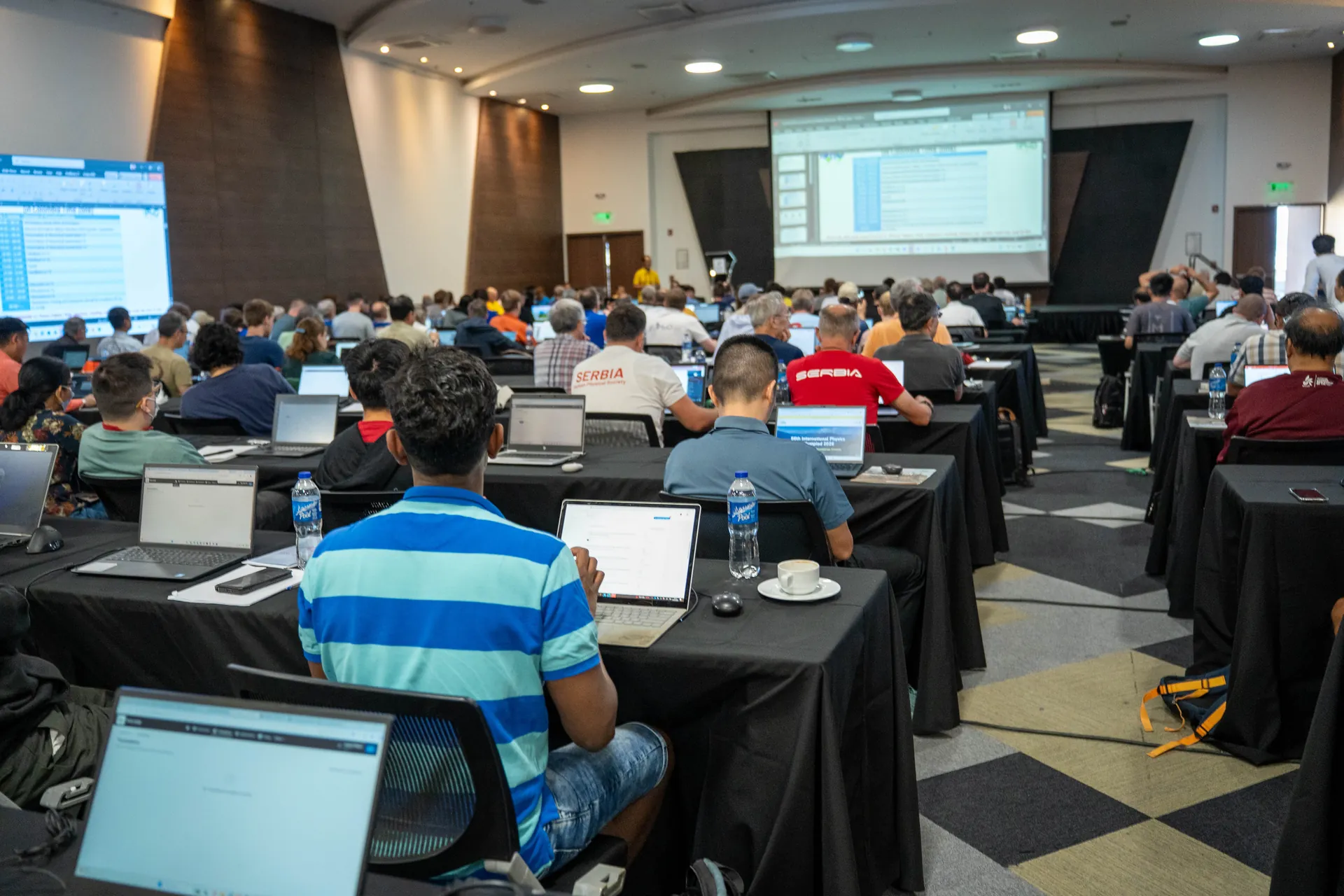
For high school students passionate about science and mathematics, the International Science Olympiads are the pinnacle of academic competition. Each one gathers the brightest students on the planet, selected through brutal national qualification pipelines, to compete in a different host country every year. Think of them as the academic Olympics, and college admissions officers treat the medals accordingly.
This guide lists every major international olympiad, explains how qualification works, and links to our in-depth guides on the biggest competitions. Whether you are choosing your first olympiad or mapping a multi-year campaign, start here.
How the International Science Olympiads Work
The pattern is the same across nearly all of these Olympiads. You cannot register for an international olympiad directly. Each country runs a national olympiad, often several escalating rounds of it, to select a small national team, typically four to six students, sometimes after an intensive training camp. In the United States, thousands of students compete each year for those few spots per subject.
Eligibility rules are set per olympiad but generally require that you are a secondary school student, under a specified age limit (usually 20), and competing for the country where you attend school. Your national coordinating body, such as the Mathematical Association of America for math or the American Chemical Society for chemistry, publishes the registration details, and if your school does not already participate, the first step is usually asking a teacher to register it.
The Core International Science Olympiads
International Mathematical Olympiad (IMO)
The oldest and most prestigious of them all, first held in Romania in 1959. Six proof-based problems over two 4.5-hour exam days, spanning algebra, geometry, combinatorics, and number theory, with each problem worth 7 points toward a maximum of 42. The 2026 edition in Shanghai drew 666 contestants from 117 countries, the largest field in its history, and the 2027 IMO heads to Budapest. In the US, the pathway runs from the AMC exams through the AIME and USAMO to the MOP training camp.
Read our full guide to the International Math Olympiad.
International Physics Olympiad (IPhO)
The premier physics competition, first held in 1967 and now drawing roughly 85 countries. Two five-hour exams, one theoretical and one experimental, with the lab component worth 40 percent of the total score. National teams have up to five students; in the US, qualification runs through the F=ma exam and the USAPhO to a training camp that selects the team.
Read our full guide to qualifying for the IPhO.
International Chemistry Olympiad (IChO)
The top pre-college chemistry competition since 1968, now spanning more than 90 countries with teams of four. Two five-hour exams, theoretical and practical, with bench skills tested as rigorously as theory. The US pathway runs through ACS local exams and the USNCO national exam to a study camp at the University of Maryland.
Read our full guide to the road to IChO.
International Biology Olympiad (IBO)
First held in 1990 and now hosting nearly 80 countries. The exam combines a broad theoretical section with demanding practical laboratory tasks, and since 2020, an International Group Project has added a collaborative research proposal component. In the US, the USA Biology Olympiad narrows roughly 12,000 registrants to a four-member team.
Read our full guide to the International Biology Olympiad.
International Olympiad in Informatics (IOI)
The world championship of competitive programming. Contestants solve algorithmic problems in C++, Python, or Java across two five-hour exam days, with solutions judged for correctness and efficiency. The 2026 edition in Tashkent set a participation record with 386 contestants from 97 countries. The US pathway runs through USACO.
Read our full guide to the IOI.
International Olympiad on Astronomy and Astrophysics (IOAA)
For students drawn to the cosmos, the IOAA tests three components: a theoretical exam, a data analysis round interpreting real telescope data, and an observational round at the instrument. National selection typically runs through astronomy olympiads and science organizations.
International Earth Science Olympiad (IESO)
The IESO covers geology, meteorology, oceanography, and environmental science, combining written exams with practical fieldwork, often outdoors, where students collect and interpret real samples and formations.
International Junior Science Olympiad (IJSO)
The stepping-stone olympiad for younger students, covering physics, chemistry, and biology together through theoretical, practical, and team rounds. The IJSO excellent early target before specializing.
International Geography Olympiad (iGeo)
The iGeo tests physical geography, human geography, and environmental issues through a written exam, fieldwork exercises with real-world problem-solving, and a multimedia test built on maps and satellite imagery.
International Linguistics Olympiad (IOL)
Puzzle-based problems built on real and constructed languages that require no prior linguistics knowledge, only pattern recognition and logical deduction. The IOL is a favorite of mathematically minded students who want something different.
International Economics Olympiad (IEO)
The IEO challenges students across economics, finance, and business through both theoretical knowledge and practical case problem-solving.
International Olympiad in Artificial Intelligence (IOAI)
The newest major addition, first held in Bulgaria in 2024, for students passionate about machine learning and AI. The IOAI is a sign of how the olympiad landscape keeps expanding with the sciences themselves.
We also have a guide to the top 50 STEM competitions and to the Science Olympiad, if you'd like to explore different options.
Research-Based Alternatives
The subject olympiads above test mastery of established knowledge. A parallel set of competitions rewards the research skills of asking and answering new questions, and for many students these are more accessible, since they reward practice and process rather than years of textbook depth.
The International Research Olympiad (IRO) tests the core skills of scientific research itself: analyzing papers, interpreting data, and forming good research questions, with finals held at Harvard Square. Full disclosure: ScienceFair.io sponsors the IRO, and our founder, Rishab Jain, founded it.
The GENIUS Olympiad is an international project competition with an environmental focus, hosted at the Rochester Institute of Technology, spanning categories from science and robotics to writing, art, and film. The Conrad Challenge invites teams to develop innovative solutions to global problems in sustainability, health, and technology, with finalists presenting at its Global Summit.
How to Prepare for Any Olympiad
The fundamentals transfer across every competition on this list. Master your subject beyond the school curriculum using the standard olympiad texts and resources for your field. Drill past papers, both from your national rounds and the international archives, under timed conditions.
Join the community around your olympiad, whether a school team, an online forum like Art of Problem Solving, or eventually a national training camp, because collaborative problem-solving accelerates everyone in it. And on competition day, handle the unglamorous details: materials packed the night before, early arrival, full time on the clock.
Above all, respect the timeline. National qualification rounds typically begin in winter, which means serious preparation starts the summer or fall before, and most international team members spend multiple years climbing their national ladder.
Beyond Olympiads: Original Research
Olympiads reward mastery of what is known. Original research rewards discovering what is not, and it is the other great arena for ambitious STEM students. Research projects compete at science fairs like the Regeneron International Science and Engineering Fair (ISEF), the world's largest pre-college STEM research competition, and the two paths compound: olympiad depth makes stronger researchers, and research experience sharpens the thinking olympiads demand.
Go Beyond Olympiads With Research
We do not coach for olympiads, but original research is exactly what we do. Our coaches include ISEF Grand Awardees and Regeneron STS Scholars who have built award-winning projects of their own. Book a free consultation to talk with an academic advisor about what a research project could look like for you.
